


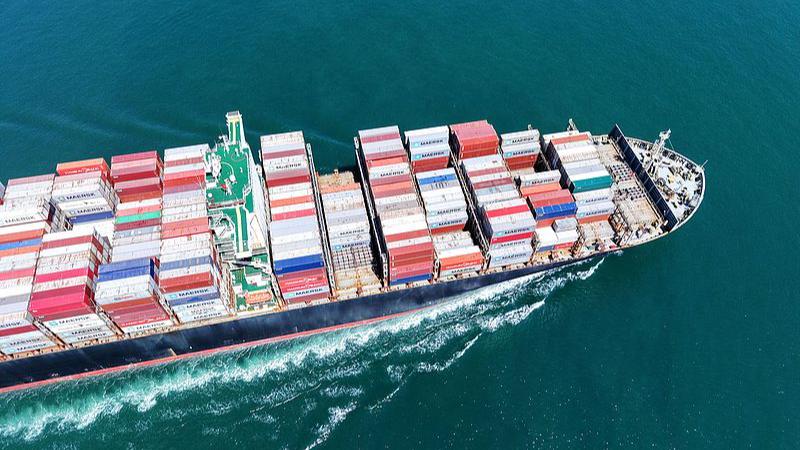
File photo of an aerial view of Qingdao Port in Qingdao, east China's Shandong Province. /VCG
China has set out clear economic priorities for the second half of 2026, striving to pursue sustained innovation-driven, high-quality and sound economic development, and getting the 15th Five-Year Plan period (2026–2030) off to a good start.
At a meeting on Thursday, the Political Bureau of the Communist Party of China (CPC) Central Committee reviewed the economy's first-half performance, analyzed the current economic situation and outlined priorities for the remaining months of the year.
Per the meeting, to steer economic work well through the second half of 2026, macroeconomic policies should be more forceful and effective, and pragmatic and workable incremental policies will be introduced in a timely manner.
Structural progress in H1, confidence despite challenges for H2
Since the beginning of 2026, China's economy has embraced new growth drivers and an improved economic structure, having effectively weathered various external shocks and internal challenges, it was noted at the meeting.
China's gross domestic product (GDP) grew by 4.7% year on year in the first half of the year, keeping pace with the target set at 4.5%-5% for the full year.
Structurally, value-added manufacturing rose to 26.2% of GDP, retail penetration of new energy vehicles surpassed 60% for three consecutive months, and new growth drivers spearheaded by high-end manufacturing, digital economy and modern services contributed over 40% to growth, according to the National Bureau of Statistics (NBS).
It was emphasized at the meeting that high priority must be given to addressing current economic difficulties and challenges, and that it is essential to remain confident, meet such difficulties head-on, and make good use of various opportunities and advantages to promote steady and sustained high-quality development.
Zhang Linshan, a researcher at the Chinese Academy of Macroeconomic Research, said the meeting's key assessment offers a realistic framing of China's current economic conditions.
"It recognized the positive momentum led by new growth drivers while making a science-based evaluation of structural challenges in high-quality development," Zhang told the Xinhua News Agency. "This will help bolster confidence and stabilize market expectations."
He added that, with ample room for policy response, rapid expansion in new growth drivers, and a surge of market demand in both quantity and quality, China retains solid underlying fundamentals for its long-term economic growth.
Macro policy outlook, and room for incremental policies
It was determined at the meeting that macroeconomic policies should be more forceful and effective with a view to better advancing the implementation of major national strategies and enhancing security capacity in key areas, as well as promoting large-scale equipment upgrades and consumer goods trade-in programs. Pragmatic and effective incremental policies will be introduced in a timely manner, it was noted.
The need to effectively implement a more proactive fiscal policy and an appropriately accommodative monetary policy, comprehensively deploy monetary tools and adjust them in a timely manner, and optimally implement joint fiscal-monetary coordination to boost domestic demand were also underscored.
Dong Yu, executive vice president of the China Institute for Development Planning at Tsinghua University, said the key to macro policy lies in precision and effectiveness.
"Aligning a more proactive fiscal stance with moderately loose monetary settings enhances consistency and effectiveness across macro policies. This coordinated approach can lift market expectations and support continued structural improvement," he explained.
Yang Zhiyong, president of the Chinese Academy of Fiscal Sciences, said newly deployed measures would enable fiscal policy to deliver maximum effectiveness.
Tian Xuan, dean at the Guanghua School of Management of Peking University, said that the flexible and effective application of monetary instruments that leverage the synergy of both incremental and existing policies to reinforce counter-cyclical regulation will foster a supportive financial environment for high-quality growth.
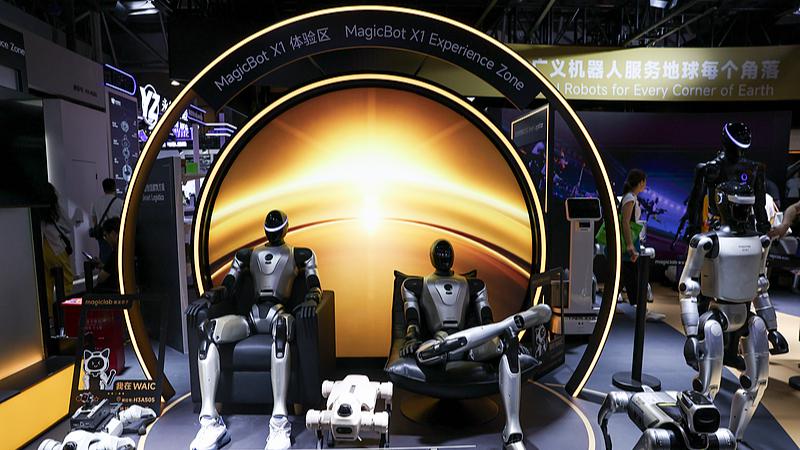
A general view of MagicLab booth on display during the 2026 World Artificial Intelligence Conference in Shanghai, China, July 20, 2026. /VCG
Consumption, investment and AI
Targeting a further boost in domestic demand, measures to increase high-quality supply catering to varied consumer groups and tap into untapped potential in services spending were underlined at Thursday's meeting.
Services consumption is rapidly driving China's retail growth. According to NBS data, service retail sales grew 5.4% from January to May compared with the same period last year. In 2025, service spending accounted for 46.1% of total per capita consumption expenditure, nearly half of all household spending.
"Demand for services is surging nationwide, but high-end service supply still falls short," said Zou Yunhan, deputy director of the macroeconomic research office at the State Information Center under the National Development and Reform Commission (NDRC), China's top economic planner.
Addressing structural supply-demand mismatches as outlined at the meeting, and satisfying and generating new demand via upgraded supply, will widen scope for domestic consumption and unlock latent economic momentum, Zou added.
Building on priorities set at April's CPC leadership meeting, further efforts were urged at the latest meeting to advance the planning and development of the "Six Networks" infrastructure initiative.
The initiative spans six strategic areas: water, new-type power grids, computing power, next-generation communications, urban underground pipelines and logistics. The NDRC forecasts investment in these networks will top 7 trillion yuan (approximately $1.035 trillion) throughout 2026.
Sheng Lei, deputy director of the NDRC's State Information Center, said the "Six Networks" integrate digital, intelligent and green technologies, bringing about a critical shift away from expansion focused on scale toward improvements in quality and efficiency.
The initiative would tackle infrastructure bottlenecks and foster new growth drivers, Sheng told China Media Group.
Sun Xuegong, director-general of the department of policy study and consultation at the Chinese Academy of Macroeconomic Research, said if implemented, the projects under the initiative will provide strong support for overall investment growth throughout the year.
Deeply implementing the AI Plus Initiative was also called for at the meeting, in order to foster new forms for the smart economy and improve the governance system for artificial intelligence, a vital driver for building a modern industrial system.
Sun said the latest meeting has reiterated the push for fostering new forms for the smart economy, a concept that first appeared in this year's government work report, adding that it has become an increasingly important platform for cultivating new quality productive forces.
More balanced trade growth
Expanding mutually beneficial international economic and trade cooperation, vigorously developing trade in services and advancing more balanced trade growth were also called for at the meeting.
China has been actively promoting the balanced development of import and export. As the primary export destination for nearly 80 countries, China's scale of import has ranked second in the world for 17 years in a row, according to the Ministry of Commerce.
In total, China has extended zero-tariff treatment to 63 countries, and is also the first major economy to give zero-tariff treatment for 100% tariff lines to all the African countries and all least developed countries that have diplomatic ties with China.
China is also the only country to host an international import expo, reaching intended deals worth over $580 billion in total during the past eight editions, according to the Ministry of Commerce. It is also carrying out the "Export to China" series of events, stepping up efforts to "buy global" and help more quality products and services around the world enter the Chinese market.
Lan Qingxin, a professor at the University of International Business and Economics, said further expanding and diversifying China's network of trading partners is key to stabilizing trade volume, optimizing trade structure and fostering balanced trade development.
Going forward, China will make continued efforts to address both its own domestic needs and global expectations, and strengthen trade in services, build open platforms and participate in the formulation of international rules, Lan said, adding that these steps will unlock new drivers for trade growth and create new space for win-win cooperation.