


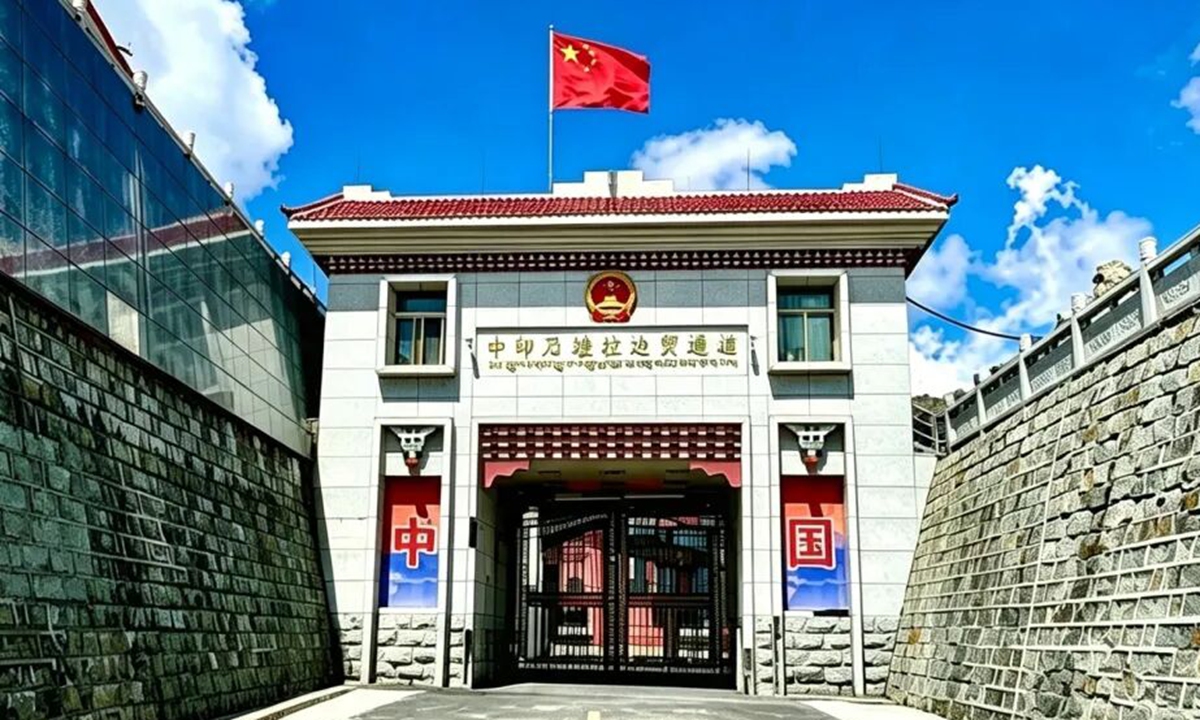
The Nathu La Pass in Southwest China's Xizang region resumed operation for border trade between China and India on August 1, 2026. (Photo: Courtesy of Yadong county publicity department)
The Nathu La Pass resumed operation for border trade between China and India on Saturday, signaling a new phase of mutually beneficial cooperation and development in cross-border trade, Gong Shijun, head of Yadong county government in Southwest China's Xizang Autonomous Region, said at the reopening ceremony, according to a statement sent to the Global Times.
According to the statement, Gong said that Yadong had historically served as a major route on the southern branch of the ancient Silk Road and a gateway for trade between China and South Asian countries. It has long been an important window for Xizang's opening-up.
He called for closer coordination among relevant departments to fully leverage the role of border trade in stabilizing growth, promoting employment, improving livelihoods, and contributing to high-quality economic and social development as well as prosperity and stability in border areas, per the statement.
The Nathu La Pass sits 4,545 meters above sea level and is wedged between Xizang's Yadong county in Xigaze Prefecture and Sikkim State. As a cross-border trade passage, the pass was temporarily closed in 2020. Before the closure, its total import and export volume topped 73 million yuan (about $10.8 million) in 2019, per Xinhua.
Another local official who prefers not to be named confirmed with the Global Times that the route reopening ended its previous closure for six years. The official said that relations between the two sides have become more relaxed and that the atmosphere is more positive compared with before.
Meanwhile, according to Indian media National Herald, China and India have also reportedly resumed traditional border trade through the historic "Shipki La pass" after nearly six years. The report said that under the arrangement, Indian traders transport their goods by road up to the border, after which the consignments are carried by mules and other pack animals to designated trading points inside Xizang.
Only registered traders will be allowed to participate in the trade under the supervision of the border police and the local administration. They will be required to return to India within 72 hours of crossing the border, the Indian media report said.
Qian Feng, director of the Research Department at Tsinghua University's National Strategy Institute, told the Global Times on Monday that before the closures, trade volumes through the two border crossings accounted for only a very small share of overall China-India trade. Therefore, the resumption of border trade routes carries greater symbolic significance than economic significance.
The reopening of the pass, which serve as important China-India trade gateways, represents a sign of improving bilateral relations, as the two countries have been increasing mutual trust through exchanges and cooperation across multiple fields and levels in recent years. The reopening not only boosts economic ties but also provides a foundation for improving people-to-people relations, Qian said.
Xinhua reported that Xizang region expands its opening up at a higher level and plans to open 12 border trade sites this year in addition to its existing 14 traditional ones, local authorities said earlier this year at the annual session of the regional people's congress.
On October 23, 2024, China and India agreed to strengthen communication and cooperation in multilateral forums and safeguard the common interests of developing countries during a meeting between the leaders of the two countries, according to Xinhua.
On August 19, 2025, the 24th Round of Talks Between the Special Representatives of China and India on the Boundary Question was held in New Delhi, India. During the meeting, the two sides reached a 10-point consensus, including an agreement to reopen three traditional border trade markets.
Following the two meetings, bilateral relations have gradually improved across various areas. Over the past two years, the two countries have pursued ties based on the view that each side should see the other as a development opportunity, steadily advancing efforts to improve China-India relations, Qian said.