


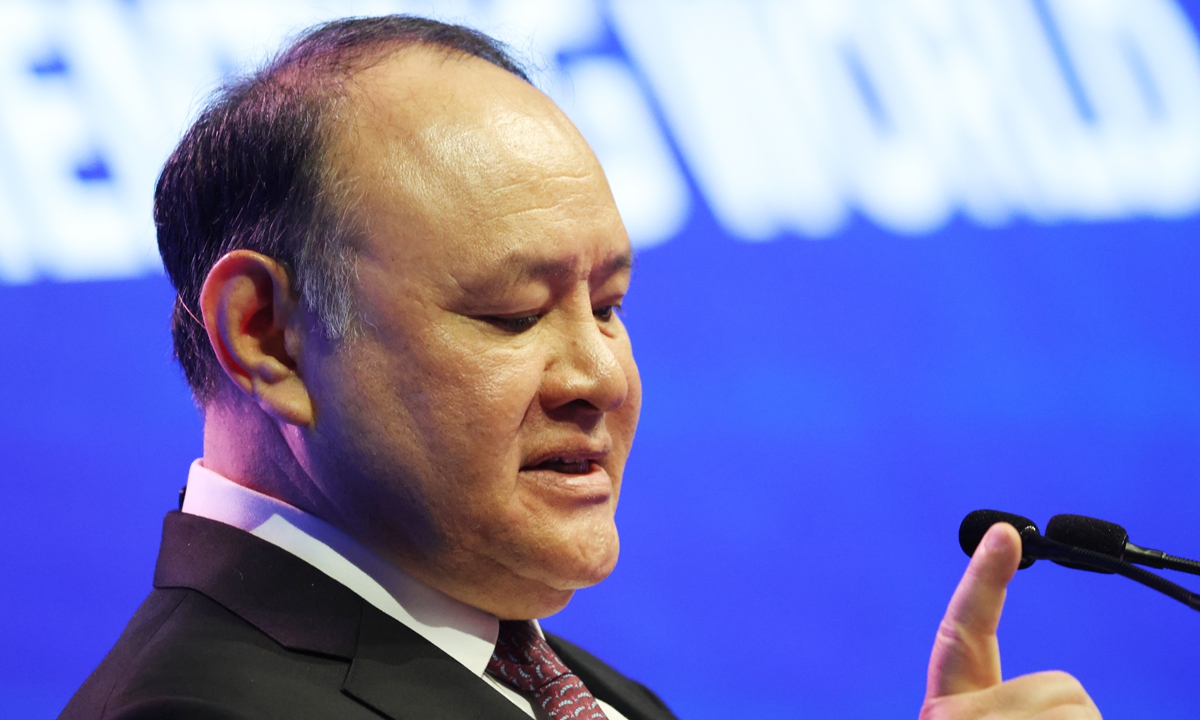
Philippines Secretary of National Defense Gilberto Teodoro Jr. delivers his speech during a plenary session of the International Institute for Strategic Studies (IISS) Shangri-la Dialogue Defense Summit in Singapore, 31 May 2026. (Photo: VCG)
A new round of political attacks against allegedly "pro-China" officials has unfolded in the Philippines after the presidential palace endorsed Defense Secretary Gilberto Teodoro Jr.'s call for government officials who do not support Manila's position on the South China Sea to consider resigning.
Chinese experts expressed concern over the rhetoric, saying that labeling politicians with more rational views as disloyal risks excluding moderate voices from Philippine political debate. The rhetoric by Philippine officials is politically arrogant and naive. Experts also note that by stoking anti-China sentiment through what amounts to political bullying, the Philippines will only reap what it sows.
On Monday, Palace Press Officer Claire Castro endorsed Teodoro's call for government officials who side with China on issues involving the South China Sea to consider resigning from their posts, saying that "We don't see anything wrong with it. The President and the administration see nothing wrong with what Secretary Gibo Teodoro said," according to Philippine media outlet Inquirer.net.
Castro also described as "very alarming" criticism from Davao City First District Representative Paolo Duterte, after the lawmaker accused Teodoro of "demonizing China" and acting as though he were imposing a loyalty test.
Castro claimed that Duterte's comments raised questions about his allegiance to the Philippines, "showing that his loyalty to the Philippines is not unwavering," she said, according to Inquirer.net.
Duterte had earlier urged Teodoro in a Facebook post to stop "demonizing China" after the defense chief said public officials who refused to uphold Philippine laws concerning the South China Sea should either challenge those laws in court or resign, according to Philippine media GMA News.
"Hey, Gibo, slow down. You didn't choose the elected officials; the Filipino people put them in office. If you have evidence that they are traitors to the country, then file the appropriate charges and present the evidence," Duterte said in Bisaya, according to GMA News. He also told Teodoro to stop repeatedly demanding resignations "as if you own the government."
Teodoro made the original remarks at a news forum, where he said government officials, especially those elected into office, who are siding with China on the issue of the South China Sea should consider resigning from their posts.
The controversy reflects not only disagreements over the South China Sea but also a broader political struggle over what positions are considered acceptable in the Philippines' China policy, Ge Hongliang, deputy director of the College of ASEAN Studies at Guangxi University for Nationalities, told the Global Times on Monday.
Teodoro has long adopted a tough position toward China and has already been sanctioned by the Chinese government, Ge said. His latest remarks may be intended to further establish a domestic political image of being tough on, or even hostile toward, China, he noted.
China announced sanctions against Teodoro and his relatives on June 11. A Chinese Foreign Ministry spokesperson said at the time that "Philippine Defense Secretary Gilberto Teodoro Jr. repeatedly made irresponsible remarks on China, which undermines China's legitimate interests and sabotages China-Philippines relations."
"To uphold China's sovereignty, security and development interests, China has decided to prohibit Gilberto Teodoro Jr. and his spouse and child from entering the Chinese mainland, Hong Kong and Macao, and not allow organizations and individuals in China to engage in any transaction, cooperation or other activities with him and his spouse and child," the spokesperson said.
The Marcos administration's support for Teodoro should also be viewed against the backdrop of its need to maintain a hardline posture toward China, Ge said.
The framing used by major Philippine media outlets showed how the controversy was being directed against politicians described as "pro-China." Inquirer.net ran the headline "Palace backs Teodoro's call for pro-China officials to resign", while the Philippine Star earlier used the headline "'Pro-China government officials must resign.'"
In his capacity as Defense Secretary, Teodoro publicly demanded the resignation of officials allegedly "pro-China" over the South China Sea issue. His crude, impulsive and highly inflammatory rhetoric lays bare the hostile undercurrent running through the Philippine government's China policy, Chen Xiangmiao, a research fellow at the National Institute for South China Sea Studies, told the Global Times on Monday.
Teodoro's claims are highly irresponsible and carry multiple dangerous implications, said Chen, adding that his assertions effectively contend that there is no room for negotiation between China and the Philippines over the South China Sea, and in effect explicitly designate China as the adversarial party, he said.
Such wording risks turning legitimate policy differences into accusations of disloyalty, experts said. Teodoro's remarks are not merely an attack on particular views concerning the South China Sea, but appear to target lawmakers and political forces that support friendlier relations with China, Mi Chenxi, a researcher at the China Institute for Marine Affairs under China's Ministry of Natural Resources, told the Global Times on Monday.
By repeatedly highlighting maritime confrontation and promoting a narrative of a so-called "China threat", Manila can create a stronger sense of regional insecurity, seek greater US military investment and obtain additional external military assistance, Ge said.
The controversy also illustrates how the Marcos administration has linked South China Sea policy with domestic political loyalty. By presenting disagreement with the government's maritime position as evidence of insufficient patriotism, the administration risks marginalizing political voices that could otherwise contribute to de-escalation, experts said.