


Light is the source of energy for solar cells, but it can also become a factor accelerating performance degradation. For wide-bandgap subcells in perovskite-organic tandem solar cells, which have long been troubled by light-induced phase segregation, Chinese researchers have developed a new strategy to overcome this challenge.
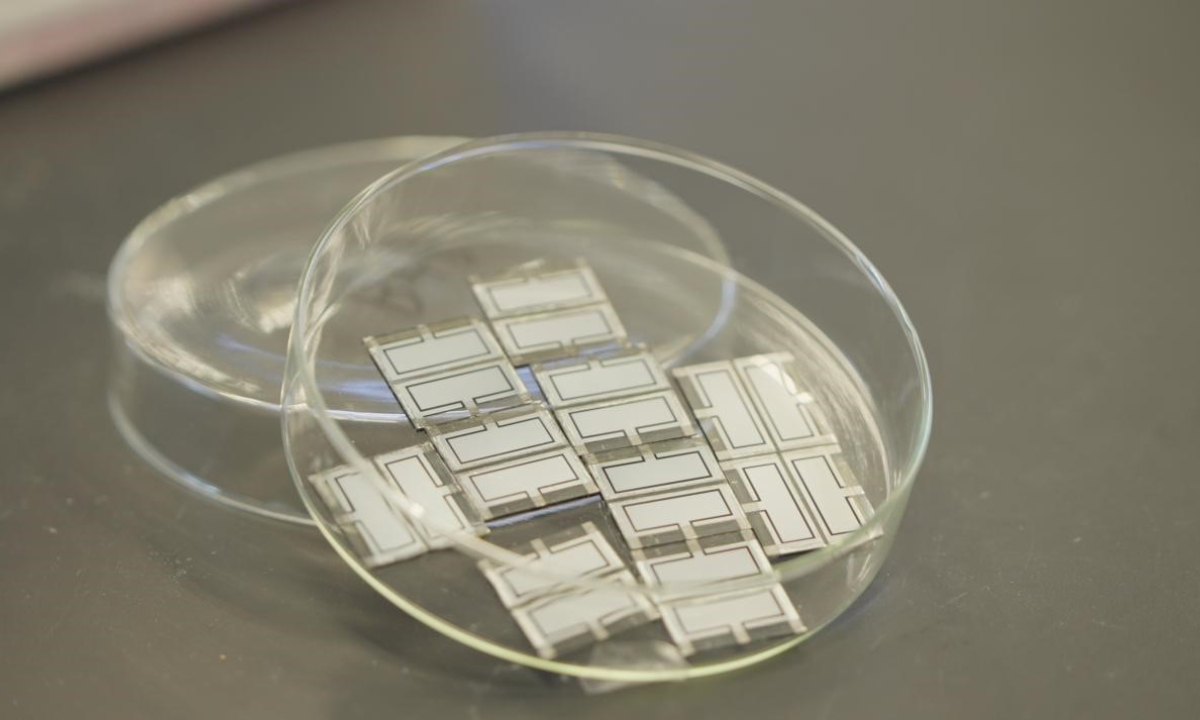
Perovskite-organic tandem solar cell device Photo: Courtesy of Institute of Chemistry under the Chinese Academy of Sciences
On July 13 Beijing Time, the international journal Nature published the latest research achievement from a team led by academician Li Yongfang and research fellow Meng Lei from the Institute of Chemistry under the Chinese Academy of Sciences.
The breakthrough marks a significant step forward in overcoming a bottleneck limiting the commercialization of next-generation photovoltaic technologies. With high efficiency, lightweight structure and flexibility, perovskite-organic tandem solar cells are expected to expand solar power applications beyond traditional panels, including building-integrated photovoltaics, portable energy devices, drones and future space power systems, the Global Times learned from the research team.
In an exclusive interview with the Global Times, Li and Meng shared insights into the technological breakthrough, remaining challenges on the path toward industrialization, and the team’s efforts to bring this emerging solar technology closer to real-world applications.
The team proposed a “full-stage regulation” strategy that suppresses harmful phase separation throughout the entire lifecycle of perovskite materials – from fabrication to operation. The perovskite-organic tandem solar cell achieved a certified steady-state photoelectric conversion efficiency of 28.04 percent, setting a new world record.
The key challenge facing wide-bandgap perovskite materials is halide phase segregation. The upper perovskite layer needs both iodine and bromine ions to maximize absorption of ultraviolet and visible light, but these ions tend to separate during crystallization.
“Once phase segregation occurs, the voltage of the solar cell continuously declines like air leaking from a tire, causing persistent performance degradation,” Meng Lei told the Global Times.
The research team introduced a photo-convertible additive molecule called TDB, which works as a “microscopic coordinator.” During fabrication, it helps iodine and bromine ions mix uniformly. During operation, it transforms into TAB, which strengthens interactions with defect sites and suppresses ion migration.
“The key technological challenge was to make high-bromine-content wide-bandgap perovskite materials transform from ‘light-fearing’ to ‘light-harnessing’,” Meng said.
The wide-bandgap perovskite single-junction cell achieved an open-circuit voltage of 1.42 volts and a fill factor of 85.13 percent. Combined with an organic solar cell, the tandem device reached a laboratory efficiency of 28.80 percent and a certified steady-state efficiency of 28.04 percent.
“By the time the paper was published, this efficiency had set a new world record for perovskite-organic tandem solar cells,” Li Yongfang told the Global Times.
Besides efficiency, perovskite and organic solar cells may reshape photovoltaic manufacturing. They can be produced through solution processing technologies such as roll-to-roll printing and slot-die coating, creating possibilities for lightweight and flexible energy materials. However, commercialization still faces challenges including large-area film uniformity, flexible device packaging reliability, and production consistency.
The technology also shows potential for space applications. Li said its high specific power and flexibility could help reduce the weight and volume of spacecraft power systems.
“Systematic space environment simulations and in-orbit verification will be needed to evaluate their performance in radiation resistance, vacuum stability and long-term operation,” Li said.