


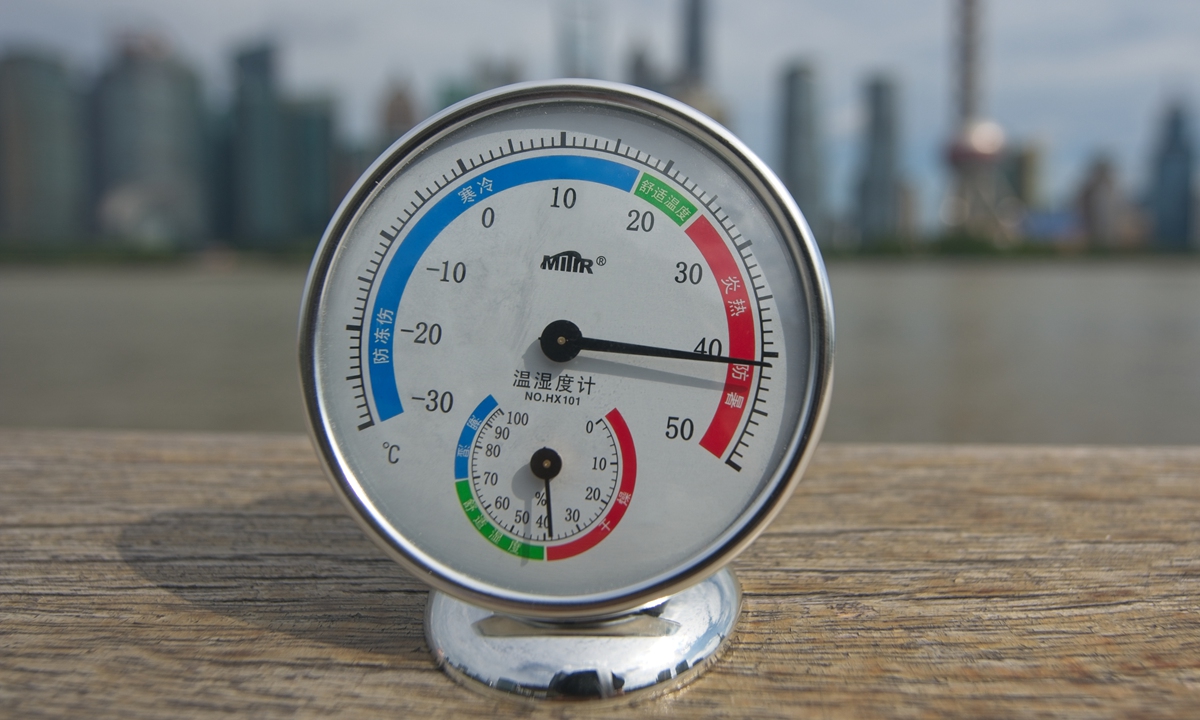
A thermometer shows temperatures over 40 degrees C in the afternoon at North Bund in Shanghai, China, on July 16, 2026. (Photo: VCG)
With El Nino conditions continuing to strengthen over the past two months, China Meteorological Administration (CMA) said on Tuesday that a strong to super Eastern Pacific (EP) El Nino is expected to develop during summer-autumn, bringing more frequent heatwaves and increased typhoon activity across China in August.
Continued warming of sea surface temperatures in the central and eastern equatorial Pacific is expected to drive the development of a strong to super EP El Nino during summer-autumn, with an increasing likelihood of reaching very strong intensity, according to a press conference held by CMA on Tuesday, CCTV News reported.
The event is likely to peak in autumn-winter before gradually weakening through spring-summer 2027. Given its rapid evolution and projected intensity, close monitoring is warranted, a representative of the administration said.
Against this background, China is expected to experience above-normal rainfall, more frequent heatwaves, and enhanced typhoon activity in August. Flood risk is expected to exceed drought risk across eastern China. Above-normal temperatures are likely nationwide, with a heightened risk of persistent drought in northwestern China, per CCTV.
In autumn, above-normal precipitation is forecast over eastern and southwestern China, while temperatures are expected to remain above average across northern and southern China. CMA recommended continued monitoring of El Nino evolution and strengthened preparedness for extreme weather, with region-specific measures to address flood, typhoon, heatwave, and drought risks.
Regarding the climate trend forecast for August, the administration noted that most parts of China will witness above-normal temperatures, while two to three typhoons will make landfall or exert notable impacts on China. These typhoons will be generally stronger than usual, with a risk of intense typhoons moving northward to affect northern China.
The current El Nino event has reached a level comparable to the historic 1997/98 episode based on both surface and subsurface ocean warming. Although this year's westerly wind bursts are slightly weaker, the event could surpass the 2015/16 El Nino in strength if it continues developing, Jiang Hua, a chief El Nino forecaster from the National Marine Environmental Forecasting Center, told the Global Times in a previous interview.
Once an extreme El Nino takes shape, its impacts on China's climate become specific and complex. While this year marks the developing phase of El Nino, the most severe weather disasters typically strike the following year; even so, the preliminary effects observed this year have already exhibited highly destructive potential, Jiang said.
Jiang specifically reminded that an El Nino event can be divided into a developing year and a decaying year, and its most severe impacts on China generally manifest in the subsequent year. A prominent feature this year lies in the unstable atmospheric circulation accompanied by frequent severe convective weather.
"Atmospheric motions featuring drastic vertical structural shifts will occur more frequently. Consequently, short-duration heavy rainfall, thunderstorms with gale-force winds and even tornadoes are more likely to take place," Jiang explained.
Global Times