


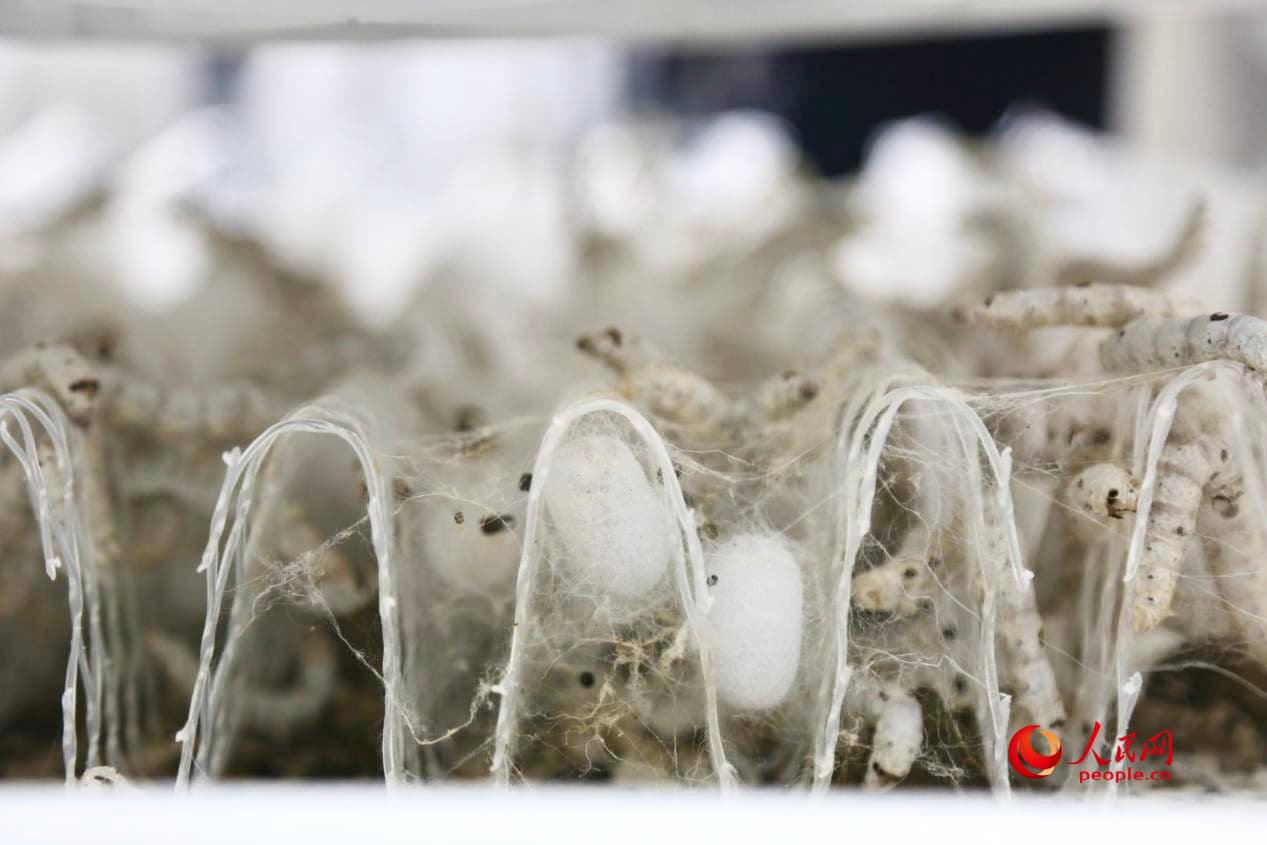
Photo shows silkworms spinning silk and forming cocoons in a modern silkworm-rearing facility in Yining county, Ili Kazak Autonomous Prefecture, northwest China's Xinjiang Uygur Autonomous Region. (People's Daily Online/Li Long)
In a modern silkworm-rearing facility in Yining county, Ili Kazak Autonomous Prefecture, northwest China's Xinjiang Uygur Autonomous Region, silkworms are thriving on specially formulated feed, producing high-quality cocoons that are helping weave a new path toward rural prosperity.
"This is an industrial-scale silkworm-rearing workshop. The silkworms here are currently in their fourth instar, when they eat the most and grow the fastest. In about 15 days, the cocoons will be ready for harvesting," said Tang Renzhong, head of a biotechnology company based in Yining county.
Unlike traditional silkworm farming, the company's operation relies on specially formulated feed and automated systems.
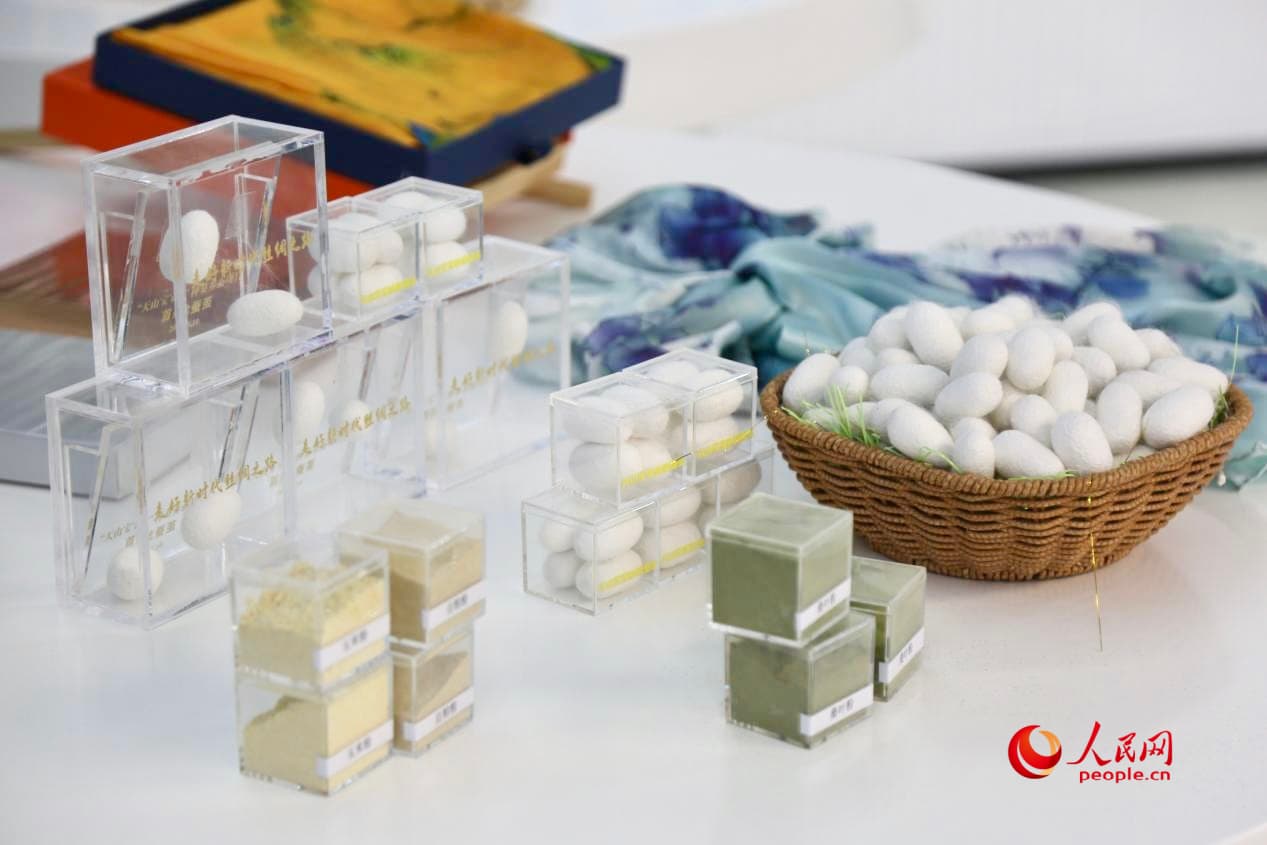
Photo shows some silkworm-related exhibits of a biotechnology company based in Yining county, Ili Kazak Autonomous Prefecture, northwest China's Xinjiang Uygur Autonomous Region. (People's Daily Online/Li Long)
It has also adopted a company-farmer collaboration model, under which the company raises young silkworms before distributing fifth-instar silkworms to farmers, while providing technical guidance throughout the process.
"Each rearing cycle takes 15 days, allowing farmers to raise up to 20 batches a year. We provide silkworm eggs and technical support, and guarantee the purchase of harvested cocoons, so farmers do not need to worry about market risks," Tang said.
In early June this year, the company provided fifth-instar silkworms to local demonstration households. Villager Mewlidetem Abudulijiang converted an unused room in her house into a silkworm-rearing space and received a smart temperature and humidity control system free of charge.
"I had never raised silkworms before. When I heard that experts from Nantong were coming to the village to provide training, I signed up immediately. Now I have learned the skills and can earn a better living through my own efforts," she said.
Another villager, Abduwekil Abduweli, also participates in the program. He calculated that a 15-day rearing cycle can bring him more than 3,000 yuan ($444.1) in income each month.
"Not only have we learned a new skill, but we have also gained an additional source of income. Everyone in my family is happy," he said.
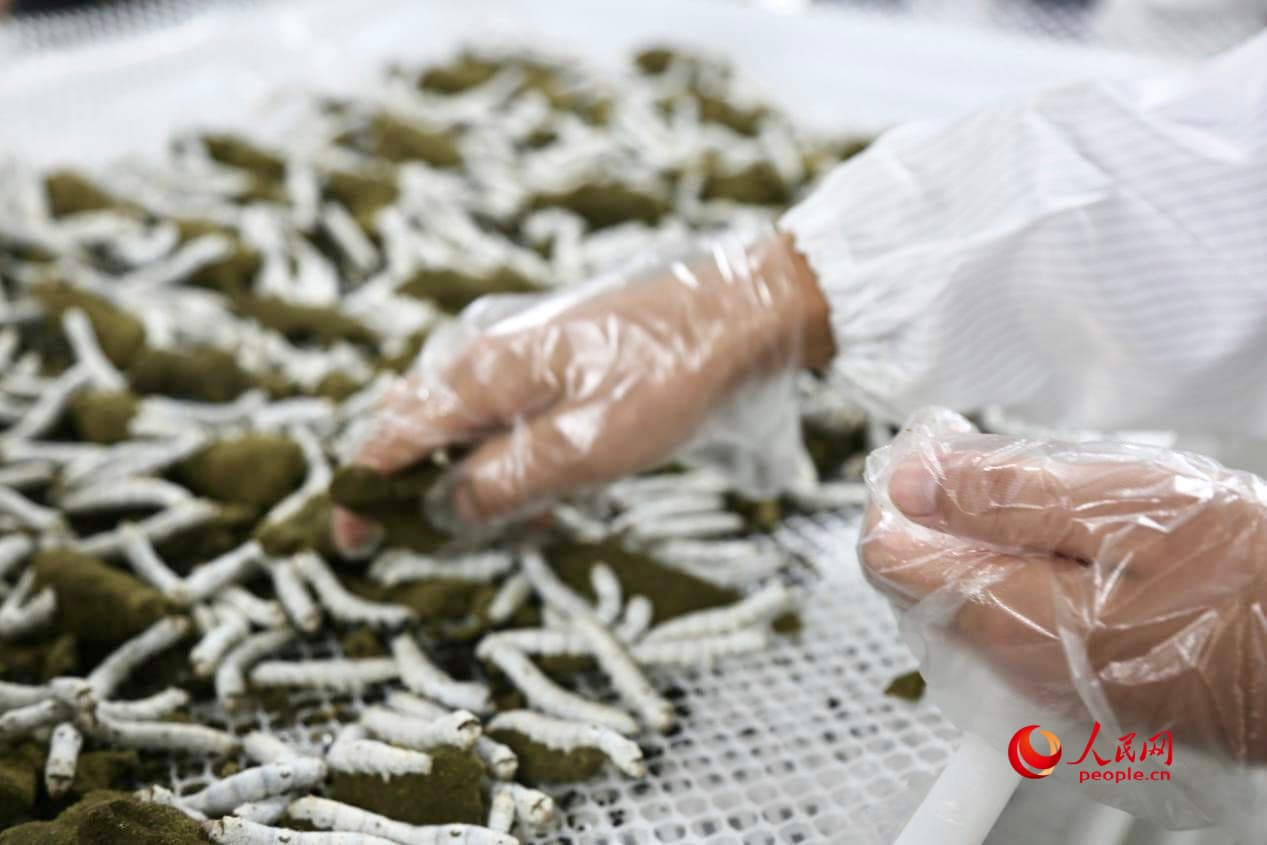
A technician feeds silkworms in a modern silkworm-rearing facility in Yining county, Ili Kazak Autonomous Prefecture, northwest China's Xinjiang Uygur Autonomous Region. (People's Daily Online/Li Long)
Seeing the demonstration households gain tangible benefits, more villagers have expressed interest in joining the program. So far, 60 households have participated in sericulture skills training.
"Previously, we had to visit households to promote the program. Now villagers are coming to us to learn more about it," Tang said.
The sericulture program was introduced to Yining with the support of a working group dispatched from Nantong, east China's Jiangsu Province, to assist local development in Xinjiang.
In 2023, the Nantong working group helped facilitate the establishment of the biotechnology company, which invested 300 million yuan to develop a comprehensive industrial ecosystem covering silkworm rearing, mulberry cultivation, and deep processing.
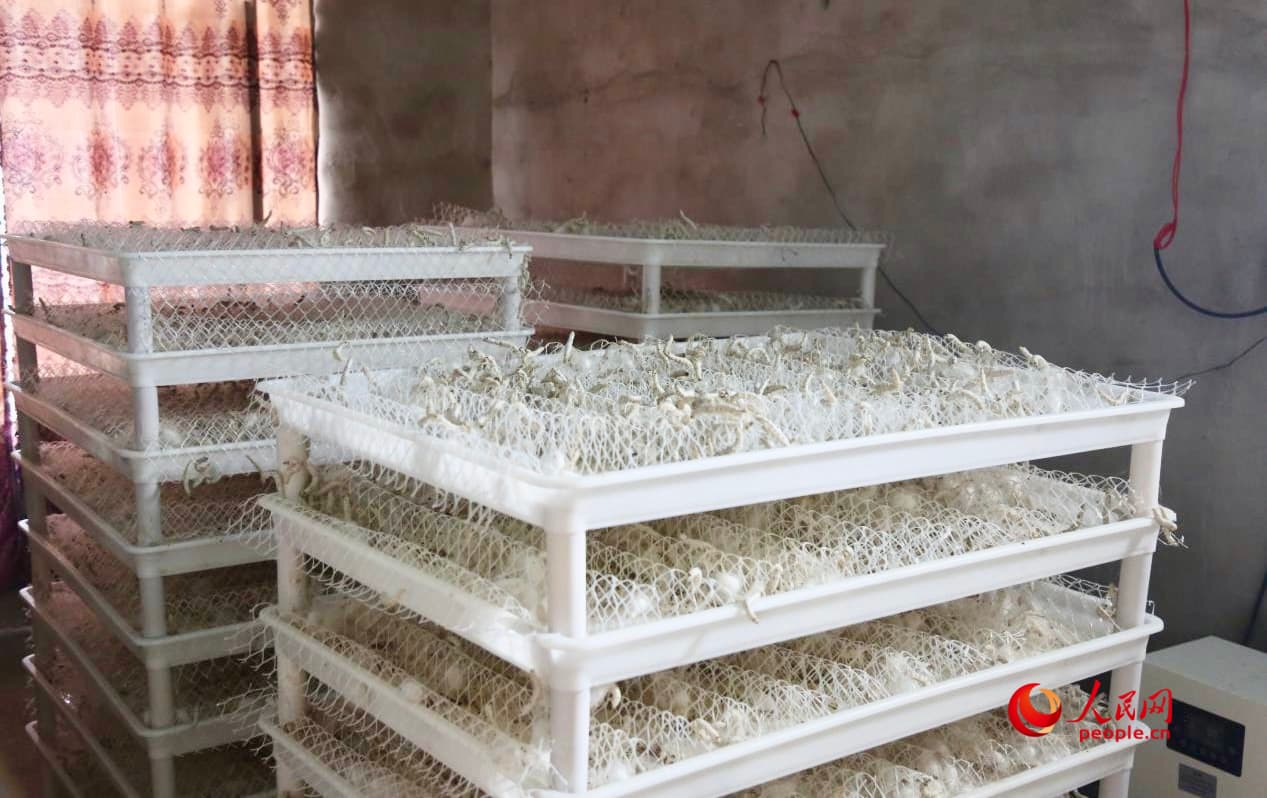
Photo shows silkworms reared in the home of a farming household in Yining county, Ili Kazak Autonomous Prefecture, northwest China's Xinjiang Uygur Autonomous Region. (People's Daily Online/Li Long)
"We introduced high-quality silkworm varieties and mature technologies from Nantong. The first batch of fresh cocoons produced during trial rearing in 2025 was tested and found to meet the 5A grade for raw silk quality, the second-highest grade," Tang said.
Each cocoon can produce silk threads up to 1,200 meters long, representing top-tier quality among cocoons and filling a gap in large-scale silkworm farming in Ili Kazak Autonomous Prefecture, according to Tang.
To ensure a stable supply of feed, the company has also established mulberry plantations. In Ta'er village, Mazha township, Yining county, 3,000 mu (200 hectares) of mulberry plantations, with varieties introduced from Nantong, provide high-quality mulberry leaves for the sericulture program and create job opportunities for local residents.
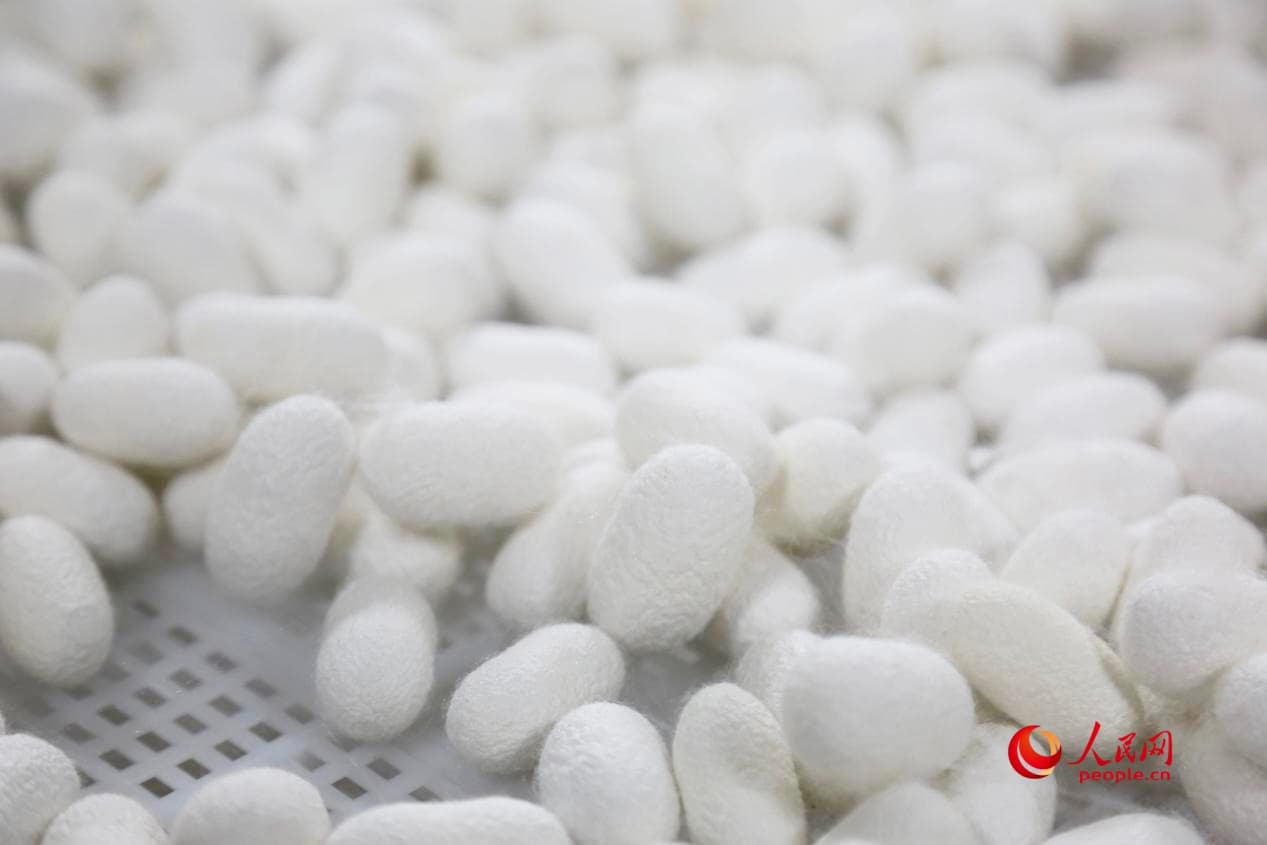
Photo shows high-quality cocoons produced by silkworms reared under a company-farmer collaboration program in Yining county, Ili Kazak Autonomous Prefecture, northwest China's Xinjiang Uygur Autonomous Region. (People's Daily Online/Li Long)
The harvested mulberry leaves are sorted, dried, and supplemented with trace elements to provide reliable raw materials for silkworm feed.
Twenty-two-year-old Nureli Tursunniyaz works as a full-time technician at the company.
"From feed processing to the ventilation and temperature control for the environment, as well as feeding amounts and schedules, I learned everything step by step from technicians from Nantong," he said.
Now, Nureli Tursunniyaz has mastered key rearing skills and serves as a bridge connecting the company, technical experts and local farmers, traveling between villages to provide guidance and explain the cooperation program to farmers.
Benefiting from the abundant sunlight and contiguous farmland resources of the Ili River Valley, combined with Jiangsu's advanced silkworm rearing technologies, the program has overcome traditional seasonal limitations and achieved year-round production, allowing a single strand of silk to weave a broader story of regional cooperation and shared prosperity.
"In the future, we will continue promoting the fifth-instar silkworm co-rearing model to expand the benefits of the industry for farmers," Tang said. "We also plan to develop downstream sectors such as silk reeling, silk weaving, and biological extraction, ensuring that the achievements of the assistance program benefit more people in Ili."