


YINCHUAN, Aug. 5 (Xinhua) -- In a wetland park on the edge of the Maowusu Desert in northwest China, birds circle above the water and reeds sway along the shoreline. Few visitors would know that the wetland is a product of the coal industry -- created with water pumped out of nearby mines.
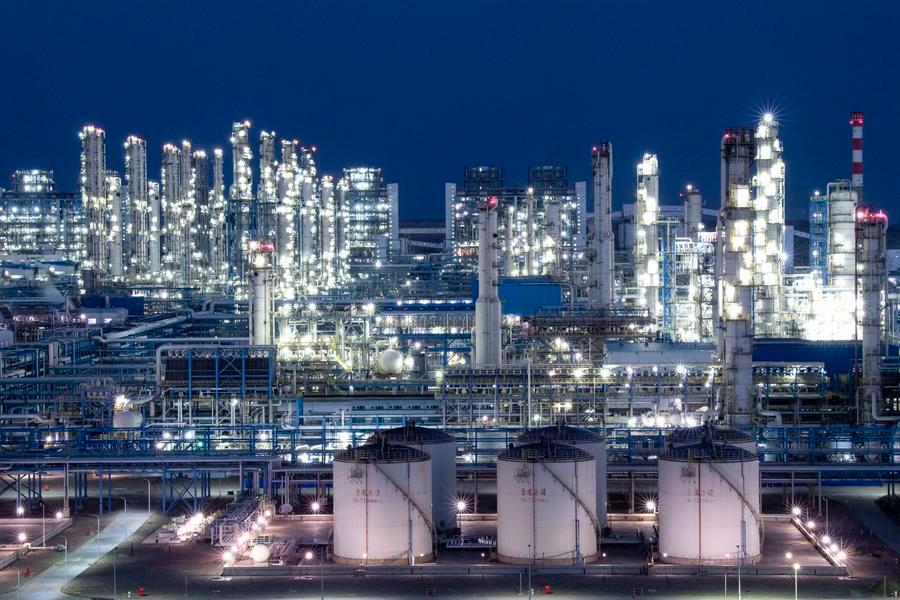
This photo taken on June 22, 2022 shows a night view of the coal-to-liquid plant of Ningxia Coal Industry Group Co., Ltd. under China Energy in Ningdong Energy and Chemical Industry Base, northwest China's Ningxia Hui Autonomous Region. (Photo: Xinhua)
For local residents, the 21,000-mu (1,400-hectare) green space is perhaps the most visible symbol of how Ningxia Hui Autonomous Region, a coal-rich area, is searching for a greener industrial future. Yet, a quiet transition is underway -- one focused on cleaner energy use and lower-carbon technologies.
The wetland park is located in Ningdong energy and chemical industry base in eastern Ningxia, one of China's major energy and chemical industry hubs, where coal remains central to industrial development.
The industrial base is home to one of the major coal-to-liquids (CTL) projects, which converts coal into high-value products, ranging from fuel products for aerospace missions to polyolefin plastic pellets used in agriculture, automobiles and construction.
But as global efforts to cut carbon emissions accelerate, CTL and modern coal chemical industries have come under increasing pressure due to their high carbon intensity, creating challenges for their future development, said Zhao Junping, deputy manager and chief engineer of the Ningxia branch of Guohua Energy Investment Co., Ltd.
To address these challenges, efforts are underway to integrate coal chemical production with renewable electricity, green hydrogen and carbon capture, utilization and storage (CCUS) technologies, aiming to reduce emissions while improving resource efficiency.
Leveraging Ningxia's abundant solar resources, Ningxia Coal Industry Co., Ltd., the operator of the CTL project in Ningdong, and Guohua Energy Investment have jointly developed a demonstration project for green hydrogen production.
At the Qingshuiying Hydrogen Plant, electrolyzers use electricity generated by a photovoltaic power station in the plant to produce hydrogen. After compression, the hydrogen is delivered through pipelines to coal chemical facilities in Ningdong, replacing part of the hydrogen previously produced from coal-based processes.
To date, the project has been operating steadily for nearly 700 days, producing a total of more than 1,800 tonnes of green hydrogen and cutting carbon dioxide emissions by nearly 40,000 tonnes, according to Yuan Hui, deputy head of the plant.
If proven viable, the approach being demonstrated at Qingshuiying could pave the way for deeper integration of solar power generation, green hydrogen production and coal chemical operations, Yuan said. "The next step will be to scale up production."
Industry data show that green hydrogen costs have fallen significantly as production expands. Further deployment, supported by energy storage and other infrastructure, will help reduce costs and improve supply reliability over time.
He Peng, deputy head of the production department at Ningxia Coal's CTL branch, noted that integrating green hydrogen into modern coal chemical industries remains at the demonstration stage, with green hydrogen currently accounting for a relatively small share.
Increasing the share of green hydrogen used in the CTL project to 20 percent would reduce annual carbon dioxide emissions by around 5 million tonnes, according to He.
While green hydrogen targets emissions at the source, CCUS technologies offer another pathway by capturing carbon from industrial processes.
In Ningxia, the first phase of a 3-million-tonne-per-year CCUS demonstration project can capture and store 500,000 tonnes of CO2 annually, equivalent to the carbon absorption of nearly 4.5 million trees. The captured CO2 is used for enhanced oil recovery and mine safety applications, giving industrial emissions a second use.
The transition underway in Ningxia reflects China's broader effort to build a cleaner, low-carbon, secure and efficient energy system. Under its development blueprint for 2026-2030, the country aims to increase the share of non-fossil energy while ensuring the safe, reliable and orderly transformation of its energy mix and improving the efficiency of fossil fuel use.
At the regional level, Ningxia aims to promote the integrated use of coal, oil, gas and silicon resources, coordinate wind, solar, hydropower and thermal power, and develop a full energy chain covering production, storage, transportation and application.
Yao Qiang, general manager of the coal chemical management department at Ningxia Coal, said the company is seeking greater efficiency, innovation and sustainability. "Our goal is to leverage our resource advantages and industrial strengths to create greater economic value," he said.