


For companies and cities, industrial tourism means more than ticket revenue and another tourist attraction on the map.
Many Chinese industrial cities were once stereotyped by pollution and factory noise. However, with industrial tourism showcasing their green and smart improvements, these sites are now being reimagined as public leisure destinations.
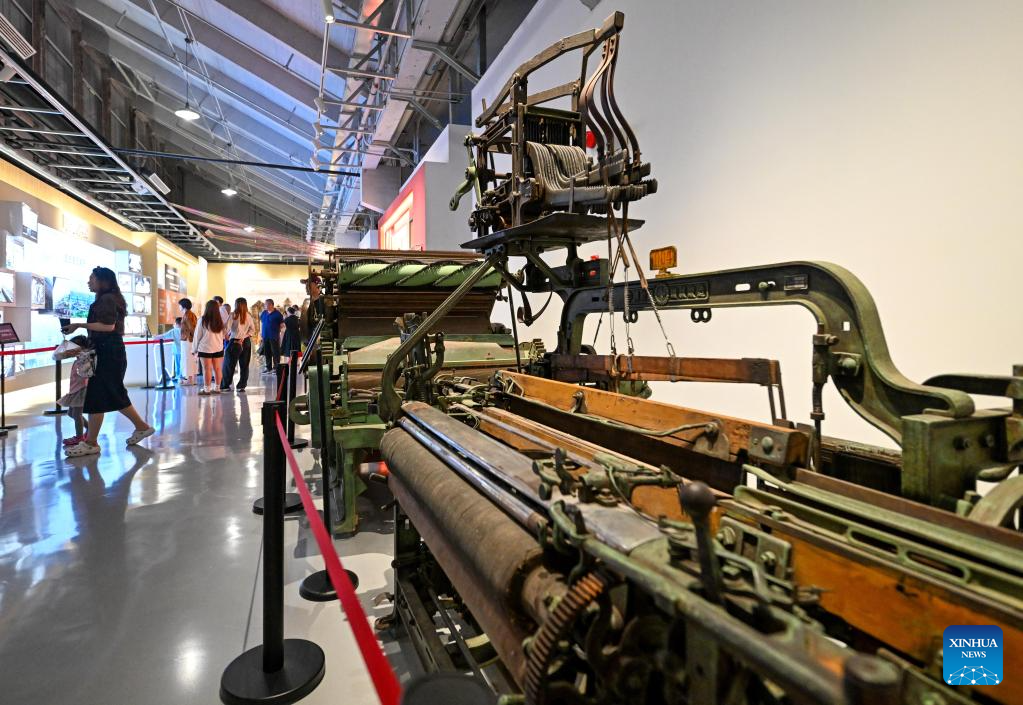
People visit a cultural and art park, transformed from the former cotton textile factories, in Shijiazhuang City, north China's Hebei Province, June 13, 2026. (Photo: Xinhua)
In the city of Xiangtan, an old industrial base in central China's Hunan Province, visitors are often surprised by the park-like environment at the plant of Xiangtan Iron and Steel Group Co., Ltd., a company established in 1958.
The company is among those shedding their old, dirty image by inviting more visitors to see their production sites firsthand. What were once niche, industry-only names are gaining wider public recognition.
"In my mind, a steel plant always meant thick smoke, rust-red iron and gray walls. I never expected the environment here to be as relaxing as a city park," said He Manting, a student at Xiangtan University.
The site features many art pieces crafted from scrap steel by workers. Such scenes are the outcome of the company's green efforts. Over the past five years, it has invested more than 6 billion yuan (about 883.72 million U.S. dollars) in green upgrades.
Beyond environmental transformation, industrial tourism serves as a bridge to cultural heritage. Once seen as a dark, salty workshop, the 280-plus-year-old soy sauce garden of Longpai Food Co., Ltd. has now become a popular travel destination, receiving nearly 20,000 visits each year.
"When visitors step into the garden, it's like stepping back in time," said Zhang Yue, a senior leader of Longpai Food. "Transforming our brand's history into a cultural tourism asset, and turning that asset into new consumption, is why we ventured into industrial tourism."
During visits, Zhang explains the science behind brewing to children in simple terms, describing how enzymes break down soybean proteins. Though the science was complex, many visitors, including sixth-grader Wang Zongyi, found the experience rewarding.
"I learned some fun science facts and got to see our intangible cultural heritage in action," said Wang. "I really admire the down-to-earth dedication of the artisans. It taught me that to do things well, you have to stay focused and keep at it."
Modern manufacturing is also taking center stage. At the smart control center of Xiangtan Iron and Steel Group, AI algorithms manage steel production, replacing grueling manual labor.
"In the past, some processes required experienced workers to stand guard," said Wen Han, a staff member at the company. "From sweating profusely by the furnaces to working comfortably in air-conditioned control rooms, new technologies are reshaping steel production."
"As more factories open their doors, they are dispelling outdated stereotypes about old industrial bases while uncovering new avenues for value growth in traditional industries," said Zhao Yi, deputy director of Xiangtan municipal bureau of culture, tourism, radio, television and sports.
Zhao added that industrial tourism breaks down traditional boundaries between sectors, unlocking massive consumption potential.
Industry research institutions predict that this sector will maintain average annual growth of about 18 percent between 2024 and 2029, with the market expected to exceed 300 billion yuan in size.
To elevate the experience, companies are integrating industrial tourism with lifestyles. For instance, the creative space of sportswear giant Anta in Jinjiang, a county-level city in east China's Fujian Province, is redefining the traditional factory outlet.
The space blends shopping with interactive fun by introducing six experience zones, including indoor climbing, skiing and basketball. "I unexpectedly found a ski zone with on-site coaching when I was shopping for clothes. The experience was top-notch," a user said on Xiaohongshu, a popular Chinese lifestyle-sharing platform.
To ensure tourism is accessible and high-quality, Jinjiang has introduced supportive measures. Addressing scattered locations, the city launched two free vintage tram lines in late May, connecting factories and commercial districts for hassle-free travel.
Last year, 11 sightseeing factories in Jinjiang welcomed 486,800 visits, generating over 20 million yuan in revenue. "Industrial tourism revitalizes existing resources and drives traditional industry upgrades," said Chen Xinxin, deputy director of Jinjiang's culture, sports and tourism bureau.
Chen added that Jinjiang has rolled out targeted policies, including subsidies, to encourage more local factories to open to the public and upgrade their tourism offerings.
Across China, the world's manufacturing powerhouse, the trend of popular industrial tourism has received fresh support from policymakers. In May, China issued a circular on promoting industrial culture, preserving industrial heritage and advancing industrial tourism.
The outline of China's 15th Five-Year Plan (2026-2030) calls for coordinated development of industrial tourism alongside "red tourism," rural tourism and wellness tourism.