


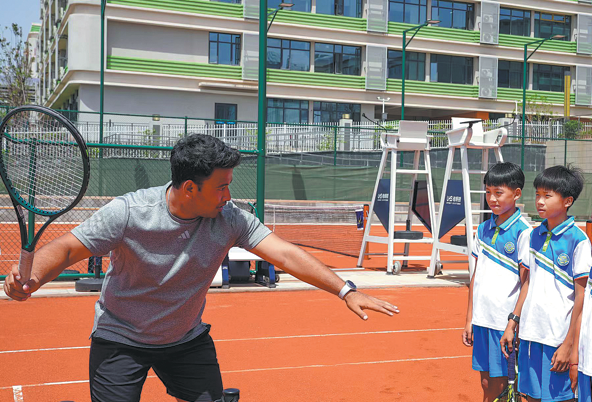
A coach trains students at a tennis school in Jingshan city, Hubei province. (File photo: Xinhua)
In Jingshan, a county-level city under Jingmen in Hubei province, tennis has been woven into the fabric of local life, going from a trendy pastime to a vital cog that supports a growing sports economy.
And when Aleksandra Otasevic and 18 other international journalists from countries across Africa, Latin America and the Caribbean, as well as Europe, visited Wuhan and Jingmen in Hubei recently, she was pleasantly surprised to find the physical evidence of this transformation.
Their journey offered a glimpse into how Chinese localities are turning distinctive sports and emerging industries into new sources of economic growth. "I didn't expect that when we came to China, we would see a great place that is so greatly involved in tennis," said Otasevic, a member of the Journalists' Association of Serbia.
Citywide passion
Jingshan's relationship with tennis began more than four decades ago, when residents of Wenfeng village formed a senior tennis team on a dirt court. What started as a curiosity gradually became a part of everyday life.
Every morning at around 6 am, farmer Peng Jufang heads to a public court to coach local players before returning to his cattle farm. He has played tennis for more than 30 years, competed in numerous tournaments and taught more than 3,000 students.
"Many people see tennis as an elite sport, but in many villages in Jingshan, almost everyone can pick up a racket," Peng said.
That accessibility helps explain the sport's wide reach. Jingshan now has over 350 standard tennis courts, allowing most urban residents to reach one within a 10-minute walk. Many public courts are free during the day, with evening players paying only a 20 yuan ($2.96) lighting fee. The city's tennis movement gained momentum after 2008, when Jingshan launched a campaign to promote the sport. The years that followed brought more courts and major tournaments, helping tennis grow from a rural pastime into a citywide passion.
In Wenfeng village, the sport has also become a source of business. The village launched its first "Village Tennis" tournament in 2023, bringing professional players, amateurs and residents onto the same courts while drawing visitors to the surrounding countryside.
Among those who saw an opportunity was Qi Chengmei, who returned home and converted her family house into a tennis-themed courtyard restaurant. The business now employs more than 10 residents and generates over 600,000 yuan in annual revenue. Today, the village is home to more than 10 tennis-themed homestays and restaurants. The wider economic impact is increasingly visible. In 2025, tennis-related tourism drew 3.52 million visits to Jingshan, while the city's tourism revenue exceeded 5 billion yuan, official data showed.
Jingshan has also built a pathway from mass participation to professional training. Through cooperation among provincial institutions, the tennis school and local authorities, Jingshan has trained a number of national-level players and joined a national program to develop reserve Olympic tennis talent.
Taking to the skies
Elsewhere in Jingmen, the search for new growth has taken to the skies.
At the Shengjing Mountain Paragliding Base in Dongbao district, colorful wings sweep across the sky as visitors wait for their turn to fly.
Jingmen began developing the base in 2017, drawing on the mountain's terrain and climate. It has since grown into a destination combining competitions, professional training and tourism, with tandem flights often fully booked during peak periods.
For visitors, paragliding offers the thrill of soaring above the mountains. For nearby villagers, it has opened up new opportunities to earn a living.
Liu Xiaojun in Jinquan village is among those benefiting from the trend. He transformed his old house into a paragliding-themed homestay, and during last summer's vacation season, all eight rooms were fully booked, with three months' earnings matching the total income of the previous year.
The visiting journalists experienced the emerging industry firsthand through virtual-reality paragliding and indoor wind tunnel flights. For Otasevic, the visit offered an up-close look at how a local tourism project connects with China's growing low-altitude economy.
"When we were in Shanghai, I first heard about the low-altitude economy. It was a great opportunity for me to understand what it really means," she said. "Everything is amazing. It can boost tourism and the local economy."