


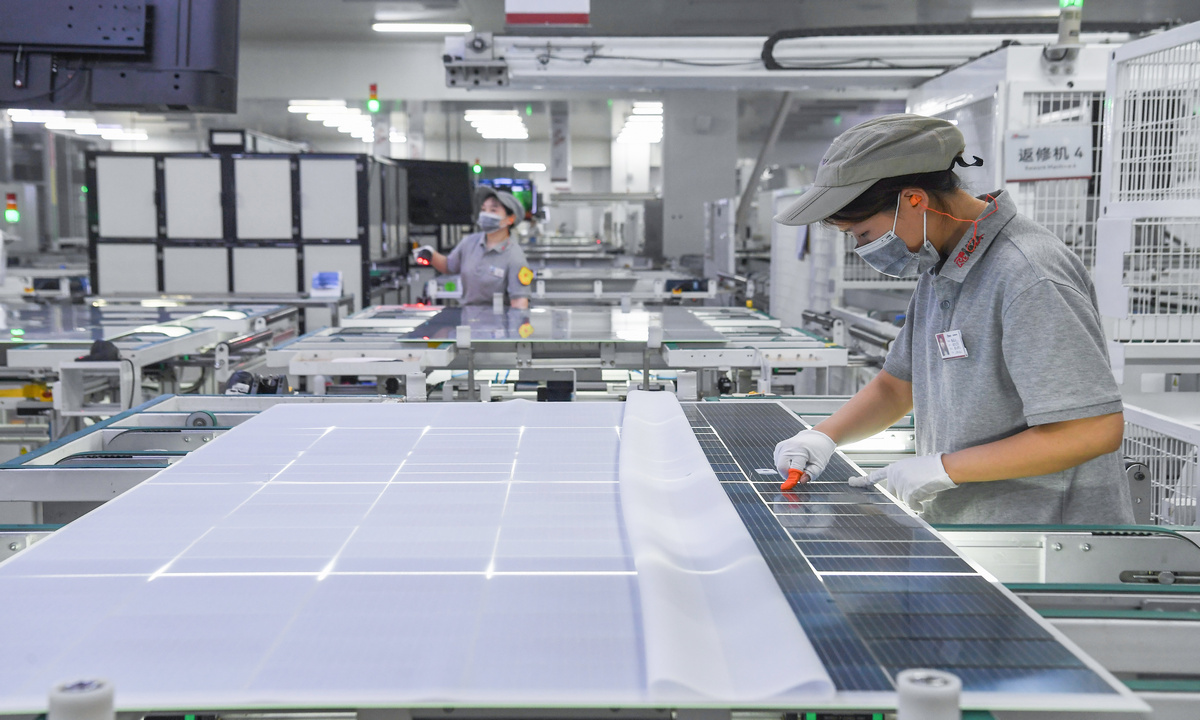
Workers assemble solar photovoltaic modules at a smart manufacturing workshop of Ronma Solar Energy Group in Jindong district of Jinhua city, East China’s Zhejiang Province, on July 28, 2026. As the company boosts production capacity and expands overseas sales channels, its products are being exported to Europe, Southeast Asia, the Middle East, and Africa. (Photo: VCG)
Chinese experts on Friday slammed the US move to impose a series of price floors and a 15 percent tariff on products made from polysilicon, saying it was another sign that the US is using trade tools to contain China's industrial growth and counter China’s chip supply chain, with "industrial security" serving as a pretext for trade protectionism.
The US administration announced on Thursday that it would impose a series of price floors and a 15 percent tariff on products made from polysilicon, the raw material used in semiconductors and solar panels and primarily produced by China, Reuters reported.
Although the White House proclamation did not specifically mention China, it has been widely seen as a move targeting Chinese producers.
The new trade measures aim to support US chip and solar supply chains needed to compete with China in artificial intelligence and energy, Reuters said.
Chinese experts criticized that the hybrid system of minimum pricing combined with tariffs is not market-based, but a deliberate effort to raise barriers and distort global competition. Such politically driven "US-style substitution" creates barriers rather than competitiveness, pushing industries toward higher costs, slower growth and reduced access to the opportunities offered by China’s manufacturing strengths and market openness.
The new order would include minimum import prices on polysilicon, wafers, cells and modules, or solar panels, and a 15 percent tariff rate on the polysilicon derivatives. Specifically, it sets minimum import prices of $21 per kilogram for polysilicon, $100 per kilogram for polysilicon ingots and wafers, $0.22 per watt for solar cells and $0.38 per watt for solar modules, according to the White House document.
The trade measures will take effect on December 4.
The White House said the policy is intended to ensure the "commercial viability" of US polysilicon production and its derivatives that is necessary to "meet US economic and national security requirements."
Polysilicon is a key raw material at the start of both semiconductor and solar manufacturing chains. It is used to make wafers, which are then processed into solar cells and assembled into modules.
The US currently has only two polysilicon factories: Hemlock Semiconductor in Michigan, a joint venture between Corning and Japan's Shin-Etsu Handotai, and Wacker Chemie's plant in Tennessee, according to Reuters.
"Such measures violate the principles of free trade and fair competition," Bai Ming, a research fellow at the Chinese Academy of International Trade and Economic Cooperation, told the Global Times on Friday. "The US is promoting market liberalization on the one hand while using tariffs, price floors and subsidies to protect domestic producers on the other."
Bai said that China's scale, technology and cost advantages in polysilicon were the result of global industrial division of labor and market competition, and that Washington’s attempt to blunt that edge through administrative controls would only heighten uncertainty.
The expert also warned that the US trade policy could backfire by increasing costs for downstream US manufacturers and consumers. Because polysilicon is a foundational input for both solar and semiconductor production, any artificial increase in its price would ripple through the industrial chain, raising costs for American solar factories, chipmakers and clean energy projects.
The US is politicizing trade issues and treating normal industrial competition as a national security threat, however, trade protectionism may appear to safeguard a few companies in the short term, but in the long run it weakens the broader industrial ecosystem, Xiang Ligang, director-general of the Zhongguancun Modern Information Consumer Application Industry Technology Alliance, told the Global Times on Friday.
"This is classic zero-sum thinking," Xiang said, adding that turning economic cooperation into strategic confrontation does not solve structural problems. It only deepens volatility in global markets.
US solar manufacturing has expanded since the US Congress introduced tax incentives in 2022, but much of that growth has been concentrated in panel assembly, leaving manufacturers reliant on imported wafers and cells, which require longer-term investment to produce domestically, according Reuters.
Chinese industry observers argued that the US action reflects anxiety over its own industrial capacity rather than a genuine effort to promote healthy competition. They said that by artificially restricting imports of cost-effective polysilicon, the US is attempting to shield less competitive domestic producers from market pressure.
However, experts said the real challenge for the US lies in converting its technological strengths into real productive capacity, but policymakers appear more focused on erecting barriers than addressing that fundamental weakness.
Xiang said that if the US wants to improve supply-chain resilience, it should focus on technological innovation, capacity building, and open cooperation – not tariffs and administrative price controls.
China has repeatedly opposed US overuse of tariffs and trade remedies. In response to reports of the US drafting a ban on imports of new Chinese optical transceivers and preparing price floors and tariffs on polysilicon and related products, Chinese Foreign Ministry spokesperson Lin Jian said on Wednesday that China firmly opposes the US overstretching the concept of national security, and abusing state power to go after Chinese businesses.
Lin said that protectionism will not make the US more competitive, and the US move seriously disrupts normal trade and economic exchanges between Chinese and US businesses, and is not in the interest of US businesses and consumers or anyone else for that matter. "China will continue firmly protecting our businesses' legitimate and lawful rights and interests," the spokesperson said.