


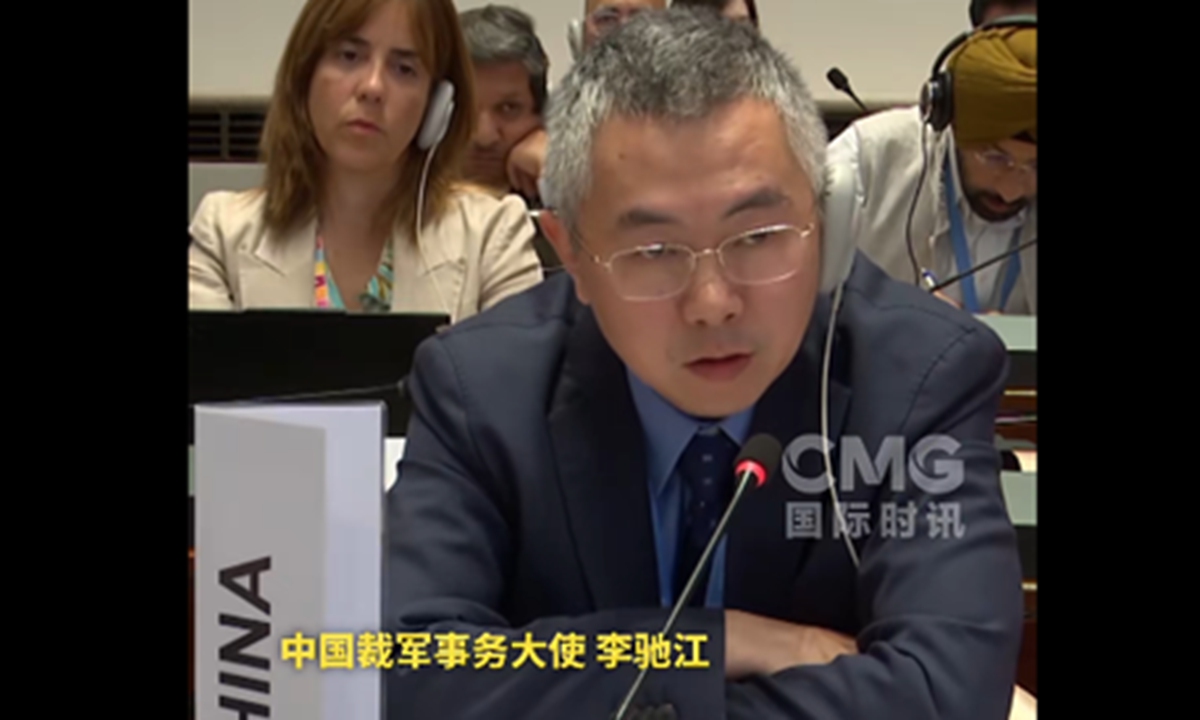
China's Ambassador for Disarmament Affairs Li Chijiang rejects a US-led joint statement concerning ballistic missile launch notifications at the Conference on Disarmament in Geneva on August 11, 2026. Photo: Screenshot from CMG
China's Ambassador for Disarmament Affairs Li Chijiang rejected a US-led joint statement concerning ballistic missile launch notifications at the Conference on Disarmament in Geneva on Tuesday, stressing that China's legitimate and reasonable defense modernization should not be called into question and Beijing's goodwill in providing advance notification of missile launches should not be hijacked by geopolitical calculations. Li also said China firmly opposes attempts by certain countries to misuse the conference as a platform for political manipulation.
At a plenary meeting of the conference on Tuesday, the US and several other countries issued a joint statement on what they called "notifications of ballistic missile launch," criticizing China's submarine-launched intercontinental ballistic missile test conducted in July. Li rejected the accusations and set out China's position, according to the Xinhua News Agency.
Li said China firmly opposes the abuse of the Conference on Disarmament for political maneuvering. Driven by its own political interests, the US had rallied a number of countries, including some that are not members of the conference, to join the statement and had nitpicked and leveled baseless accusations against China's goodwill gesture of providing advance notification of the missile test, he said.
Li criticized the move as "microphone diplomacy," saying it amounted to political manipulation and blatant double standards that China would neither accept nor tolerate.
Li said the US accusations were entirely unfounded. Washington had cited the Hague Code of Conduct against Ballistic Missile Proliferation, a voluntary political commitment, in demanding that China provide advance notification of missile launches. China, however, is not a subscribing state to the code and is therefore not bound by it, he said.
China has always conducted intercontinental ballistic missile tests in a safe, standardized and responsible manner, Li said. Before the latest test, China notified the US and other countries in advance and adopted prudent and reasonable measures to ensure that the launch did not harm the interests of any country, demonstrating China's goodwill and responsible approach.
Such goodwill gestures by China must not be hijacked by geopolitical calculations, Li said.
Li also said the US was in no position to criticize China over missile testing. China has conducted only three intercontinental ballistic missile tests to date, the fewest among the five nuclear-weapon states, while the US has carried out more such tests, and more frequently, than any other country, he said.
The US also repeatedly withdrew from international agreements and mechanisms, spending heavily on expanding its nuclear forces, and pursuing nuclear-sharing and extended-deterrence arrangements, which pose a serious threat to international peace and security. The US has itself failed to properly fulfill responsibilities regarding missile-test notifications and therefore has no grounds to criticize China's voluntary advance notification, Li added.
Li stressed that China remains committed to peaceful development and follows a self-defensive nuclear strategy. China keeps its nuclear forces at the minimum level required for national security and does not participate in any form of nuclear arms race, he said.
China's nuclear forces are an indispensable part of efforts to deter nuclear war, safeguard world peace and security, and maintain global strategic stability, Li said, adding that China's legitimate and reasonable defense modernization should not be questioned.
He urged the US to reflect on its own policies and take more actions that genuinely contribute to global peace and stability.
The Geneva-based Conference on Disarmament was recognized by the first special session of the UN General Assembly devoted to disarmament in 1978 as the world's sole multilateral disarmament negotiating forum. It currently has 65 member states and holds three sessions each year, addressing major international security issues including nuclear disarmament, the cessation of the nuclear arms race and the prevention of nuclear war.