


Across China, a new generation of retirees is redefining what it means to grow old.
Gathering at neighborhood community centers, they are proactively learning new skills, socializing and pursuing long-held passions with boundless energy.
This trend reflects a broader societal shift as China works to build an age-friendly society tailored to the social, cultural and personal fulfillment of its aging population.
In Yinchuan, capital of Northwest China's Ningxia Hui Autonomous Region, 72-year-old Li Shuyan is a vivid example.
Every day, she sets out with a small pink tote bag packed with a table tennis paddle, two silk fans and a thick songbook. She is an avid table tennis player, a choir singer and a fan dance instructor.
Li picked up table tennis at age 62 after watching her granddaughter compete in a local tournament. "She placed third. I thought to myself, that looks like fun," Li recalled with a smile, miming a serve.
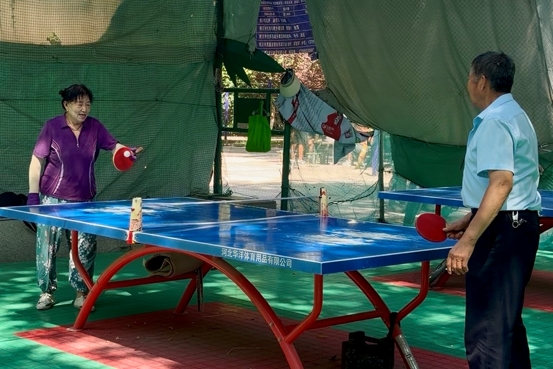
Li Shuyan plays table tennis at a community fitness plaza in Changcheng Garden Community, Yinchuan, Northwest China's Ningxia Hui Autonomous Region. China is expanding community-based recreational facilities to support an increasingly active aging population. (Photo: Feng Yulin/People's Daily app)
Li lives with her husband. Their son works at a local radio station, and their daughter is a journalist. "Staying healthy lets me enjoy my own life," she said. "It gives me independence and gives my children peace of mind."
Li is far from alone. China is home to over 300 million adults aged 60 and above, and neighborhood centers have become vibrant hubs for seniors seeking fitness, hobbies and companionship.
At Changcheng Garden Community—a residential complex in Yinchuan with more than 3,000 registered senior residents—organizers take a resident-led approach.
"With so many seniors and such varied interests, you can't micro-manage everything," said Liu Ye, a community staff member. The center provides the space and handles scheduling, while residents organize and run the activities themselves.
Guo Guixiang, another 72-year-old resident, keeps an equally full calendar. She practices traditional paper-cutting, gifting her intricate designs to neighbors for weddings and housewarmings.
"Bringing them joy brings me joy," she said.
Her community involvement doesn't stop with crafts. Guo led a local yangge folk dance troupe for five years, running rehearsals every evening. When her instructor retired at nearly 80, Guo joined another troupe nearby to keep dancing.
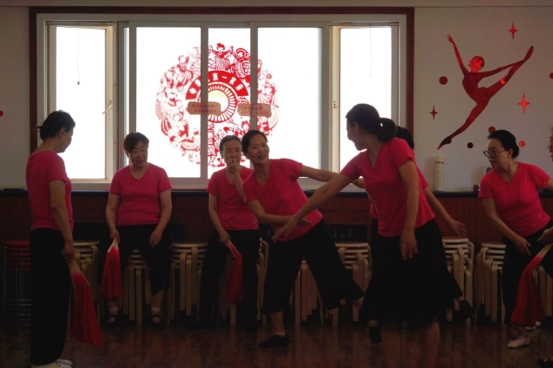
Seniors rehearse a folk dance at Changcheng Garden Community in Yinchuan, Northwest China's Ningxia Hui Autonomous Region. Neighborhood hubs across the region offer spaces for retirees to organize resident-led cultural activities. (Photo: Liu Jiayi/People's Daily app)
Stories like theirs are unfolding across the country. A recent lifestyle report revealed that over half of China's retirees are currently enrolled in or have taken hobby classes.
In Guangzhou, 90-year-old Yan Liangheng balances weightlifting, snooker and calligraphy with using AI to compose traditional festival couplets. In Beijing, 67-year-old Li Deyi, a former poultry farmer, reinvented himself as a docent at a historical memorial—writing his own scripts and giving lively, rap-style tours to visitors.
Back in Yinchuan, Li Shuyan already has her next goals in sight: learning English and studying classical Chinese poetry. Though she left school after primary education, her thirst for knowledge never faded.
"Reciting poetry has been my dream since childhood," she said with a broad grin.
At 72, Li shows no signs of slowing down. Her story represents a growing trend across China, where millions of seniors are treating retirement not as a fade-out, but as an empowering second act.
(Intern Huang Ying also contributed to this story.)