


BEIJING, Aug. 12 (Xinhua) -- Each year, surging temperatures put China's power grid to the test at the height of summer. In recent weeks, sweltering heat and high humidity have gripped many megacities, driving electricity demand to record highs.
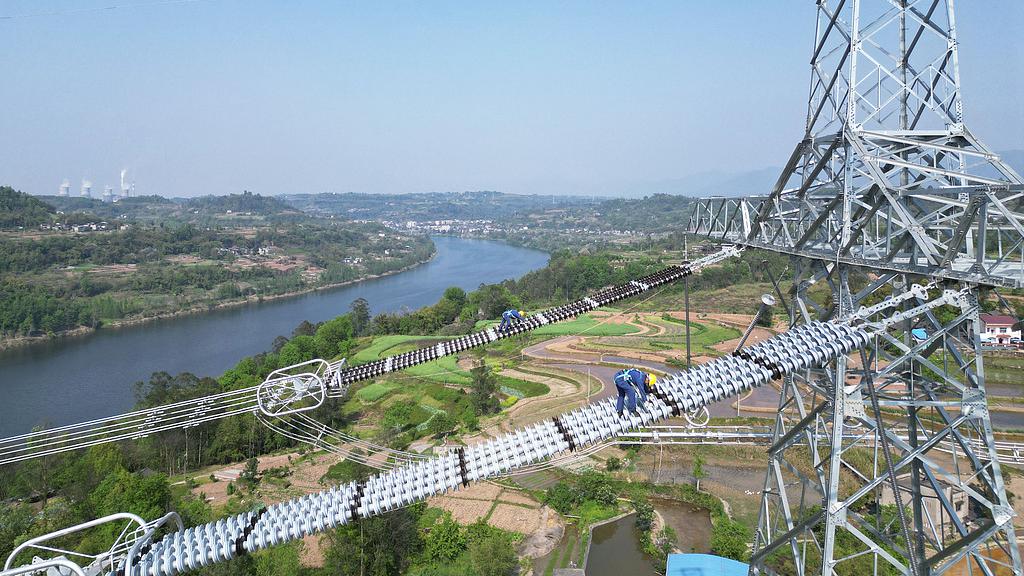
State Grid workers inspect transmission towers as the Chongqing section of the ±800 kV Hami-Chongqing ultra-high-voltage transmission project completes line inspection, Chongqing Municipality, China, April 8, 2025. (Photo: VCG)
While rolling blackouts in response to a summer crunch are not yet a distant memory, power grid operators across China have nonetheless faced the 2026 summer peak with greater confidence, thanks to advances in securing power supplies and strengthening grid flexibility.
Long-distance power transmission enabled by ultra-high-voltage (UHV) technology, energy storage and virtual power plants are among the measures helping keep electricity supplies stable as demand soars.
LONG-DISTANCE POWER TRANSMISSION
The summer heat test is particularly tough for Chongqing, a megacity in southwest China with a population of more than 30 million, known as one of the country's "furnaces" due to its ruthlessly sultry summers.
Keeping the city's air conditioners running and its automotive and electronics assembly lines humming through the summer peak puts enormous pressure on the local power grid. But a game-changer arrived in June last year, when the Hami-Chongqing transmission line, a 2,260-kilometer energy artery using UHV technology, went into operation.
This UHV line carries electricity generated in Hami, northwest China's Xinjiang Uygur Autonomous Region, to Chongqing, with more than 70 percent of the power coming from clean energy sources.
"This is our strongest source of confidence in coping with summer peak demand," said Shuai Hong, deputy chief engineer of the power dispatch and control center of State Grid Chongqing Electric Power Company.
Shuai said electricity purchased from outside the municipality accounts for about one-third of its total grid load this year. Specifically, the Hami-Chongqing line can transmit up to 6 million kilowatts at peak, equivalent to covering roughly one-fifth of the city's maximum power load.
UHV refers to power transmission technology with exceptionally high voltage levels that is well-suited to long-distance transmission due to its minimal energy loss. The Hami-Chongqing line is one of more than 40 UHV lines in China built to bridge a great divide in the country's energy landscape: China's energy resources are concentrated largely in the west, while the heaviest demand for electricity is in its central and eastern regions.
In past summers, scorching temperatures often forced industrial producers to scale back operations and businesses to curb electricity consumption. Chongqing Wang Cheng Technology Co., Ltd., an automotive and machinery components manufacturer, knows the strain all too well.
Before gaining access to electricity generated in Xinjiang, the company's production was hampered by power shortages in July and August. To cope, it would frontload production to avoid peak-demand periods and split orders into smaller batches.
This summer, however, more than 100 of the company's smart production lines ran at full capacity, while there was no need to sidestep peak demand periods or rush orders ahead of schedule. Instead, the pace of production could be planned and adjusted with greater flexibility, no longer dictated by seasonal availability of electricity.
UHV technology is particularly efficient at transmitting green electricity from wind- and solar-rich regions to megacities. This summer, the national capital city of Beijing was supplied with green electricity through a "solar-wind relay."
Pulsing through two UHV transmission lines, solar power generated in northwestern Qinghai Province helped meet Beijing's daytime demand, while wind power from turbines in northeastern Heilongjiang Province took over after nightfall.
Renewable energy, notably, is playing an increasingly vital role in powering the national grid. By the end of 2025, renewable energy had accounted for more than 60 percent of China's total installed power generation capacity. A national plan for renewable energy development during the 15th Five-Year Plan period (2026-2030), released last month, aims to further strengthen renewable energy's role in supporting the power system.
BALANCING EBB, FLOW
Meeting the summer peak is not just about bringing in more power. The ability to balance supply and demand in real time matters just as much.
In Shandong Province, energy storage facilities have been running at full tilt, offering much-needed backup power to the grid. On Aug. 3, State Grid Shandong Electric Power Company organized a province-wide coordinated dispatch of energy storage facilities, as midday and evening peak-hour demand hit record highs.
In the evening that day, 172 energy storage power stations across the province, including 73 stand-alone stations and 99 others built as supporting facilities to new energy projects, began discharging simultaneously. Their combined discharge capacity peaked at 11.98 million kilowatts.
The maximum discharge capacity was equivalent to the grid power load of Jinan, the capital city of Shandong, helping power the entire province through evening peak hours, said Zhou Lei with the dispatch control center of State Grid Shandong Electric Power Company.
Thanks to their rapid response and flexibility, new-type energy storage facilities have emerged as key resources for shaving peak loads and smoothing fluctuations in renewable power generation. For instance, they help the grid absorb surplus renewable electricity during the day and discharge it during evening peak periods.
As of the end of July, Shandong had 14.41 million kilowatts of installed new-type energy storage capacity.
Energy storage is only one side of the equation. Increasingly, the country's grid is turning to consumers themselves as a source of flexibility. Through vehicle-to-grid (V2G) technology, for example, electric vehicles can soak up surplus power during off-peak hours and return it to the grid when electricity demand rises.
Since July 1, Wuhan, capital city of central China's Hubei Province, has been piloting a V2G pricing mechanism that allows eligible new energy vehicles and private charging piles to feed electricity back into the grid. By charging during off-peak hours and discharging during peak periods, vehicle owners can earn additional income while helping the grid shave peak loads.