


At Dongguan Port in Dongguan, South China's Guangdong Province, giant "express parcels" are being lifted onto ocean-going vessels. From a distance, they look like ordinary shipping containers, but up close, each container reveals itself to be a fully finished house.
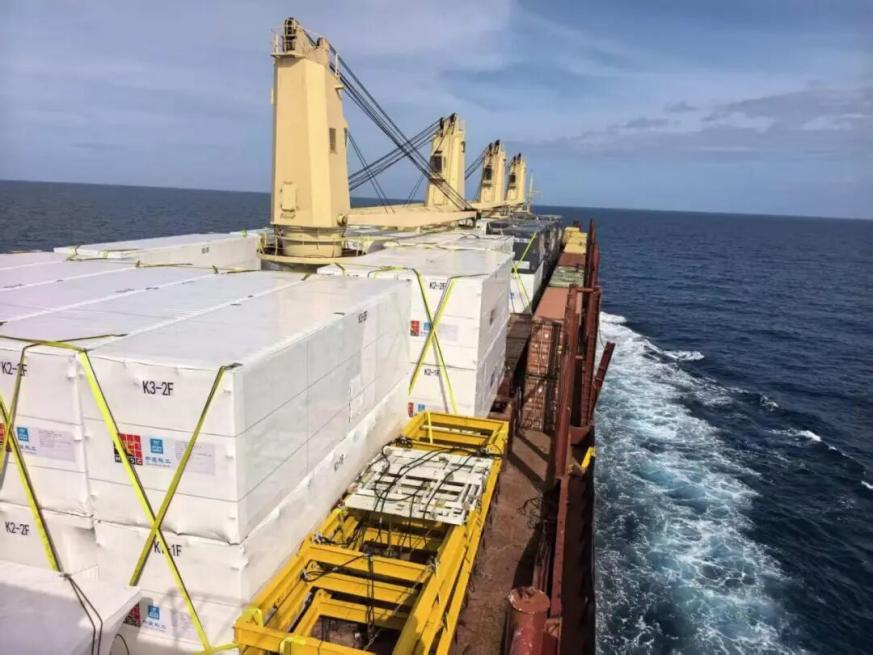
A ship transports construction modules from the China Construction Science and Industry Corp, Ltd overseas. (Photo courtesy of the China Construction Science and Industry Corp, Ltd)
These modular units are shipped across the seas to Australia, North America and the Middle East, where they are assembled like building blocks to form hotels, apartments, hospitals and other structures.
Why have China's container-like prefabricated houses become so popular in global markets? The People's Daily looked into the story.
Inside a smart factory operated by China Construction Science and Industry Corp, Ltd, a subsidiary of Chinese construction company China State Construction Engineering Corporation, in Huizhou, Guangdong, there is no dust or scaffolding typically seen at construction sites.
Instead, a fully automated production line, stretching more than 400 meters, runs around the clock. Here, a house is divided into six panels, each manufactured simultaneously on six sub-lines before being assembled into a complete module. Construction precision is consistently maintained at the millimeter level.
A single production line at the factory can turn out 50 housing modules a day, according to Li Huakun, chief engineer of the China Construction Science and Industry Green Technology Co, Ltd. That is 10 times the daily output of similar factories in North America, where the figure is around five modules.
At a smart construction industrial park operated by the China State Construction Hailong Technology Company Limited in Longgang, Shenzhen, a four-story, 50-meter-high vertical factory likewise bears none of the raucous commotion typical of conventional construction sites.
Every 20 minutes, a fully equipped module rolls off the production line, said Wang Qiong, chief engineer of the company. With 190 workstations and more than 80 pieces of equipment linked together, the facility has essentially turned house building into an industrial manufacturing process: raw materials such as sand and gravel enter at one end, and a finished housing module emerges at the other.
The facility is home to the world's first flexible smart manufacturing production line for concrete MiC (modular integrated construction), overcoming a major challenge in the mass production of concrete modules.
Construction materials are stored in a 10-story automated warehouse, while nearly 100 automated guided vehicles (AGVs) move around the factory, delivering materials according to production schedules.

Visitors explore the prefabricated houses on display at the China International Integrated Housing Industry and Building Industrialization Expo in Guangzhou, South China's Guangdong Province, on May 8, 2026. (Photo/Jia Mengya)
Inspection robots use laser scanning to reconstruct the interiors of modules in three dimensions, with any millimeter-level deviation automatically identified and flagged by the system.
"More than 70 percent of construction processes have been moved to the factory, which cuts construction time by over 60 percent," Wang said. The production line is capable of delivering 20,000 to 30,000 concrete prefabricated modules annually.
Prefabricated houses mainly fall into three categories: steel structures, concrete structures, and wooden structures. Chinese companies have developed strong advantages, particularly in steel and concrete technologies. The parallel development of the two technical approaches has given China's construction sector greater flexibility and competitiveness in global markets.
With industrialized standards, digitalized precision, and automated efficiency, houses are increasingly shifting from being "built on construction sites" to being "manufactured in factories."
In New South Wales, Australia, giant "express parcels" shipped from Dongguan Port are arriving one after another, and an apartment complex is rapidly taking shape.
Traditional building construction involves laying foundations, erecting scaffolding, constructing walls, plastering, and decorating step by step. However, that is not how this project is being built. The giant "express parcels" arrive with structural components, walls, electrical and plumbing systems, and interior finishes already completed in Chinese factories. The only task left at the site is assembly – much like putting together building blocks.
From the arrival of the modules at the construction site to completion of the main structure takes only a few months, whereas a traditional project of the same scale in Australia would typically take two and a half years, Li told the People's Daily.
In Australia, labor costs account for 30 to 40 percent of the total cost of traditional construction. Modular construction shifts a large number of processes to factories in China, reducing on-site labor by more than half and cutting the construction period by more than half. As a result, overall construction costs can be reduced by more than 10 percent, Li said.
More importantly, modular construction delivers higher quality. Factory-built modules boast far higher precision than on-site manual construction. Every unit undergoes full-range quality inspection prior to delivery, enabling a perfectly tight, seamless fit during on-site assembly.
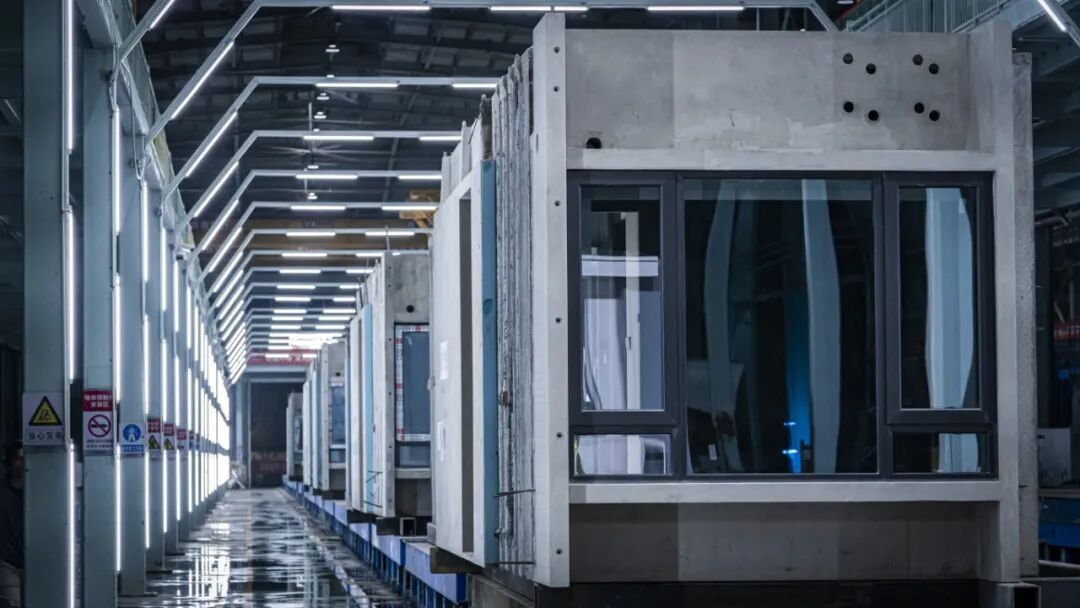
A China State Construction Hailong Technology Company Limited MiC (modular integrated construction) workshop (Photo courtesy of the China State Construction Hailong Technology Company Limited)
Dubai, a major hub for construction in the Middle East, has long relied on traditional cast-in-place concrete standards in its approval system. Before this, there had been no precedent for approving multi-story MiC projects.
In 2025, the China State Construction Hailong Technology Company Limited obtained Dubai's first preliminary approval in principle for a MiC project. The company adapted its technology to US standards and Dubai's building codes, improved structural calculation documentation, and transformed Chinese project experience into localized technical materials. The approval marked a shift for Chinese construction from "benchmarking against international standards" to "integrating into the international market."
"Overseas clients care most about three things: delivery quality, delivery efficiency, and cost," said Jiang Li, deputy general manager of China Construction Science and Industry. Supported by robotics, digital factories, and green building materials, China's construction industry is increasingly able to deliver on all three fronts.
Behind this success lies the world's most complete construction industry chain. From steel and concrete to bathroom fixtures and electrical appliances, almost every component can be quickly sourced in China. Customized solutions also ensure structural safety during overseas transportation.
"Modular construction represents a new quality productive force for the construction industry," Wang said. Having achieved industrialized production and data-driven management across the entire process, Wang's company is now confident that China's modular construction technologies will become an important driver of the global transformation toward industrialized construction.