


TIANJIN, Aug. 13 (Xinhua) -- Even in the blazing summer heat of Urumqi in northwest China's Xinjiang Uygur Autonomous Region, workers at a residential project are kept surprisingly cool by a "residential building machine" whose giant canopy shades the entire construction area.
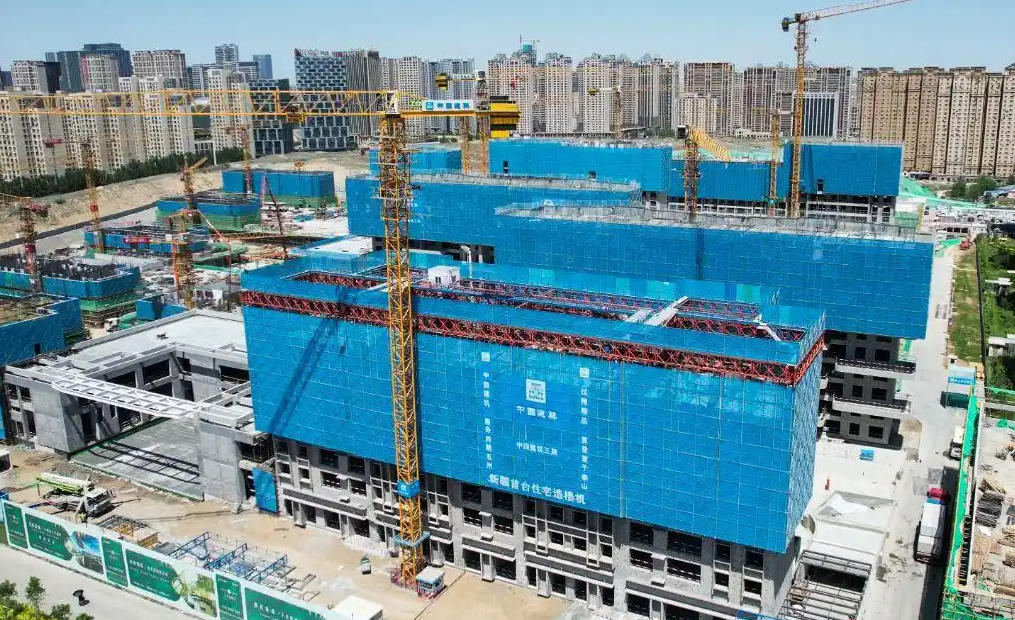
Photo: Xinhua
From a distance, the smart platform looks like a blue square cap perched atop the rising structure. Stepping inside, one finds a spacious steel platform supported by 16 columns, surrounded by safety railings and netting.
"This is essentially a movable airborne factory," said Han Junqiang with China Construction Third Engineering Bureau Co., Ltd. "It turns traditional open-air, high-rise work into an enclosed, safe indoor operation."
But the system does more than shield workers from the elements. It also drastically reduces the heavy lifting workload. Building materials and equipment are hoisted along with the platform as it climbs, delivering everything directly to the new floor.
To ensure precision on large single-floor layouts, the system uses a "digital twin" integrated with multiple sensors that collect real-time operational data from all angles, enabling instant warnings and automatic corrections. With this setup, each floor can be completed in as little as four days, while every step of the process is continuously monitored.
With new technologies, construction is now moving toward greater precision, safety, and environmental sustainability. The shift is being driven from the top down. Since 2022, the Ministry of Housing and Urban-Rural Development has launched smart construction pilot programs in 24 cities.
Tianjin Municipality is among them, and a growing number of projects there are showcasing what AI-enabled construction can achieve. One example is the Tianjin Liulin urban-renewal project. Covering 82,000 square meters, it is designated as one of the city's pilot smart-construction projects.
The contractor, China Construction Sixth Engineering Bureau Co., Ltd., has deployed an AI-powered "smart-site" camera system, tower-crane sensors with visualization, virtual safety-training modules, and VR hazard simulations. These tools detect unsafe behavior in real time and issue automatic warnings or corrective instructions, significantly reducing accident risks.
To improve the occupant experience, the project has also used Building Information Modeling to simulate outdoor wind flows, improve natural daylight inside apartments, and optimize residential energy efficiency.
Smart devices are becoming more common inside the houses, including cameras with algorithms that detect falls by elderly residents or children, and gas sensors that automatically shut off valves and open windows in case of leaks. These are increasingly being built into new urban housing.
The policy backing is clear. This year's government work report called for developing smart construction and cultivating a modernized industrial chain for the sector. The housing ministry has also issued technical guidelines to accelerate the adoption of smart technologies across the entire lifecycle of building projects.
Analysts noted substantial untapped potential for AI-driven productivity gains in construction as data shows that the value added by China's construction industry has exceeded 6 percent of GDP every year since 2021. In 2025, the sector generated 8.64 trillion yuan (about 1.27 trillion U.S. dollars) in added value, accounting for 6.16 percent of the national economy.
Wang Guangbin, dean of the center of innovation and development in construction at Tongji University, described smart construction as a game-changer. "It improves quality through digital design, intelligent production, and lean construction. At the same time, it redefines resource allocation through platform-based collaboration, online supervision and smart maintenance."
Wang added that the shift is turning a traditionally labor-intensive industry into a technology and knowledge-intensive one, while also driving upgrades in related sectors that include building materials, engineering machinery, industrial software and smart terminals.
The smart approach extends to more complex infrastructure as well. In east China's Fujian Province, construction is underway on the Tian'an Expressway. The project marked progress recently when the left bore of the Guangping Tunnel was holed through, despite challenging ground conditions in a karst landscape where rock is unstable and prone to collapse.
Yu Canxin, project manager from China Railway 18th Bureau Group Co., Ltd., said the team used geological radar and horizontal directional drilling to map hidden hazards ahead of the tunnel face. The data helped fine-tune the excavation plan. Multiple smart sensors were also installed along the bore, feeding back constant readings on rock movement and settlement. This real-time data stream allowed the team to continuously monitor ground settlement and other critical indicators, ultimately ensuring the successful completion of the left bore.
From site surveys and construction execution to long-term maintenance, AI is now embedding itself across every phase of construction. Technologies, including intelligent monitoring, digital twins and automated construction, are fundamentally re-engineering the industry's value chain.
Experts say the goal is not merely faster or cheaper construction, but a fundamental shift toward modern industrial practices -- where design, production, and logistics are all integrated into a data-driven workflow. The aim is to strengthen domestic supply chains, upgrade materials and equipment, and revitalize the broader innovation ecosystem around construction.