


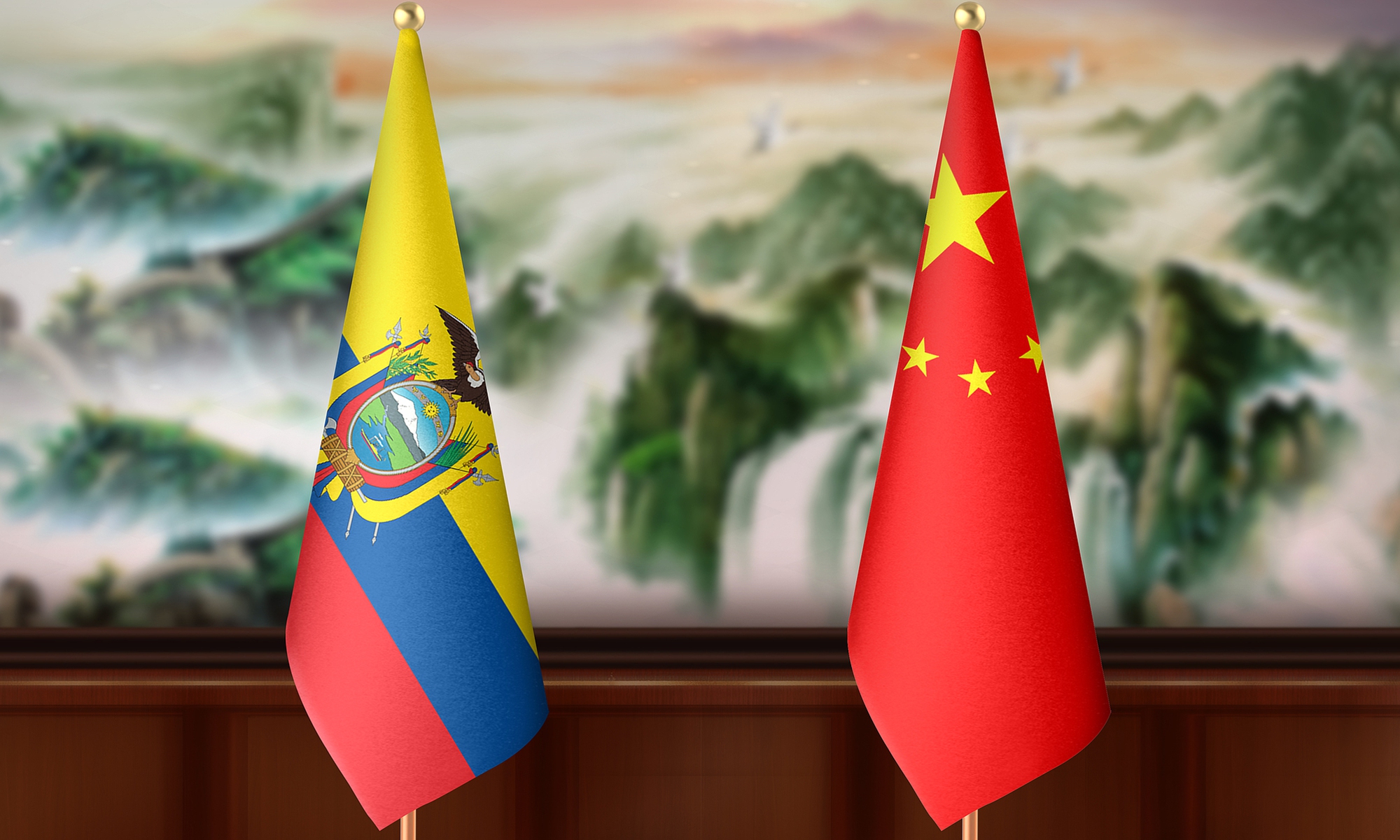
The Chinese national flag and the Ecuadorian national flag. (Photo: VCG)
At the invitation of Chinese President Xi Jinping, President of the Republic of Ecuador Daniel Roy-Gilchrist Noboa Azín will pay a state visit to China from August 16 to 23, a Chinese foreign ministry spokesperson announced on Friday.
Noting that 2026 marks the 10th anniversary of the China-Ecuador comprehensive strategic partnership, the Chinese spokesperson said that China hopes the visit will help further consolidate political mutual trust between the two countries, carry forward the traditional friendship, and achieve new progress in the comprehensive strategic partnership for the benefit of the two peoples.
The spokesperson said Ecuador is an important Latin American country, and that the two sides have signed a document on Belt and Road cooperation and a free trade agreement, practical cooperation in various areas has been fruitful, and the friendship between the peoples has been deepening.
A release from Ecuador's Ministry of Foreign Affairs notes that the China leg serves as the first stop of his Asia tour, which will also take him to Vietnam and Singapore. The statement adds that the state visit to China is intended to deepen strategic ties and advance key initiatives spanning trade, investment, infrastructure, energy, technology and sustainable‑development cooperation.
Citing Ecuadorian foreign minister Roberto Kury, local media outlet Vistazo reported that the agenda would include Chinese investment interest in energy and mining, as well as Quito's aim of boosting its exports.
According to the Chinese Foreign Ministry, the upcoming visit will be President Daniel Noboa's first state visit to China. It's also President Noboa's second visit to China following his initial trip in June 2025 for the Annual Meeting of the New Champions in North China's Dalian.
During Noboa's last China visit, he met with the Chinese leader in Beijing. The two heads of state jointly witnessed the signing of the cooperation plan between China and Ecuador on jointly promoting Belt and Road cooperation.
Ecuadorian digital outlet Primicias wrote that the trip will mark a new chapter in the bilateral relationship that Ecuador has consolidated with one of its key economic partners.
"In recent years, China‑Ecuador relations have maintained steady growth. This upcoming visit is expected to further consolidate high‑level political mutual trust between the two countries and forge top‑level consensus for further cooperation in the next phase," Pan Deng, director of the Latin America and Caribbean Region Law Center at the China University of Political Science and Law, told the Global Times on Friday.
Meanwhile, the visit will also help strengthen the bilateral institutional cooperation network, translate cooperation plans into concrete outcomes across niche sectors, and establish a multi‑tiered dialogue mechanism covering governments, enterprises and academia, Pan noted.
"Pragmatic cooperation between China and Ecuador has outgrown fragmented, ad hoc short‑term projects, entering a new era of long‑term cooperation that is institutionalized, regular and scalable," Pan added.
According to China's Ministry of Commerce, the China‑Ecuador Free Trade Agreement was signed on May 11, 2023 and officially entered into force on May 1, 2024. Ecuador thus became China's 27th free‑trade partner and the fourth for China in Latin America.
China has, for consecutive years, stood as Ecuador's second‑largest trading partner. Figures from China's Ministry of Foreign Affairs show that the bilateral trade volume stood at $17.33 billion in 2025, marking a 24‑percent year‑on‑year rise. For the January‑April period of 2026, bilateral trade totaled $6.28 billion, representing nearly 20‑percent year‑on‑year growth.
Pan noted that China‑Ecuador cooperation represents a typical model of complementary development. China boasts strengths in the market, production capacity, technology and capital, while Ecuador is endowed with high‑quality agricultural and marine resources, clean‑energy potential and a favorable Pacific geographic location. The two sides form a sound partnership based on mutual benefit and win‑win outcomes.
Specifically, Ecuador's agricultural produce, aquatic products and specialty resources steadily continue to enter the Chinese market. In terms of investment and infrastructure, Chinese players have long taken part in local livelihood projects and infrastructure building that align with Ecuador's actual development needs, he noted.
Ahead of the Ecuadorian president's state visit to China, Uruguayan President Yamandu Orsi travelled to China in February as Latin America's first head of state to visit China in 2026. During Orsi's visit, the two sides issued a joint statement on deepening their comprehensive strategic partnership, and signed more than 10 cooperation documents covering investment, trade and other fields.
Much like China‑Uruguay ties, evolving China‑Ecuador relations demonstrate that Latin American countries can pursue development‑oriented practical cooperation through independent diplomacy, without being forced to take sides or sacrificing their sovereignty and economic autonomy, said Pan.
Amid rising trade protectionism, geopolitical disruptions and heightened market uncertainties, the two sides uphold open cooperation and mutual benefit, offering the Global South a viable pathway for cooperation rooted in equality, mutual benefit, stability and no political strings attached, he added.