


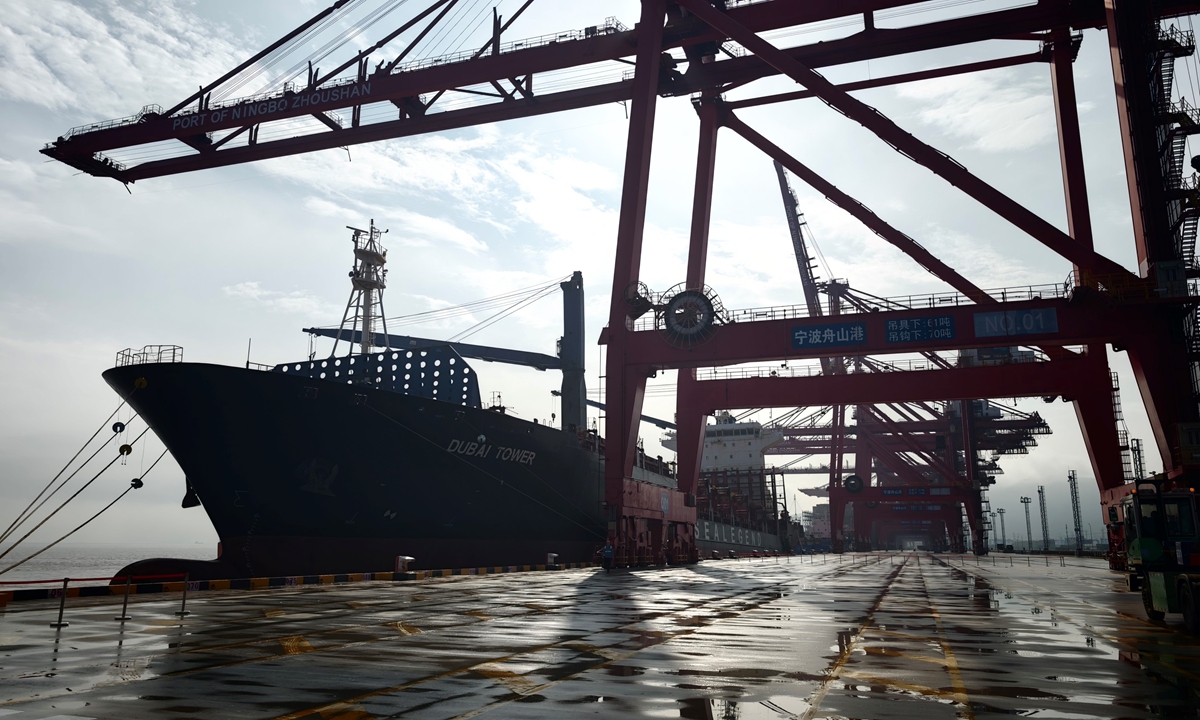
Chinese container shipping company Sea Legend Shipping's container vessel "Dubai Tower" (Photo: Courtesy of Ningbo-Zhoushan Port)
Chinese container shipping company Sea Legend Shipping's container vessel "Dubai Tower" departed Ningbo-Zhoushan Port in East China's Zhejiang Province on Saturday, launching weekly services for the 2026 summer navigation season on the China-Europe Arctic route, a faster and lower-carbon alternative to traditional shipping routes between China and Europe, according to a statement the port sent to the Global Times.
Ningbo-Zhoushan Port was the Dubai Tower's first Chinese port of call on this voyage. The vessel will then call at Felixstowe, Rotterdam, Hamburg and Gdynia, carrying high-value, temperature-sensitive goods—including energy-storage systems, power batteries, solar modules and new-energy components—from manufacturing hubs such as Ningbo and Yiwu to meet Europe's peak-season demand, the port said in the statement.
Compared with the roughly 40-day journey via the Suez Canal, the Arctic route cuts one-way transit time to about 20 days, while reducing exposure to schedule disruptions and rising costs caused by geopolitical tensions.
Chinese port and shipping operators have also signed green-channel agreements with partner terminals in Europe, giving arriving vessels priority berthing and cargo handling and sharply reducing anchorage waits. This helps exporters reduce inventories, free up working capital and meet tight delivery deadlines for orders targeting Europe's Christmas season, per the statement.
Due to natural Arctic ice conditions, the China-Europe Arctic Express has an annual navigation window concentrated between July and October. Port and shipping operators plan to arrange at least eight voyages this year, deploying seven to eight ice-strengthened vessels suitable for Arctic navigation on a rotating basis. Some of the vessels use LNG propulsion to further reduce their environmental footprint.
In the medium to long term, operators plan to maintain four months of regular service each year, continuously upgrade the hardware and software supporting polar navigation, and gradually extend the navigation season. Through regular operations, the route is expected to inject fresh momentum into the stable development of China-Europe trade.
On September 22 last year, the China-Europe Arctic Express between Ningbo-Zhoushan Port and Felixstowe completed its maiden trial voyage. Traveling through the Northern Sea Route, the vessel reached the UK port in 20 days, demonstrating the feasibility of the entire operation, including route navigation, the transport of new-energy-related hazardous cargo and coordination with overseas ports. The voyage marked a significant step by China's port and shipping sector in advancing Belt and Road cooperation and the Polar Silk Road while supporting the country's dual-circulation development strategy.
Building on the trial, operators have spent nearly a year improving operational standards, fleet deployment and supporting port services, enabling the route to transit to regular weekly operations during the seasonal navigation window.