


Before traveling to Xizang Autonomous Region in southwest China, I learned about Tibetan culture only from screens and books. But nothing I had watched or read prepared me to see how the time-honored Shoton Festival, a Tibetan tradition, transcends ethnic boundaries, uniting people and energizing local tourism.
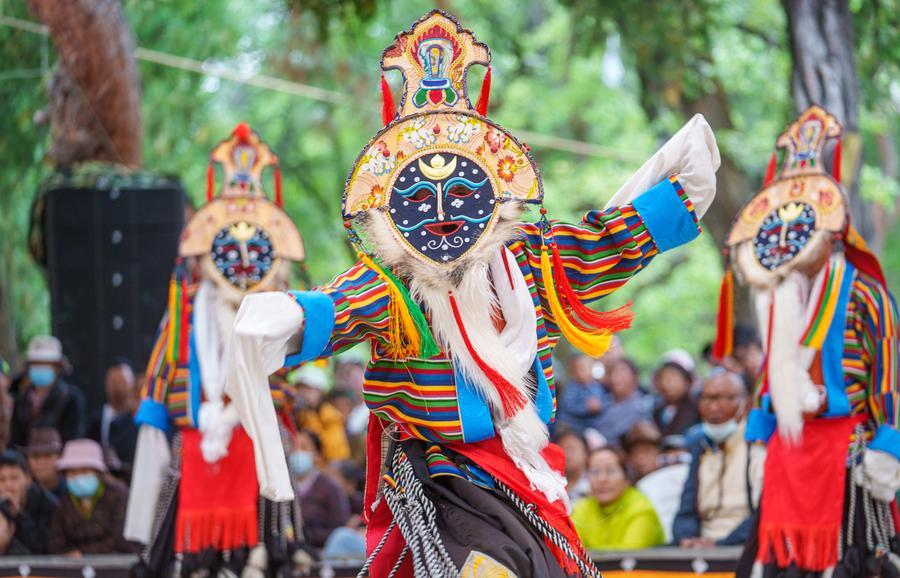
Artists stage a Tibetan opera during the Shoton Festival in Lhasa, southwest China's Xizang Autonomous Region, Aug. 15, 2026. (Photo: Xinhua)
Shoton literally means yogurt banquet in Tibetan. According to Tibetan Buddhist tradition, monks stayed indoors in summer to avoid accidentally treading on insects and harming living creatures. When the retreat ended, locals offered the monks fresh yogurt as alms. Over time, this religious practice evolved into an annual public festival with Tibetan opera, horse races and other events.
Last Wednesday, a grand "Buddha-sunning" ceremony -- the rite of unfurling a giant Buddha thangka in sunlight -- at Drepung Monastery in west Lhasa kicked off the festival, where I witnessed the spectacular gathering.
Though the ritual began at 7 a.m., I arrived at 4 a.m., only to find locals, tourists and foreign visitors had already gathered under the starry sky hours earlier.
At the scheduled time, nearly 100 monks carried a 500-square-meter thangka of the Buddha uphill and unrolled it on a hillside platform. As sunlight fell across the massive artwork, crowds lined up to present white hadas -- traditional Tibetan scarves standing for purity and auspiciousness -- to the giant thangka, praying for peace and blessings.
Among them was Yang, a Shanghai tourist who had queued from 2:30 a.m. Though not a Buddhist, she joined in with a hada gifted by a Tibetan ahead in the queue, a warm gesture of hospitality.
"He invited me to share in the joy of the festival," she said. She told me that she had rearranged her Mount Qomolangma trip for the occasion, which was definitely worth it.
After the ceremony, Tibetan opera performances began at the foot of the mountain. Performers in traditional costumes sang in long, flowing phrases, accompanied by drums.
The troupe's leader, Nyima Tsering, said the group has participated in performances at the Shoton Festival for more than 20 years.
"Our performers farm and herd during the year. When Shoton comes, they come back to the stage to perform and pass down the traditions," he told me.
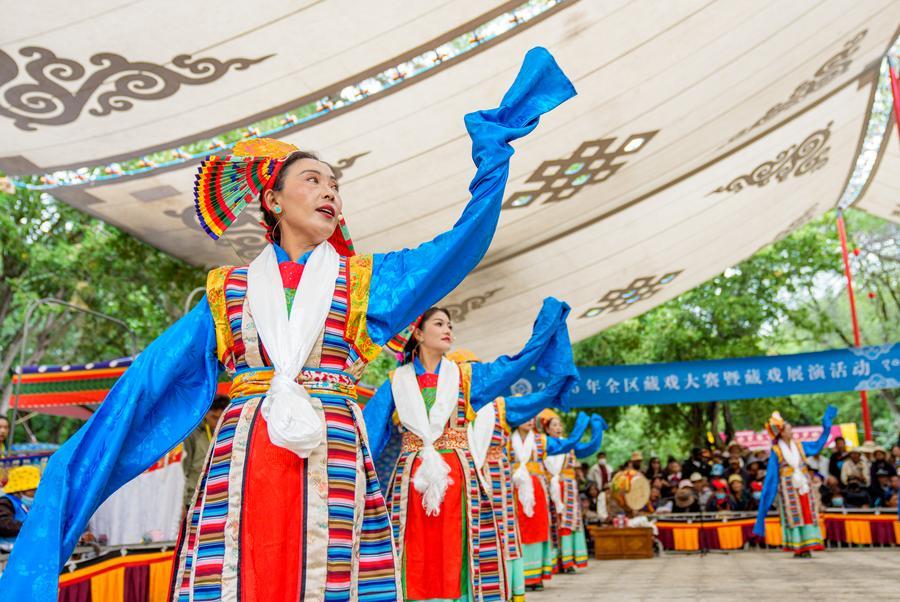
Artists stage a Tibetan opera during the Shoton Festival in Lhasa, southwest China's Xizang Autonomous Region, Aug. 15, 2026. (Photo: Xinhua)
For these performers, Tibetan opera, also a national intangible cultural heritage, is not just a festival showcase. It is something they have lived with year after year -- an important part of their lives.
Over the next few days, at Norbulingka, a UNESCO World Heritage site known as Lhasa's "Summer Palace," and Dzongyab Lukhang Park at the foot of the majestic Potala Palace, other Tibetan opera troupes performed one after another. I could not understand a word of the lyrics. Yet I did not need a translation to sense the surrounding joy, with smiles spreading across faces and applause breaking out from time to time.
Nearby, the festival market buzzed. Stalls offered handicrafts, incense, notebooks and miniature opera masks. Tamdrin, a vendor with a farmers' and herdsmen's cooperative in Lhasa's Dagze District, said festival markets are a key income source for them. The cooperative earned nearly 100,000 yuan (14,733 U.S. dollars) at last year's Shoton Festival, and she expects higher sales amid more visitors this year.
Then, not far from the market, music echoed across an open space. People of various ethnic groups linked hands to dance Guozhuang, the traditional Tibetan dance. As the music played on, the circle swelled to include more onlookers, including those who did not know how to dance.
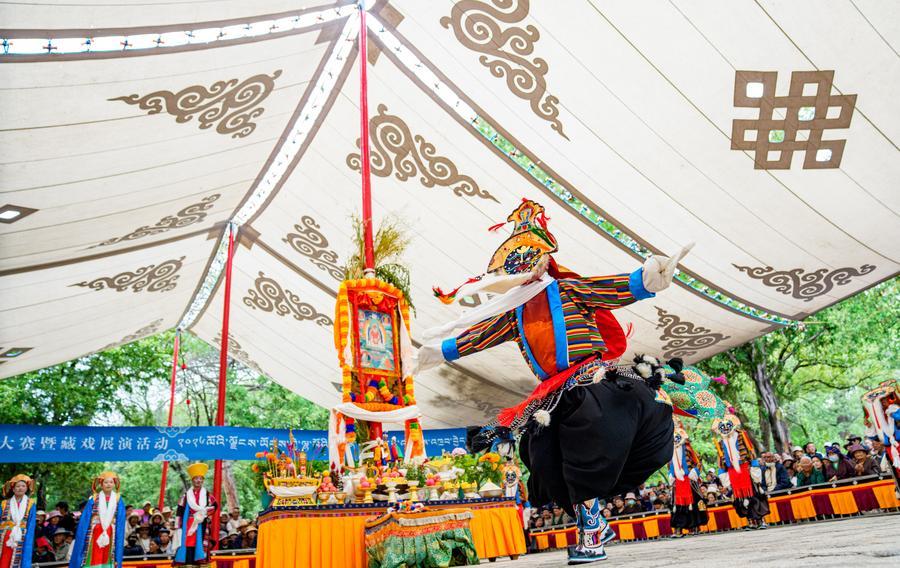
Artists stage a Tibetan opera during the Shoton Festival in Lhasa, southwest China's Xizang Autonomous Region, Aug. 15, 2026. (Photo: Xinhua)
During the festival, a Tibetan family offered me homemade yogurt. I took a spoonful, and the history I had read came alive in this vivid taste on my tongue.
In addition to the weekend, Lhasa residents enjoyed a Friday holiday for the festival, with horse races drawing spectators from near and far.
The Shoton Festival is an epitome of the booming cultural tourism sector across Xizang.
Leveraging local resources, including lucid rivers and lush mountains, as well as rich Tibetan ethnic culture, Xizang received over 70.73 million tourist visits in 2025, marking a year-on-year increase of 10.71 percent, with total tourism revenue up 9.51 percent to 81.68 billion yuan.
What I witnessed during Shoton was not merely a checklist of rituals: the thangka, the opera, the horse racing and the yogurt. It is also a slice of shared life, a moment that brings people together. Tradition in Xizang is not a relic behind glass. It is something still being participated in and remembered every day.