


High tech, equipment manufacturing power China's Jan-July growth
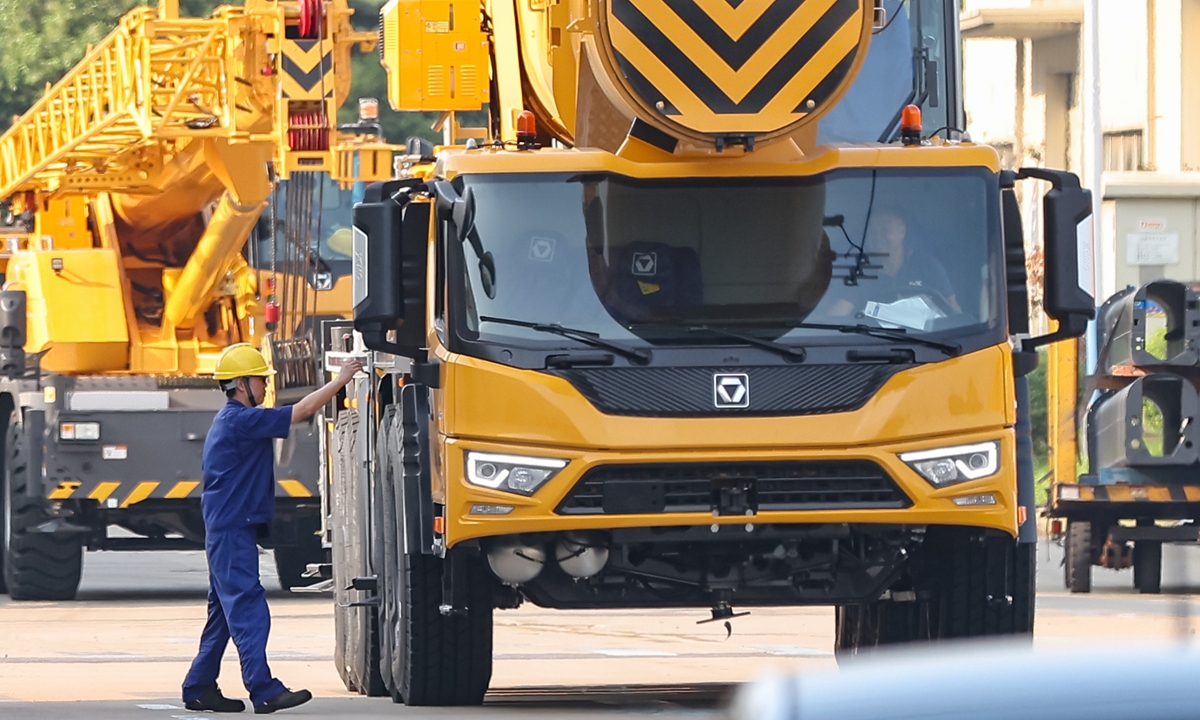
A worker checks finished truck-mounted cranes at a manufacturer in Xuzhou, East China's Jiangsu Province on August 17, 2026. According to China's National Bureau of Statistics, the value-added of industrial enterprises above designated size grew by 4.5 percent year-on-year in real terms in July 2026. (Photo: VCG)
China's economy remained largely stable in the first seven months of 2026 and continued to move toward innovation-driven, higher-quality development, with high-tech manufacturing and equipment manufacturing growing far faster than industry as a whole, official data released on Monday showed.
From January to July, the value-added industrial output of industrial enterprises above designated size expanded by 5.3 percent year-on-year, according to the National Bureau of Statistics (NBS). Value-added industrial output of equipment manufacturing grew 9.7 percent and high-tech manufacturing 13.8 percent, 4.4 and 8.5 percentage points faster than industry overall. Output of 3D printing equipment, lithium-ion batteries and industrial robots jumped 52.3 percent, 40.2 percent and 28.5 percent.
In July alone, value-added output of industrial enterprises above designated size rose 4.5 percent year-on-year, while high-tech manufacturing surged 16.9 percent, and digital product manufacturing climbed 17.3 percent, accelerating by 3.5 points. Equipment manufacturing grew 12.3 percent and made up 38.2 percent of industrial value added, up 2.6 points.
Other readings pointed to broad stability. The services production index rose 4.7 percent, retail sales of consumer goods and services 2.6 percent, and goods trade 17.3 percent. The consumer prices rose 0.9 percent.
Fu Linghui, NBS spokesperson and chief economist, told a press conference in Beijing on Monday that the economy held steady and showed resilience despite continued geopolitical conflicts, an unstable global energy market and extreme weather at home in July.
Whether in the value-added output of investment, consumption or industry, indicators tied to strategic emerging industries significantly led the average growth rate, Hu Qimu, a professor at the Maritime Silk Road Institute of Huaqiao University, told the Global Times on Monday. This fully demonstrates that China's industrial structure is undergoing a profound transformation, with new growth drivers gradually emerging, he said.
Overall growth rates capture only part of the picture, with structural data being more revealing, Cong Yi, a professor at the Tianjin University of Finance and Economics, told the Global Times. Chinese industry is moving toward a fusion of high-end, intelligent and green development, the economist said, with new drivers expanding rapidly even as outdated capacity is phasing out.
Equipment manufacturing, the core of Chinese industry, is upgrading from within, Cong added, with mid- and high-end equipment growing especially fast.
AI accelerates shiftArtificial intelligence has become an accelerator for the shift from old growth drivers to new ones, said Wang Guanhua, NBS spokesperson and deputy head of its department of comprehensive statistics of the national economy.
In July, value added output of integrated circuit manufacturing soared 109.3 percent year-on-year, while aircraft manufacturing, special equipment manufacturing for the electronics industry and electronic special materials manufacturing rose 38.3 percent, 34.8 percent and 30.8 percent. Driven by AI, output of sensors, storage chips, electronic components and optical fiber increased 35.3 percent, 30.2 percent, 23.4 percent and 21.1 percent, while output of industrial robots and robot reducers grew 30.2 percent and 22.7 percent.
Within AI related manufacturing sectors, value added output of electronic components and equipment manufacturing rose 24.7 percent and smart equipment manufacturing 15.1 percent, output of 3D printing equipment climbed 65.7 percent and that of smart wristbands doubled. The electronics sector alone contributed 43.7 percent of July's industrial growth, the largest share among major categories.
New growth drivers represented by high-tech manufacturing and digital product manufacturing contributed 50.9 percent of the expansion in industrial value added in the first seven months, three percentage points more than in the first half, Wang said.
The performance of high-tech and equipment manufacturing reflects AI moving rapidly from a standalone technology into application scenarios, Hu said, with most of the value added and investment in these segments tied to AI algorithms and applications, covering humanoid robots, industrial robots, software and intellectual property.
Capital spending told a similar story. Investment in electronic circuit manufacturing and integrated circuit manufacturing rose 57.7 percent and 11.5 percent, and information services investment grew 19.2 percent, Fu said. Faster commercialization of the low-altitude economy lifted aerospace equipment manufacturing investment 12.3 percent.
Demand-side indicators reflected the shift. Retail sales of wearable smart devices, including AI glasses, more than doubled. Export delivery value of industrial enterprises above designated size reached 1.4 trillion yuan ($196 billion) in July, up 10.4 percent, while mechanical and electrical products made up 63.8 percent of goods exports.
Policy broadens upgradeThe composition of investment kept improving even as the overall number fell. Fixed-asset investment declined 6.7 percent in the first seven months, with the drop concentrated in real estate development, down 19.2 percent. Investment in high-tech industries rose 5 percent and in intellectual property products 9.1 percent, lifting their shares of total investment by 1.2 and 2.1 percentage points respectively, while manufacturing investment made up 26.6 percent of the total.
Fu attributed part of the decline to rainstorms and heat that slowed construction and to the phase-in effects of restructuring, saying investment should be judged by structure, quality and efficiency rather than growth rates alone.
Industrial upgrading will not advance in lockstep, Wang said, with some sectors moving faster than others and the handover between old and new engines still needing time. The task now is to push forward the upgrading of traditional industries, the expansion of emerging ones and the cultivation of future industries in a coordinated way, he said.
The overall development direction will not change, Cong said, with central policy expected to keep backing it through the implementation of major national strategies and enhancing security capacity in key areas, as well as promoting large-scale equipment upgrades and consumer goods trade-in programs.
Smaller private firms need clearer guidance to join the shift, the economist added, and unlocking domestic demand — in consumption as well as infrastructure such as urban renewal and equipment upgrades — should be a policy priority, he noted.
The long-term growth trajectory of the Chinese economy remains unchanged, Hu said. A modest slowdown in headline growth is a normal feature of a gear change between old and new drivers, with the economy still hitting new highs in aggregate size and growth increasingly coming from strategic emerging industries, high-end manufacturing and producer services — storing up strength for higher-quality expansion.
China has a sound foundation and favorable conditions for meeting its annual growth target, Fu said, citing a solid economic base, stronger new drivers and more effective macro policies. The external environment remains complex and the imbalance of strong supply and weak demand persists, he said, adding that counter-cyclical adjustment will be stepped up, domestic demand expanded and supply optimized as a unified national market takes shape.