


Stefan Liller has watched China's development story from the inside for years.
As the resident representative of the United Nations Development Programme (UNDP) in China, he has witnessed a transformation that has lifted hundreds of millions out of extreme poverty and made China a leader in renewable energy and technology.
Now, with the 2030 deadline for the UN's Sustainable Development Goals (SDGs) approaching, he says the world needs more of that progress and greater cooperation to reach those targets.
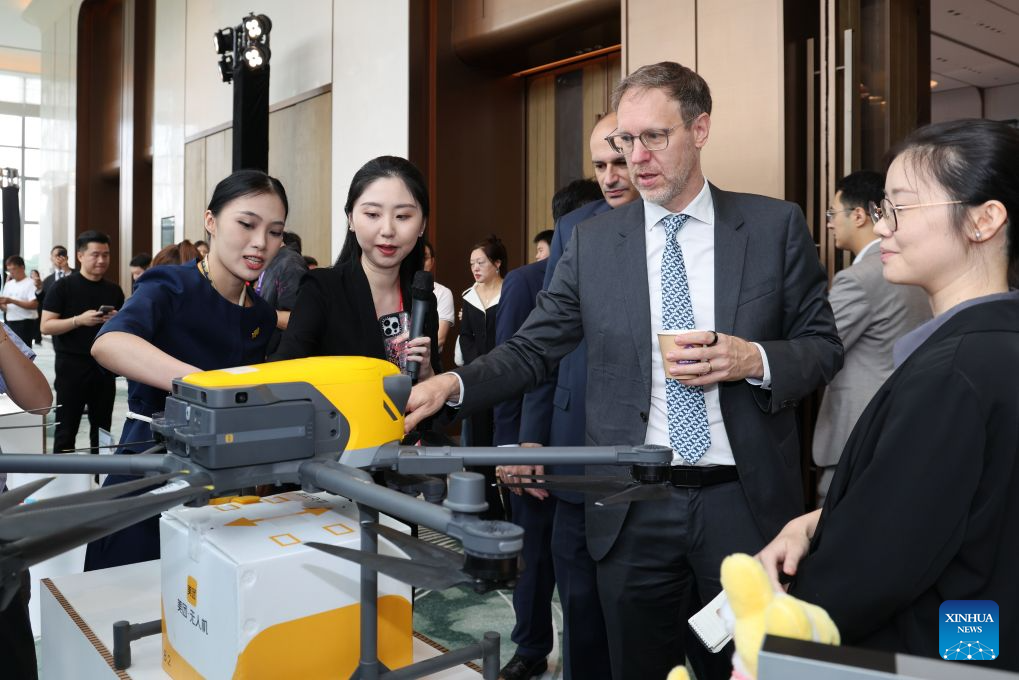
Stefan Liller (second from right, front), resident representative of the United Nations Development Programme (UNDP) in China, learns about Meituan drones at the Asia-Pacific Digital & Intelligent Economy Sustainable Development Innovation Week in Shenzhen, South China's Guangdong Province, July 30, 2026. (Photo: Xinhua)
"These priorities are reflected across major development concepts and longstanding policy objectives, from Ecological Civilization and Beautiful China to Rural Revitalization, and they continue to be reinforced in the country's 15th Five-Year Plan," Liller said in a written interview with the People's Daily.
National and global progress align
The UNDP has partnered with China for more than four and a half decades.
During that time, Liller said the agency has witnessed China's remarkable progress across many dimensions of development, from basic services and education to a green-tech rollout few countries can match.
One important feature of China's development story, he noted, has been its growing emphasis on green and high-quality development, with economic, social and environmental objectives advancing in tandem.
As 2030 approaches, China will play an increasingly vital role not only in advancing its own sustainable development, but also in contributing to global efforts by sharing its experience, Liller said.
China's experience over the past four and a half decades also illustrates how national development and global development can be mutually reinforcing rather than competing objectives, he added.
Cooperation must be demand-driven
Having worked in Latin America, East Africa, Southeast Asia and Central Asia, Liller has seen similar pressures surface everywhere in different forms: inequality, climate change, biodiversity loss, shifting demographics and technological transformation. Financing gaps and tight fiscal space also constrain many countries.
He stressed that there is "no one-size-fits-all pathway to development."
While global partnerships can provide financing, technology and expertise, "lasting progress ultimately depends on national leadership, strong institutions and development strategies that are determined by the countries themselves," he said.
For this reason, the UNDP considers it particularly important that international development cooperation be demand-driven and respond to partner countries' actual development needs and aspirations.
"Development cooperation is most effective when it empowers countries to build their own capacity, strengthen their institutions and pursue solutions that reflect local priorities," Liller said.
Turning goals into local impact
Through the China International Development Cooperation Agency, the UNDP has run more than 35 projects funded by the Global Development and South-South Cooperation Fund, reaching 24 countries across Asia, Africa, Eastern Europe and Latin America, and directly benefiting more than 18 million people.
One example is the UNDP's Livelihoods Support for Urban Poor Communities project in Bangladesh.
The project was designed in close partnership with the Government of Bangladesh to address locally identified priorities, including urban poverty, unemployment, skill gaps among women and youth, and food and nutrition insecurity. It combines immediate assistance for vulnerable households with vocational training, entrepreneurship support and livelihood opportunities aimed at building long-term resilience.
As of June, the project had reached around 387,000 people across six cities. More than 800 beneficiaries received productive assets, including sewing machines, IT equipment and business carts, to help them establish or expand small businesses and generate sustainable income.
For Liller, the project's true value lies less in spreadsheets than in the personal stories behind them.
"These conversations brought the project's impact to life beyond the numbers, demonstrating how improved livelihoods can restore confidence, create new opportunities and strengthen people's hope for the future," he said.
He views the project as a case study in how these elements come together: Bangladesh provides national leadership, local knowledge and the core development priorities; China's Global Development and South-South Cooperation Fund provides vital financial resources; and the UNDP contributes technical expertise, global development experience and implementation support.
Scaling solutions through capacity
Liller noted that the Bangladesh project and other initiatives show the potential of effective South-South and triangular cooperation that leverages the strengths of China, UN agencies and partner countries.
The next step, he said, is to build on this progress and scale up successful solutions.
His approach rests on three pillars.
First, stop treating projects as one-off initiatives. Governments, local communities, businesses, universities and development partners need to unite around shared goals, rather than tackling the same problem in isolation.
Second, make funding go further. Public funding alone cannot close a financing gap of this magnitude. Liller highlights mechanisms like the Global Development Capital Pool as ways to mobilize private and multilateral capital, allowing good ideas to expand beyond their initial budgets.
Third, focus on lasting impact: leave behind the capacity to sustain results.
"Every successful project should aim to strengthen institutions, develop local expertise and build the capacity needed for countries to continue adapting, expanding and improving solutions long after individual projects have ended," Liller said. "This is ultimately what transforms a successful project into a sustainable development model."
"Together with partner countries, we can continue building partnerships that scale innovation, mobilize investment and strengthen national capacities, helping more countries translate shared development ambitions into lasting results for people worldwide, while contributing to broader progress toward the SDGs," he said.
(Compiled by Song Yiran; Edited by Wang Ruofan and Zhan Huilan)