


Every Sunday morning, a pocket park tucked beside a residential compound in North China's Tianjin Municipality comes alive. Neighbors stop by, enthusiasts gather, and seasoned wrestlers square off in bouts of Chinese-style wrestling, also known as liaojiao or guanjiao.
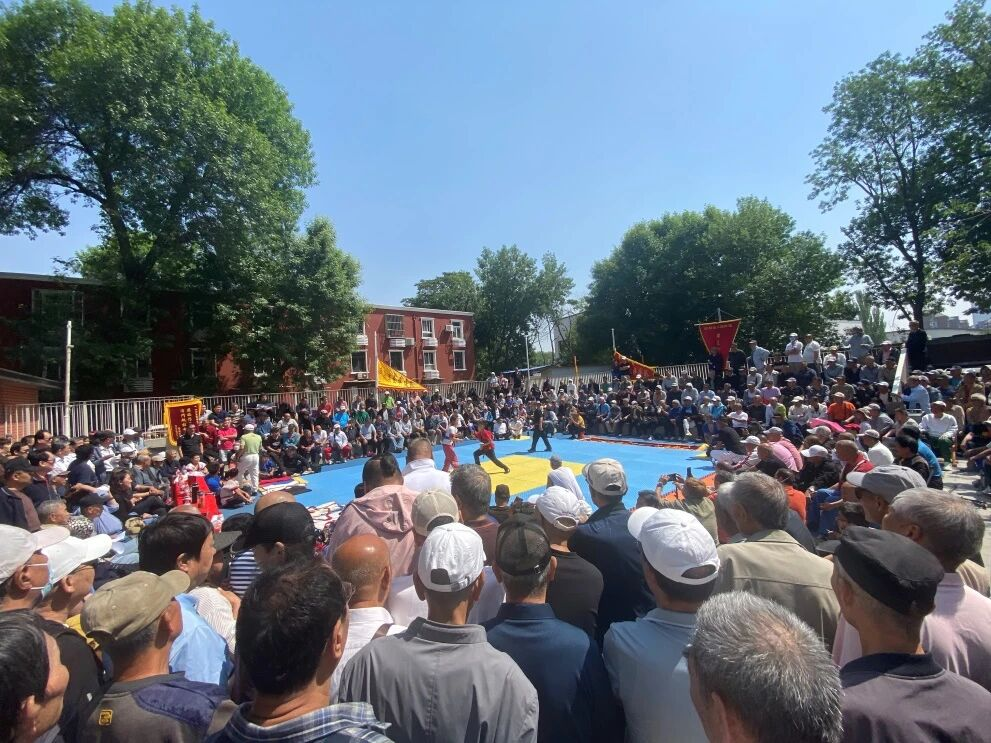
Spectators gather around the wrestling ground during a Sunday session in Tianjin. (Photo: China Urban Regeneration Forum)
Except on bitterly cold, rainy, or snowy days, members of the Jinyou Wrestling Club stage a weekly session here at 10 am, laying mats, welcoming newcomers, refereeing bouts, and explaining the action — all on a voluntary basis. Shortly after 9:30 am on a recent Sunday, a few dozen spectators had gathered. Soon the crowd topped 200.
The traditional sport prizes technique over brute force. Wrestlers often use grips, trips, turns, and shifts in balance to throw an opponent, reflecting a principle usually summed up in Chinese as "using skill to overcome greater strength." Wrestling flourished at the imperial court during the Qing Dynasty (1644-1911), where an official wrestling unit helped develop and preserve the practice, while wrestling traditions also spread and flourished among the wider public. Its modern competitive form took shape in the 20th century from much older wrestling traditions.
In Tianjin, that broader tradition took on a distinctly local character around the city's old transport hubs and wharves near the South Canal. Dockworkers and other laborers took up wrestling for exercise and recreation, with informal grounds springing up on street corners and in sand pits. The tradition helped establish Tianjin as one of northern China's best-known centers of the sport.
That grassroots tradition lives on through the Jinyou Wrestling Club, founded by a group of wrestling enthusiasts in 2003. The club has kept the Sunday gatherings going for more than two decades. After several relocations, the club eventually settled beside the Lixingli residential compound. Once little more than a patch of sandy ground, the site was upgraded in 2025 as part of a local pocket-park renovation project, with a dedicated wrestling platform and stepped seating added for spectators.
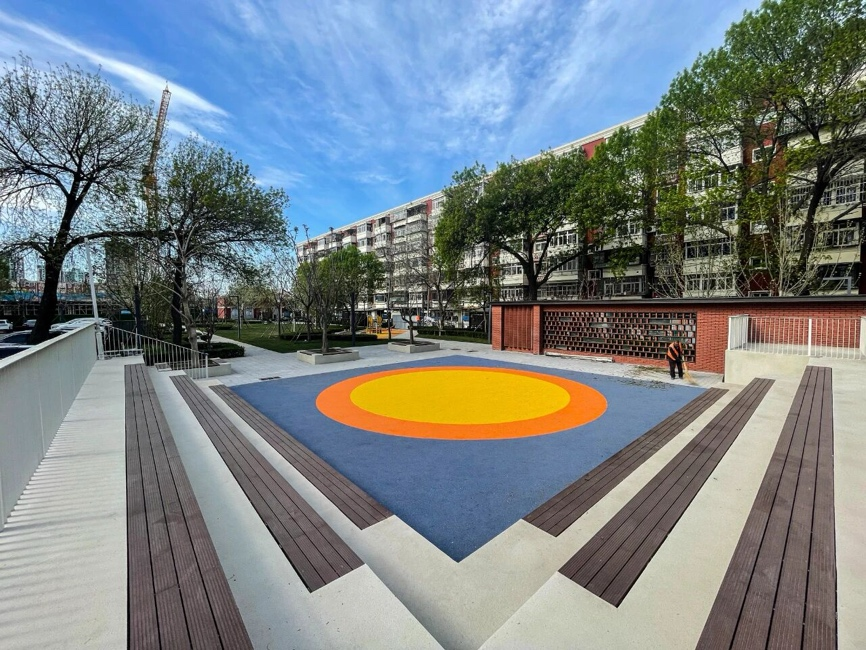
The site was renovated into a pocket park in 2025. (Photo: China Urban Regeneration Forum)
The improved venue now attracts visitors from well beyond the neighborhood. That same Sunday, 63-year-old Tian Jingsheng, a former wrestling coach with the Hebei provincial sports training team, stepped onto the mat for his first friendly bout – his first in more than a year. "Nice move!" someone shouted from the crowd as Tian and his opponent tested grips, shifted their weight, and looked for an opening.
For experienced spectators, the appeal lies not merely in who wins, but in a wrestler's movement, balance, and use of leverage. Yet technique is only part of what older wrestlers hope to pass on. "Salute before the bout, compete on the mat, and remain friends afterwards," goes a lesson often shared with younger practitioners. At 81, Wu Ruichang, a longtime enthusiast, still occasionally steps onto the mat, while 78-year-old Li Deyuan continues to serve as a referee and commentator.
"You can feel the passion and power of wrestling here, but also the warmth of everyday life," Tian said. In this small community park, Chinese-style wrestling is kept alive every Sunday by those who practice, teach, and gather to watch it.
(Compiled by Zeng Xingcheng)