


HEFEI, Aug. 20 (Xinhua) -- Volkswagen Anhui's 100,000th intelligent electric vehicle (EV) rolled off the production line on Tuesday in Hefei, capital of east China's Anhui Province, marking another milestone in the German automaker's electrification push in China.
Volkswagen Anhui is Volkswagen Group's first joint venture in China that focuses on both the research and development (R&D) and manufacturing of new energy vehicles (NEVs).
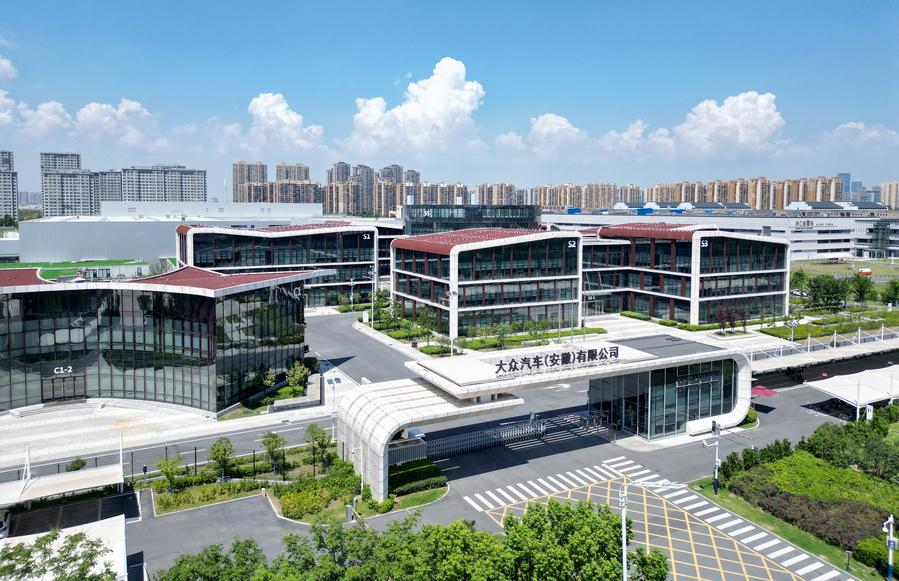
An aerial photo taken on Aug. 20, 2023 shows a view of Volkswagen (Anhui) Automotive Company Limited in Hefei, east China's Anhui Province. (Photo: Xinhua)
"The 100,000th vehicle is far more than a number," said Miroslav Khula, CEO of Volkswagen Anhui. "We will continue to unlock the synergies between German engineering and local innovation, delivering higher-quality products to our customers."
Competition in China's NEV market has evolved beyond product specs and pricing into a multi-dimensional battlefield that spans software, intelligent driving, electronic and electrical architecture, and even supply chain coordination.
The landmark 100,000th EV is an ID. UNYX 08, the first model co-developed by Volkswagen and its Chinese partner XPENG. It went into mass production at Volkswagen Anhui's Hefei plant in March, equipped with localized cutting-edge technologies including 800-volt ultra-fast charging and enhanced L2-level assisted driving.
Volkswagen Group has invested more than 3.5 billion euros in Hefei, where its Volkswagen Group China Technology Company (VCTC), the group's largest R&D center outside Germany, is located, housing about 3,000 R&D professionals.
The zonal electronic and electrical architecture co-developed by VCTC, CARIAD China and XPENG, known as China Electronic Architecture, was delivered at the end of 2025, taking just 18 months from concept to production, the fastest development timeline Volkswagen Group has ever achieved for a brand-new electronic and electrical architecture.
This marks a shift in which global automakers are no longer just manufacturing in China -- they are now integrating their Chinese partners' technological capabilities into their core R&D systems.
Hefei, where Volkswagen Anhui is based, is a key hub in China's NEV industry. In 2025, the city produced over 1.37 million NEVs, the most among all Chinese cities. It is home to major carmakers including JAC, BYD and NIO, along with a supply chain spanning power batteries, automotive electronics and intelligent driving, serving as a nexus between China's market and Volkswagen's global operations.
The all-electric CUPRA Tavascan is Volkswagen Anhui's flagship model for export to Europe, with the Hefei plant the sole global production site. In February, the European Commission accepted Volkswagen Anhui's price undertaking, allowing the CUPRA Tavascan to enter the European market exempt from countervailing duties of up to 20.7 percent.
Volkswagen Anhui's experience is not an isolated case. General Motors recently extended its joint venture with Chinese partner SAIC Motor by 20 years, following a similar move by Honda Motor and China's GAC Group, which renewed their partnership through 2038.
These back-to-back extensions reflect global automakers' confidence in the long-term value of the Chinese market, and, more significantly, their recognition that China's R&D, manufacturing and supply chain capabilities are poised to support their global operations.
According to Khula, under its dual-engine strategy of growing its China business and expanding overseas export, Volkswagen Anhui is strengthening its all-electric ID. UNYX lineup and accelerating the series production and delivery of next-generation intelligent connected vehicles in China, while drawing on the strengths of China's NEV supply chain and intelligent manufacturing ecosystem, particularly in Hefei, to support the group's global production layout.
China's NEV production and sales reached more than 7.43 million and 7.44 million units, respectively, in the first half of 2026, up 6.7 percent and 7.3 percent year on year, according to the China Association of Automobile Manufacturers. NEV exports, meanwhile, surged to over 2.35 million units in this period, a 120-percent increase from a year earlier.
Volkswagen Group plans to speed up its China push in 2026, with more than 20 NEV models across its brands set to hit the market in quick succession, the company added.