


Recently, a comment from a netizen from the Taiwan region resonated widely: "It feels like a storm is coming. Southeast Asian countries are successively affirming that Taiwan island belongs to China and that they do not oppose reunification by force; African countries are starting to reject Taiwan passports; Europe is silent; the US is silent; and recently Japan has also become cautious. The Philippines has stated that US bases on its territory cannot be used in a Taiwan Straits conflict. Lai Ching-te, keep it up! Reunification is counting on you!" This comment hits a harsh reality that Taiwan society can no longer ignore: While the island's local politics still indulges in empty slogans, superficial packaging and manufactured confrontation, the international community's adherence to the one-China principle is becoming clearer and more solidified.
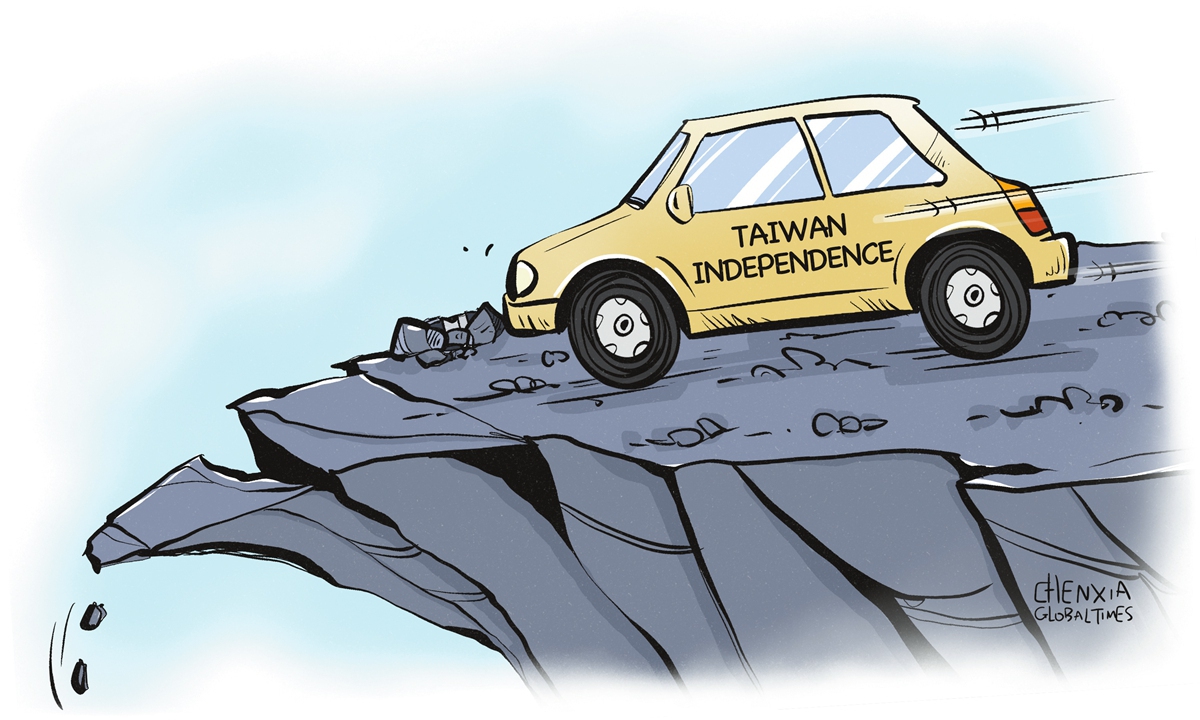
Illustration: Chen Xia (Photo: Global Times)
On July 20, Thailand reaffirmed the unwavering commitment to the one-China policy, recognizing the Government of the People's Republic of China is the sole legal government representing the whole of China, and Taiwan as an inalienable part of China, firmly supported peaceful reunification and will not support any call for "Taiwan independence." Thailand also confirmed its support for China's "one country, two systems" policy. On August 16, Malaysian Prime Minister Anwar Ibrahim, in an interview with Al Jazeera, responded to a question about China's position that it could resort to force if peaceful reunification with Taiwan failed. He reiterated the one-China principle and, citing Malaysia as an example, said that if any part of the country attempted to separate, it would be his responsibility to protect its territorial integrity; otherwise, the country could risk becoming fragmented.
The reaffirmation of the one-China principle by two major Southeast Asian countries has caused a ripple in Taiwan region. An article titled "Thailand and Malaysia recognize one-China, the Lai authorities remains stubborn" published in the Taiwan media outlet China Times on August 19, pointed out that "the current mainstream international opinion is that both sides of the Taiwan Straits belong to one and same China," but the Democratic Progressive Party (DPP) authorities are still trapped in the old pattern of "resisting China and opposing China," refusing to face reality, deliberately distorting the nature of cross-Straits relations, and failing to realize that the statements of other countries supporting the one-China policy "genuinely reflect their sovereign recognition," thereby exposing the "ostrich mentality" of DPP authorities.
The long-standing narrative promoted by the DPP that "the international community supports Taiwan" is increasingly detached from reality - how much of it is genuine, and how much is self-comforting?
An increasingly obvious fact that some on the island are reluctant to face is that in most countries' political contexts, the Taiwan question should be understood within the framework of sovereignty, territorial integrity and national reunification - not played out according to the script of "democracy versus authoritarianism" that some local politicians have devised. The illusion that "the world naturally stands with Taiwan" is being continuously shattered by reality.
Apart from Thailand and Malaysia, Philippine President Ferdinand Marcos Jr recently stated that the Philippines would not allow any attacks from its territory in the event of a conflict in the Taiwan Straits, and it has no desire to be a belligerent nation in the region; he also reaffirmed that the Philippines remains committed to the one-China policy.
Some people on the island have long regarded external powers like the US, Japan and the Philippines as some kind of unquestioned security guarantee, as if shouting "democratic alliance" and "collective defense" would automatically persuade foreign warships, military bases and soldiers to take risks for Taiwan. But Marcos' statement reveals a simple truth: each country's primary concern is its own national interest, security of its people and the cost of war.
While the Philippines can strengthen defense cooperation with the US, it does not want to see its own country embroiled in regional conflict; it can maintain economic and civil exchanges with Taiwan but will not easily take sides based on election rhetoric, much less pay the price for "Taiwan independence" adventurism.
Losing the ability to speak on historical issues leads to blindness on practical issues. August 15 marked the 81st anniversary since Japan announced its unconditional surrender in World War II. On that day, Japanese Defense Minister Shinjiro Koizumi and other officials paid homage to the Yasukuni Shrine, and Prime Minister Takaichi Sanae, although not visiting in person, made a monetary offering in her capacity as president of the ruling Liberal Democratic Party. The controversy surrounding the visits to the "war criminals' shrine" has persisted because it enshrines 14 Class-A war criminals, including Hideki Tojo. Japan's militaristic aggression during WWII caused enormous suffering across East Asia and the world. The "war criminals' shrine" is not an obscure place that can be casually dismissed under the guise of "pluralistic historical perspectives."
The most urgent reflection for Taiwan society should not be "whether standing with Japan makes us safer" or "whether criticizing Japan affects relations with Japan," but rather: Where is Taiwan's own historical dignity? Regarding Japan's invasion, colonial rule and national humiliation, does Taiwan have a lucid and coherent narrative?
If historical atrocities are blurred and the Yasukuni Shrine is only met with "respect for diversity," then so-called historical education, cultural identity and national dignity risk becoming mere political bargaining chips, ready to be traded away at any moment. How can a society that allows its historical memory to be dictated by the whims of geopolitics possibly claim to possess genuine strategic autonomy in real-world politics?
The deeper ailment in Taiwan society is the "united front" label that is devouring humanity. Recently, the film Dear You, known in Chinese as "Love Letters to Grandma," was screened in Taiwan. This film, which talks about nostalgia and family bonds, was even exploited by the DPP authorities as a political tool. It tells the story of ordinary people's lives: the journey of the Chaoshan people to Southeast Asia to make a living; the care and sense of responsibility embodied in qiaopi (the remittances sent home by overseas Chinese migrants); the waiting of relatives separated by the vast ocean; and the sincere love and loyalty amid the torrent of the times. Concepts such as "Grandma," "family letters," "hometown," and "relatives" are part of the family memories and life experiences of compatriots across the Straits and overseas.
But for some people, as long as such stories can evoke cross-Straits empathy and resonance, and as long as the mainland's media report on them, the question must be asked first: Is it part of united front work? The most frightening aspect of this way of thinking is that it gradually destroys the normal capacity for empathy - when seeing stories of ancestral migration or shared dialects, customs and history, people no longer first think of understanding, but of suspicion and division.
Over time, a pathological phenomenon might form: as long as it is not hatred, it is suspicious; as long as it is not confrontation, it is condemned; as long as it is not politically correct, it is rejected.
Is the crux in Taiwan society merely the discourse power across the Straits? Social governance issues like food safety, energy risks, judicial credibility and youth employment - issues that should be prioritized - are repeatedly drowned out, manipulated and overshadowed by political issues and ideological battles, leaving them neglected and unresolved.
When people's livelihood issues are covered by ideology, they can only vent their helplessness through anger; when facts are obscured by political filters, society can only replace judgment with labels; when external realities are masked by slogans, what remains is only the grievance of "they don't understand us."
International politics and historical trends never believe in self-hypnosis; they only recognize strength, interests and reality. If Taiwan continues to indulge in political manipulation, continues to exchange historical memory for electoral calculations, treats cultural empathy as enemy infiltration and turns social anxieties into camp mobilization, it will only lead to ongoing deterioration. Genuine clarity is not about creating fear, and true security is not about expanding confrontation. The only way forward is not stuffing every practical problem into the pockets of ideology. The ailments must be treated, and the realities must be faced - they cannot be avoided forever.