


China will introduce a new package of policies and measures to further expand domestic demand and strengthen the momentum of economic growth, China's Vice Minister of Finance Liao Min disclosed on Friday.
Speaking at a press conference, Liao said the ministry will formulate and roll out practical and effective new policy measures in a timely manner in light of macroeconomic developments in the latter half of the year.
The country's fiscal policies will continue to focus on accelerating fund use, expanding domestic demand, and strengthening fiscal reform and management, the vice minister stressed.
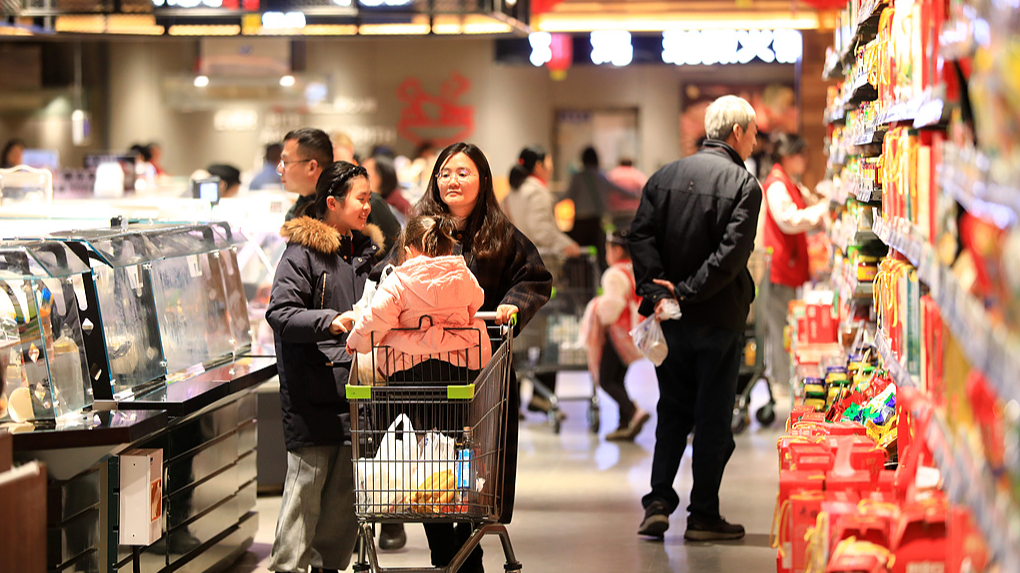
People shop at a local supermarket, Huai'an city, east China's Jiangsu Province, February 27, 2026. (Photo: VCG)
Expanding domestic demand has become increasingly important for China to sustain economic growth and strengthen its economy's resilience amid external uncertainties.
Liao said China has long been the world's second-largest consumer market for goods and the largest online retail market. It is also one of the world's major import markets for consumer goods, with products from countries around the world enjoying strong popularity among Chinese consumers.
As people's incomes continue to rise, consumer demand has become more diversified, Liao said. Services consumption, green consumption and new forms of consumption have emerged as bright spots, while tourism, performances and sporting events have remained popular.
Products such as smartwatches and smart glasses are also widely sought after, with sales posting multifold growth. All these trends demonstrate the strong endogenous momentum of China's consumer market, Liao said.
China has continued to expand domestic demand through multiple measures. So far this year, the ministry has allocated 187.5 billion yuan (about 27.65 billion U.S. dollars) to support consumer goods trade-in programs, helping generate 178 million purchases with a combined sales of approximately 1.32 trillion yuan.
China has also introduced interest subsidies for personal consumption loans and loans to service-sector business entities, while supporting employment and entrepreneurship among key groups.
Efforts have also been made to improve the consumption environment by advancing the development of pilot cities for modern commercial circulation systems and piloting new forms, models and scenarios of consumption.
Liao said China has optimized the implementation of coordinated fiscal and financial policies to boost domestic demand, with the new measures taking effect on Aug. 1.
The measures broaden the scope of interest subsidies for consumer loans. New credit-card installment purchases, including those for cars and home decoration, are now eligible for policy support.
The number of financial institutions handling interest subsidies for loans to micro, small and medium-sized enterprises and service-sector businesses has increased from about 100 to around 400, Liao said.
The measures also raise the loan caps under the interest subsidy policy, from 50 million yuan to 75 million yuan for micro, small and medium-sized enterprises, and from 10 million yuan to 20 million yuan for service-sector businesses. Liao said the interest subsidy ceiling for personal consumption loans has also been raised from 3,000 yuan to 5,000 yuan.
The Ministry of Finance, in line with economic development needs, is continuing to formulate new coordinated fiscal and financial policies and measures, which will be rolled out in the second half of this year, said Liao.