


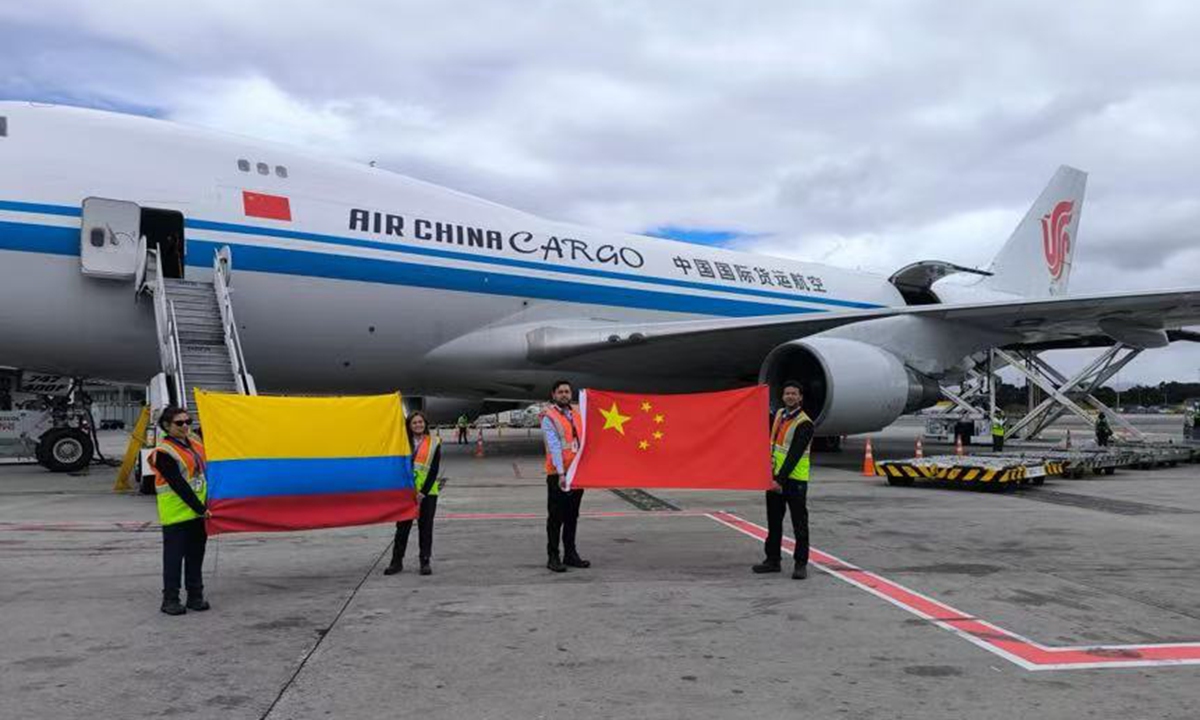
Photo: Chinese Embassy in Colombia
Following the earthquake in Colombia earlier this month, the Chinese government has delivered emergency humanitarian earthquake relief supplies to the country. Chinese Ambassador to Colombia Zhu Jingyang told the Global Times on Saturday that the two countries' support in the face of natural disasters vividly embodies the spirit of a community with a shared future for humanity.
A magnitude-7.5 earthquake struck northwestern Colombia on August 10, according to China Earthquake Networks Center, with 32 cities severely affected.
Chinese Embassy in Colombia said that the emergency humanitarian relief supplies provided by the Chinese government arrived at El Dorado International Airport in Bogota at noon on August 18. The roughly 80-ton shipment included generators, water purification vehicles, disinfection equipment, solar lighting equipment, tents and blankets.
Chinese Ambassador to Colombia Zhu told the Global Times on Saturday that the hardest-hit areas faced complex challenges.
Choco, the epicenter, is one of Colombia's least-developed regions, making reconstruction difficult. Valle del Cauca, the country's second-most populous department, was widely affected. Pereira, capital of Risaralda, suffered numerous building collapses and the highest death toll. "Our embassy has tailored and carefully organized the relief effort, and the humanitarian supplies provided by the Chinese government have been delivered to the Colombian side," Zhu said.
With strong assistance from COSCO Shipping, the embassy worked with Colombian authorities to transport and distribute the supplies to victims in Valle del Cauca.
Heavy machinery from Chinese companies arrived in Pereira shortly after the earthquake to assist with rescue and debris clearance, while Chinese companies in Colombia spontaneously donated and transported supplies to Choco, ensuring Chinese assistance reached all major disaster areas, and fully demonstrating China's humanitarian care and its sense of responsibility as a major country, Zhu introduced.
China's relief efforts drew an enthusiastic response in Colombia. Zhu said that, according to incomplete statistics, most major Colombian media outlets and several major international media extensively covered China's cash and emergency humanitarian assistance.
Posts on the embassy's social media accounts have garnered nearly 8 million views. Many Colombians spontaneously expressed their gratitude, while regional media, self-media and opinion leaders produced articles, graphics and videos promoting China's relief efforts and calling for the new government to strengthen cooperation with China and safeguard bilateral friendship.
"Recognition from the Colombian people shows that China-Colombia friendship is deeply rooted in people's hearts," Zhu said. "Strengthening bilateral cooperation has become a consensus across regions and sectors. China-Colombia ties are not affected by changes of government, and the two countries' support in the face of natural disasters vividly embodies the spirit of a community with a shared future for humanity, where nations stand together through storms and share weal and woe." Zhu also cited a Pew survey showing public favorability toward China among Colombians has reached a record high.
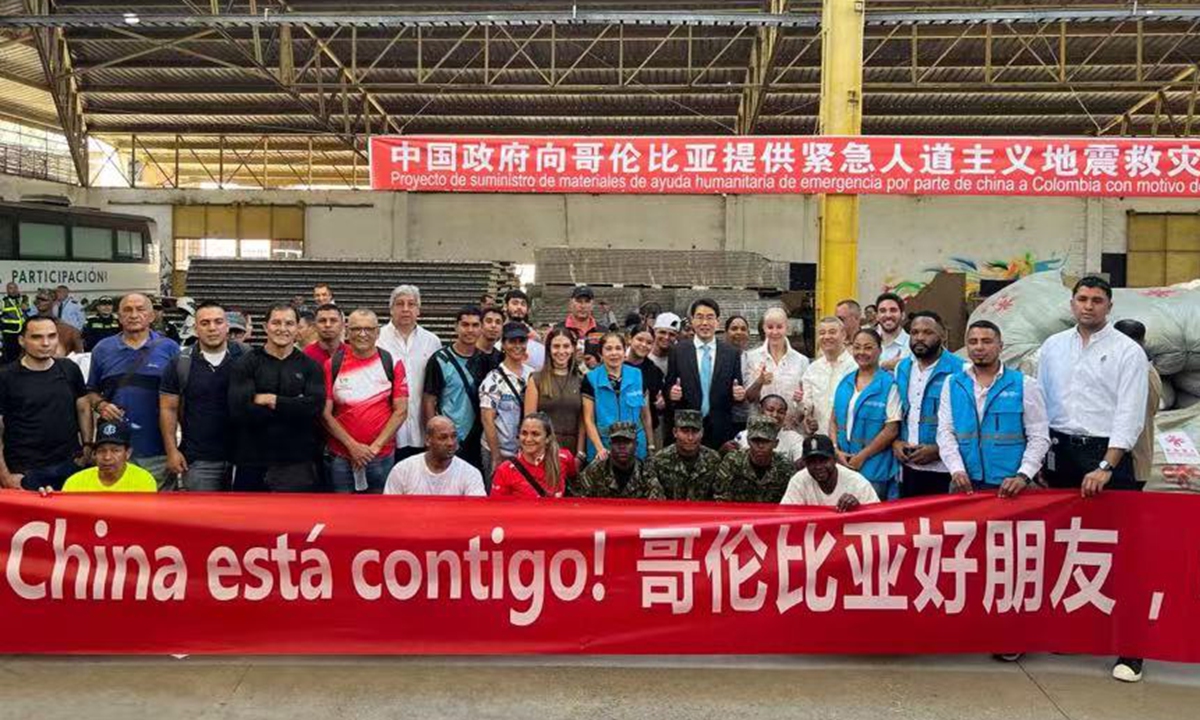
Photo: Chinese Embassy in Colombia
On the day of the earthquake, the embassy also received an urgent request from the Hong Kong SAR government to help locate a Hong Kong resident's family that had lost contact in Cali, Zhu said.
Despite communications disruptions, the embassy contacted them within hours and confirmed they were safe. After some Chinese-owned shops reported collapsed or cracked exterior walls, the embassy organized community groups to conduct targeted assessments and aid. It also issued multiple consular advisories, urging Chinese nationals to avoid non-essential travel to affected areas and guard against aftershocks, health hazards and other secondary risks.
In the interview, Zhu urged Chinese nationals in Colombia and those planning to visit to remain vigilant, noting the country's serious security situation and successive natural disasters, including earthquakes, forest fires and volcanic eruptions.
He also urged them to avoid complacency, noting that one department remains at extremely high risk and 18 other remain at high risk, strengthen safety precautions and emergency preparedness.