


China's captive-bred population of green peafowl, a national first-class protected species, has surpassed 100 birds, marking new progress in preserving the germplasm resources of an endangered species and protecting biodiversity in southwest China's Yunnan Province.
The green peafowl, native to China, once numbered fewer than 500 in the wild and was included on a list of 48 critically endangered species under emergency protection by the National Forestry and Grassland Administration (NFGA) during China's 14th Five-Year Plan period (2021-2025).
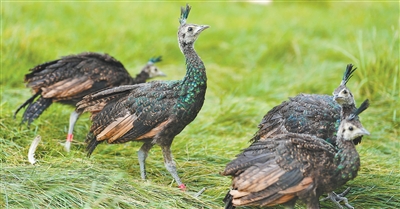
Photo shows young green peafowl, a national first-class protected species, in southwest China's Yunnan Province. (Photo: People's Daily)
China has been working since 2020 to establish a captive breeding population of green peafowl. Over the past three years, the hatching rate has reached about 70 percent, and offspring from the first captive-bred generation have begun producing chicks of their own, a sign that captive breeding techniques are gradually maturing.
Finding purebred green peafowl proved difficult from the start. Peafowl in Chinese zoos are overwhelmingly blue peafowl or hybrids, after years of introductions of the non-native blue species. Genetic testing showed that even birds resembling green peafowl in appearance often carried blue peafowl genes. Capturing green peafowl from the wild was equally risky, given the small size of the remaining wild population.
A breakthrough came in 2020, when the NFGA transferred five rescued green peafowl to the Yunnan Wildlife Rescue and Breeding Center. Genetic testing confirmed that all five were purebred and could be divided into breeding pairs and trios based on their lineage.
Researchers built enclosures that shielded the birds from bright light and loud noise and closely mimicked their natural habitat, including hidden groves, raised perches and sand-bathing pits.
Early results were inconsistent. The first hatching season in 2021 produced five chicks, but 2022 saw a complete hatching failure, and the hatching rate in 2023 was just 15 percent.
Researchers traced the setbacks to inadequate nutrition for breeding birds, delays between egg laying and incubation, and imprecise temperature and humidity control. Improved diets, faster transfer of eggs to incubation, high-precision incubators and supplemental oxygen for late-stage chicks pushed the hatching rate to 73.85 percent in 2024, when 48 chicks hatched.
In 2025, the center collected 102 eggs and hatched 68 chicks, with the hatching rate stabilizing at about 70 percent and a survival rate of 81.25 percent. The results pushed the national captive population past 100.
Challenges remain, however. About 30 percent of hatched chicks have shown deformed toes, making them unsuitable for future breeding.
"This season, we shifted our focus from quantity to quality," said Lu Lin, head of the center's wildlife rescue and breeding department. So far this year, the center has hatched another 54 chicks, and its work has shifted entirely toward improving chick health, with the focus now on raising survival rates and reducing deformities.
The center has significantly improved chicks' skeletal development by upgrading its rearing facilities, replacing traditional bedding with specialized sheet-style bedding and adding supplemental lighting to mimic natural conditions.
The ultimate goal is to preserve the species' germplasm resources and prepare green peafowl for eventual release into the wild. That effort is underway, with natural-hatching trials and trackers fitted to six birds undergoing rewilding training.