


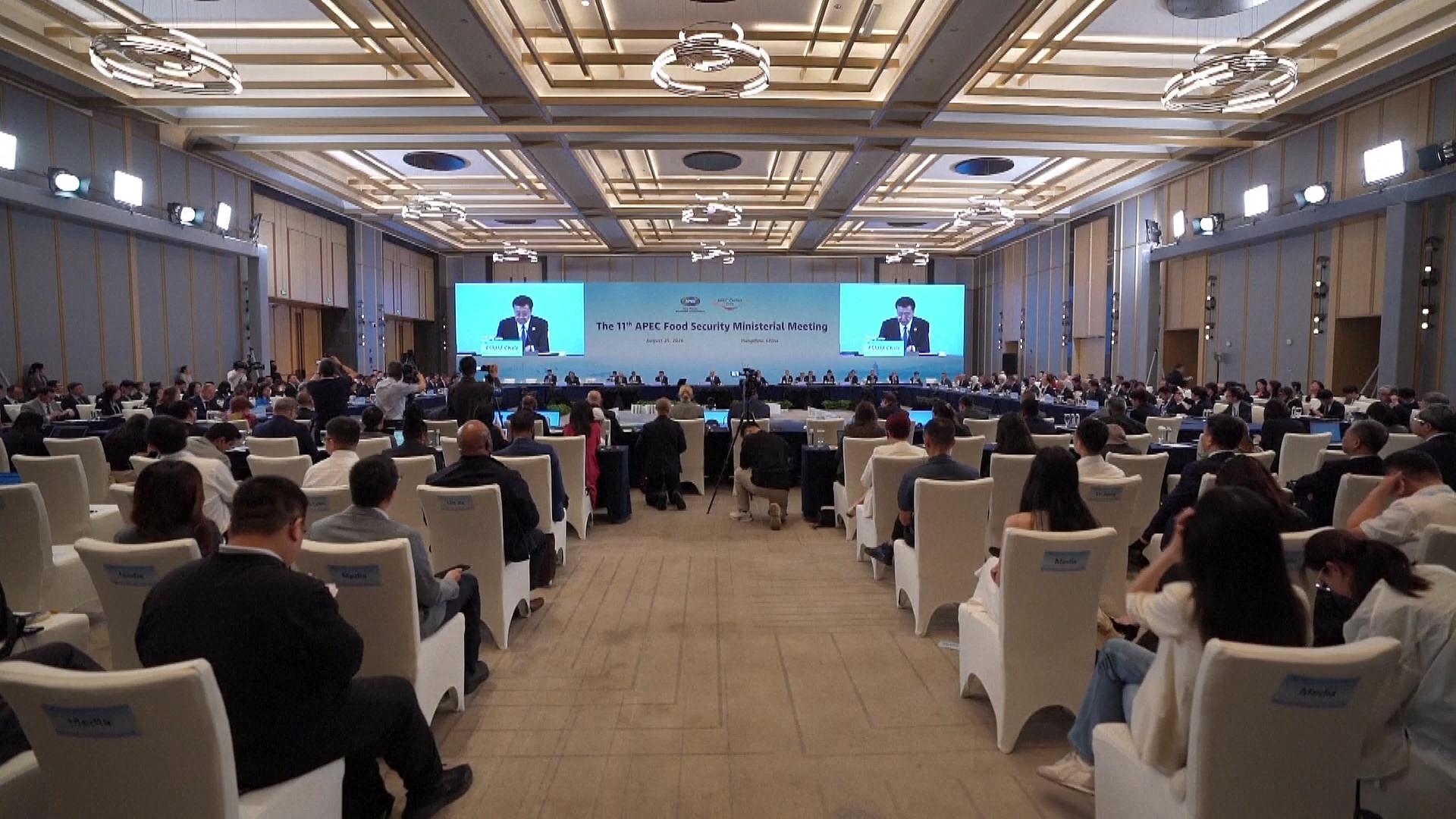
The 11th APEC Food Security Ministerial Meeting is held in Hangzhou, east China's Zhejiang Province, August 25, 2026. (Photo: VCG)
Home to half the global population and a majority of the world's food production and consumption, the Asia-Pacific region is facing mounting pressure on its agri-food systems. Economic volatility, persistent supply chain disruptions, resource constraints and increasingly frequent extreme weather events are all testing the ability of economies to keep food supplies stable in an era of growing uncertainty.
Against this backdrop, the 11th APEC Food Security Ministerial Meeting in Hangzhou on Tuesday endorsed a new set of principles that place innovation and digital technologies, including artificial intelligence (AI), at the center of efforts to build more resilient food systems across the region.
The principles encourage economies to use data and science to improve decision-making, strengthen early warning and response capabilities, and apply digital and emerging technologies across the agri-food value chain, from production and processing to distribution.
The approach reflects a broader shift in how food security is being addressed. Instead of focusing only on increasing output, APEC economies are also looking at how technology can help farmers respond to changing weather patterns, manage resources more efficiently and make food supply chains more resilient to disruptions.
Eduardo Pedrosa, executive director of the APEC Secretariat, said economies across the region are drawing on shared experience as they adapt to changes affecting food production and supply chains.
"There are a lot of lessons that have been learned about how the economies in the APEC region have been adjusting to these changes," Pedrosa said. He pointed to examples including biotechnology and precision agriculture, while stressing that the core purpose of these technologies is to ensure farmers benefit from advances.
Pedrosa also cited practical applications such as blockchain technology in agricultural payments and transactions.
The focus on tech-enabled food security aligns with China's priorities for its 2026 APEC host year, where innovation and digitalization are cross-cutting themes across all tracks. Discussions on agricultural technology and digital innovation have also been featured in this year's APEC meetings, including the Third APEC Senior Officials' Meeting (SOM3) in Dalian earlier this month.
Ministers attending the meeting also adopted a joint statement emphasizing the need for sustained innovation and investment to improve food quality, productivity and efficiency, as part of broader efforts to build more resilient agri-food systems across the Asia-Pacific.