


JINAN, Aug. 28 (Xinhua) -- In a greenhouse in Shouguang, east China's Shandong Province, a robot dog patrols the aisles. Its cameras scan bell pepper leaves for early signs of disease -- spotting problems days before they become visible to the human eye.
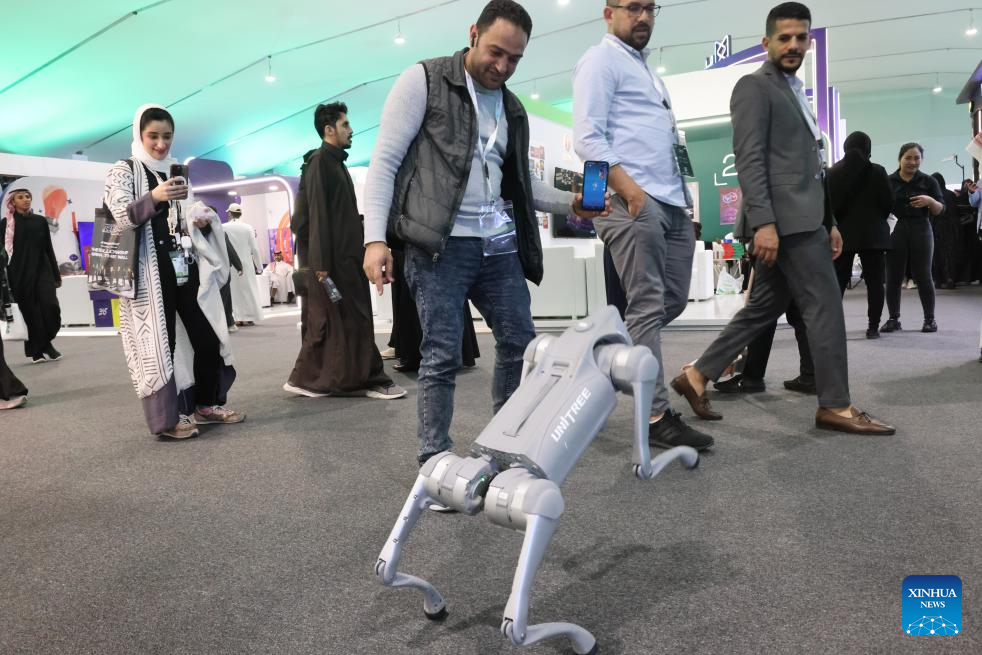
People watch the performance of a robot dog launched by the Chinese company, Unitree Robotics, at the Future of Media Exhibition in Riyadh, Saudi Arabia, on Feb. 20, 2025. (Photo: Xinhua)
Shouguang, a county-level city under Weifang, Shandong, is the country's vegetable powerhouse. With an annual production of 5 million tonnes, it grows enough vegetables to feed more than 40 million people -- over 30 times its own population.
For decades, the city has supplied vegetables to dining tables across China. Now, technology is reshaping its vegetable-production sector, with the changes rippling far beyond the city itself.
ROBOTS TRANSFORM GREENHOUSE FARMING
Growing vegetables used to be backbreaking work. Yield and quality depended on the constant tracking and adjustment of ventilation, lighting, irrigation and fertilization in greenhouses -- tasks that were largely carried out manually. But with the help of a highly automated system, farmers can now monitor and control greenhouse conditions with just a few taps on a smartphone.
The robot dog and its synergy with other unmanned equipment have been the transformative forces. Equipped with high-definition cameras, the quadruped robot detects crop diseases caused by pests or unfavorable microclimate earlier than human worker can. Once an anomaly is detected, specialized robots move in to spray pesticide or fertilizer. The timely intervention has reduced the use of these agrochemicals by 35 percent, according to Wang Yihong, operations manager of Weifang Yuntu Tech Co., Ltd., the developer.
The high-tech greenhouse, due to its precise management of temperature and humidity, boosted production by 5 to 15 percent and improved overall efficiency by 20 to 30 percent, said Li Guangju, a senior agronomist with the local agriculture and rural affairs bureau.
"Robot dogs are becoming increasingly popular on large farms," said Wang, adding that they can cover a daily service area 10 times larger than human growers. The firm has since extended the project beyond Shandong, into central China's Henan Province and northwest China's Xinjiang Uygur Autonomous Region.
Today in Shouguang, 85 percent of newly built greenhouses are empowered by Internet of Things technology, which facilitates smart agriculture, according to local agricultural and rural affairs bureau.
TECHNOLOGY POWERS PRECISION BREEDING
While bustling robots are the most visible face of Shouguang's transformation, a deeper revolution is taking root in its laboratories, where cutting-edge science is turning seed development into precision engineering.
Though being a vegetable powerhouse, Shouguang once relied heavily on imported seeds. With international seed companies holding a dominant market position, local growers faced volatile profits. To break free from this dependency, local seed companies ramped up their own innovation efforts.
Shouguang Sanmu Seed Co., Ltd., once a simple seed distributor, has evolved into a comprehensive biotech enterprise. Working with universities and research institutes, it has developed a tomato variety that slashes production costs by three-quarters. It now holds 97 national plant variety rights and has developed over 260 varieties.
At the Shouguang Vegetable Research Center co-established by the Chinese Academy of Agricultural Sciences and the local government, scientists are using whole-genome selection to slash breeding cycles by nearly a third. In just seven years, the center has developed 41 new vegetable varieties.
To date, a total of 315 proprietary varieties have been developed in Shouguang, accounting for about half of the province's total, and the market share of domestically bred seeds in Shouguang has climbed from 54 percent in 2010 to over 70 percent today.
SEEDS OF CHANGE
The transformation in Shouguang reflects a broader national drive in agricultural innovation. Sci-tech progress now contributes more than 64 percent of China's agricultural growth, securing the country's place among the world's leading agricultural innovators.
Infrastructure for modern farming is expanding rapidly. In 2025, China added about 5.05 million hectares of newly built or upgraded high-standard farmland, bringing the total to over 66.7 million hectares. Meanwhile, the comprehensive mechanization rate for crop cultivation and harvesting reached 76.7 percent.
As physical infrastructure advances, technology and expertise are spreading across regions. Expert workstations, training programs and cross-provincial technical advisory teams are helping disseminate advanced practices nationwide and accelerate the adoption of smart agricultural systems.
China's agricultural technology is reaching far beyond its borders, benefiting populations worldwide. Shouguang Vegetable Industry Development Center is involved in more than 300 agricultural projects in over 40 countries, using Chinese-designed systems ranging from automated irrigation to climate-controlled greenhouses, said Zhang Linlin, deputy director of the center.
In the Abu Dhabi desert, for example, a joint venture produces 7 tonnes of fresh vegetables daily, demonstrating that these technologies can succeed even in more challenging environment.
The future of Shouguang's vegetable industry lies in boosting productivity and cutting overall costs through the adoption of new technologies, crop varieties, business models and equipment, Li said.