


GYIRONG, Xizang, Aug. 29 (Xinhua) -- Drones are flying ahead to scout conditions as rescue teams advance on foot toward key disaster-hit areas of Gyirong Port in southwest China's Xizang Autonomous Region, where blocked roads and the risk of secondary disasters are complicating the search for hundreds of people still missing.
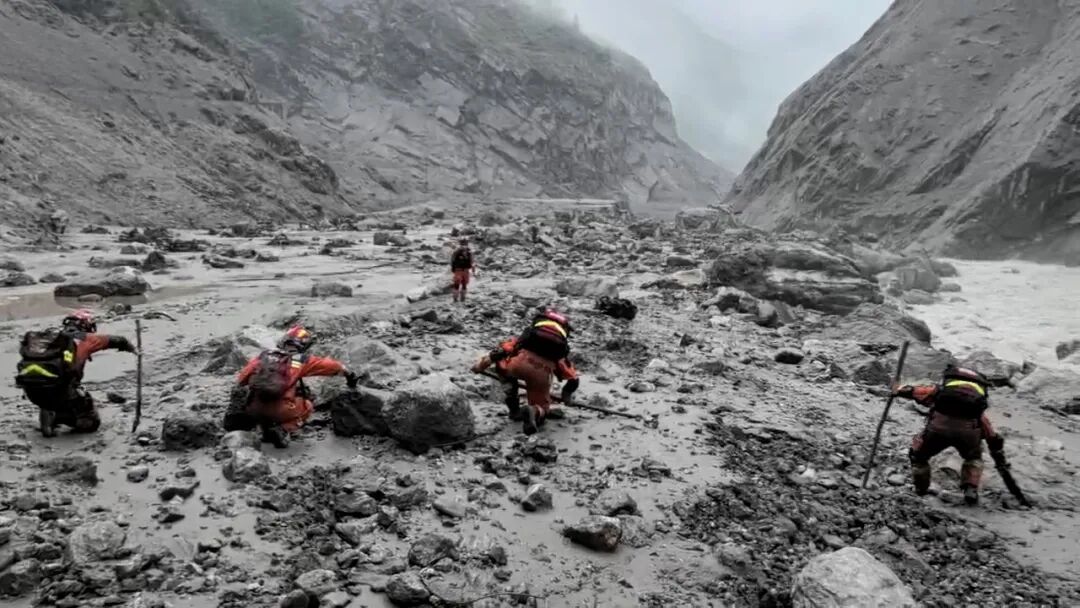
Photo: People's Daily
As of 1 a.m. Saturday, seven people had been confirmed dead and 554 others remained missing at the port on the China-Nepal border, according to Xizang's emergency management department.
"We will race against time to search for every missing person and will not give up any hope," an official with a frontline working group of the Ministry of Emergency Management told Xinhua on Saturday.
The official said rescuers are pushing deeper into the disaster zone while authorities step up monitoring of secondary-disaster risks and work to keep emergency communications running.
To ensure efficient operations, the frontline working group has set up a temporary Party organization, while Party-member vanguard teams from fire and rescue forces have been deployed to key disaster-hit areas to carry out continuous search and rescue.
With road access cut off, fire and rescue teams are using drones to survey conditions deep inside the affected area. Two teams comprising 17 personnel have also been deployed to help set up monitoring posts.
Drones are sent ahead for reconnaissance before rescuers follow on foot into key affected areas, an approach aimed at ensuring rescue operations are precise, professional and safe, the official said.
The National Fire and Rescue Administration has dispatched 681 personnel from the national comprehensive fire and rescue force, along with 13 rescue dogs, 113 vehicles and 47 drones, as well as specialized rescue equipment.
Advance teams are pushing toward the core affected area via land and water routes and heavy-lift drone transport. Twenty-one rescuers have so far reached the border gate at Gyirong Port, according to the official.
The Ministry of Emergency Management (MEM) has also dispatched 60 personnel and 28 pieces of equipment from a natural disaster rescue center operated by China Anneng Group.
Road access is only one of the challenges facing rescuers. Experts said the mudslide was triggered by a high-altitude glacier collapse on the Nepalese side. Roads and communications were cut off in the aftermath, further complicating rescue operations.
Preventing secondary disasters and maintaining communications are therefore key parts of the emergency response, the official said.
The office of the National Commission for Disaster Prevention, Reduction and Relief and the MEM have organized rolling consultations with relevant departments to continuously monitor and assess secondary-disaster risks and guide rescue operations.
Two Wing Loong unmanned aerial vehicles have been deployed to provide uninterrupted emergency communications support. The working group has also coordinated with the Ministry of Industry and Information Technology on inspections of communications lines, emergency repairs and network optimization, with one base station restored to service and three new ones added.
Military, civilian and commercial satellite resources have also been mobilized for remote-sensing monitoring of the disaster site and surrounding areas, both upstream and downstream.
Meanwhile, the Ministry of Natural Resources, the Ministry of Water Resources, the China Earthquake Administration and relevant research institutions continue to monitor and issue early warnings for risks that include ice-rock avalanches, secondary mudslides and landslides.
China and Nepal are "having close communication and coordinating efforts for the search and rescue," according to China's foreign ministry, which has said that, for Chinese rescuers, "all lives are precious, regardless of their nationalities."
Looking ahead, the emergency management official said the frontline working group will focus on three priorities.
The first is to organize search and rescue operations in a scientific manner, making every minute count in the search for every missing person. Additional specialized rescue teams and equipment will be deployed as needed.
The second is to strengthen monitoring and prevention of secondary disasters. Slope-monitoring radar and other equipment are being deployed at search sites, while satellite remote sensing, drones and on-site monitoring will be used together to track secondary-disaster risks in real time and strengthen early warning and safety controls.
The third is to provide guidance on disaster relief and assistance for affected residents.
The working group, together with the National Food and Strategic Reserves Administration, has allocated 30,000 items of central government disaster-relief supplies, including tents, heating stoves, clothing, quilts, folding beds and moisture-proof mats.
It has also coordinated donations of more than 50,000 items of emergency supplies, including food and drinking water, and coordinated with the Red Cross Society of China to allocate another 2,500 items, including tents and quilts.
The working group will continue making every effort to ensure the basic living needs of people affected by the disaster are met, the official said.