


Rescuers push deeper into mudslide-hit area at China-Nepal border
Rescuers are racing to search for survivors after a devastating mudslide, triggered by an ice-rock avalanche in Nepal, hit the border port of Gyirong in southwest China's Xizang Autonomous Region.
The disaster, which occurred on August 26, has killed 16 people and left 546 people missing in Xizang.
So far, more than 2,000 rescuers have joined search and rescue operations, including personnel from the Chinese People's Liberation Army, the People's Armed Police Force and China Anneng. A total of 269 rescue vehicles and 3,922 sets of rescue equipment have also been dispatched to the front line.
Rescue and relief work makes headway in core rescue zone
Despite difficulties such as high-altitude terrain, steep valleys and volatile weather, rescuers are pushing into the core disaster area, carrying out road mud removal, search and rescue operations, hazard identification, disinfection and epidemic prevention, and clearing and restoring damaged routes.
So far, two rounds of searches have been completed in the core disaster zone, and further in‑depth searches will follow.
Communications have been restored at the core rescue site, with successful phone calls made to rescuers at the port via a newly built base station. The first emergency communication base station near the border gate of Gyirong Port has started operating. Telecom operators in Xizang have restored one damaged base station and built eight new ones near the port.
Rescue and disaster relief work still face great challenges as Gyirong County is expected to see more rainfall in the coming days, with significant nighttime precipitation. The meteorological authorities have advised caution in the Gyirong Port area over the next few days due to rainfall and elevated geological disaster risks.
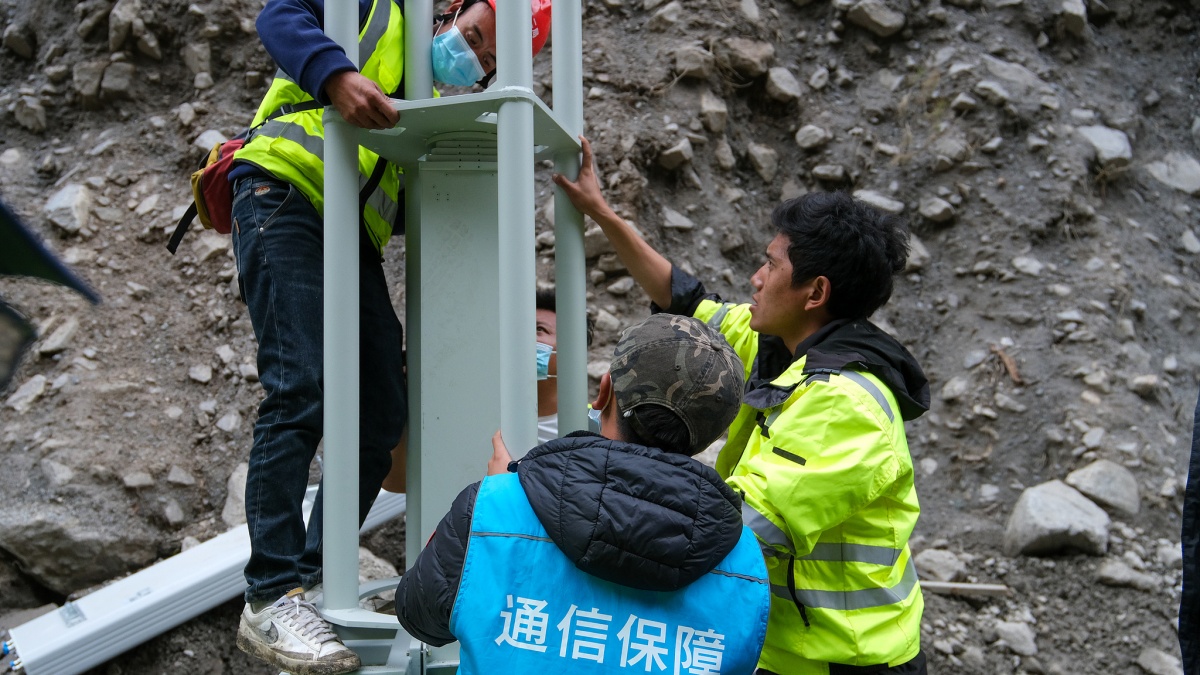
Communications support teams install a 5G base station in Gyirong County, southwest China's Xizang Autonomous Region, August 30, 2026. /VCG
Heavy-duty equipment deployed to clear the G216 national highway
Multiple rescue teams deployed heavy-duty equipment, including excavators and loaders, to clear the G216 national highway, a key road leading to Gyirong Port. Rescuers have advanced 533 meters as of 10 a.m. on Monday, leaving some 1.15 kilometers to go before reaching the port.
An expert with China Anneng Group identified three major challenges facing the operation. First, reopening the road is extremely difficult. Second, the machines are operating beside fast-flowing water, which lowers equipment efficiency and poses significant safety risks. Third, time is tight, and the task is arduous. Xizang is now in the flood season, with uncertain upstream water conditions, which adds urgency to the road-clearing mission.
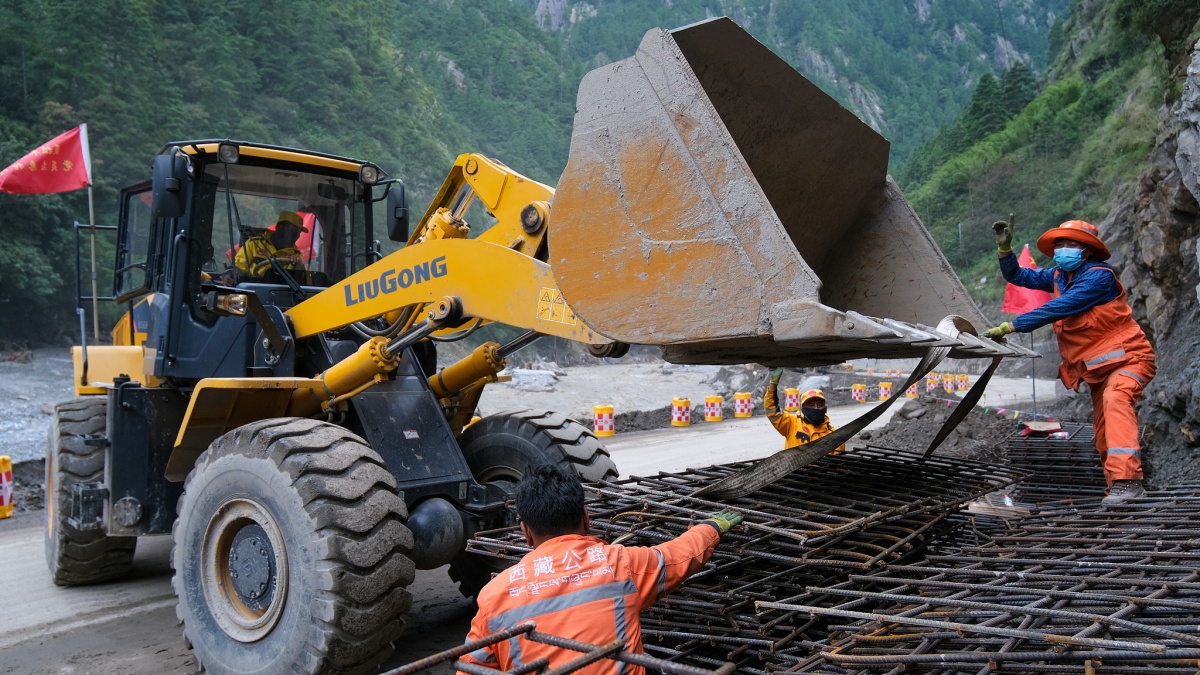
Rescue teams work along the G216 National Highway in Gyirong County, southwest China's Xizang Autonomous Region, August 30, 2026. /VCG
Barrier lakes above mudslide-hit port basically drained
China's Ministry of Water Resources said on Sunday that the Purepu Zangbo barrier lake above mudslide-hit Gyirong Port has largely drained, returning the river channel to a flowing state. It cited drone footage and panoramic images captured in the morning, along with reports from emergency response teams.
A new barrier lake that formed 2.8 kilometers downstream of the Purepu Zangbo barrier lake has also been largely drained. Drone footage and panoramic images show that upstream water has breached the barrier lake, restoring the river channel to a flowing state.
Authorities warn that an impact crater upstream of the Purepu Zangbo barrier lake still needs attention. Located about 5.6 km upstream at an altitude of around 3,700 meters, the crater is roughly 800 meters higher than the barrier lake.
China's Ministry of Natural Resources has launched investigations into dangers posed by the debris. Experts have identified eight high-risk areas and will continue monitoring the situation.
Post-disaster psychological support
Psychological support and counseling staff are helping the relocated residents find some level of stability.
A psychological rescue expert team dispatched by the National Health Commission has arrived in Gyirong Town. Incorporating traditional Tibetan medical physiotherapy, the experts are helping affected residents ease their emotions and relieve stress. Psychological rescue workers are also speaking with medical staff on the front lines to help them manage stress.
Support for Nepal
Chinese relief supplies and four Chinese rescue experts arrived in Kathmandu on Sunday to assist the disaster relief efforts in Nepal.
The supplies, which include tents, blankets, sleeping bags, hardtack and emergency kits, were handed over at Kathmandu's airport. Chinese Ambassador to Nepal Zhang Maoming and Nepal's Minister of Science, Technology and Innovation Mahabir Pun attended the handover ceremony.
Pun has thanked the Chinese government for sending relief supplies and rescue teams to the disaster-hit areas. He said the assistance will help provide shelter, support reconstruction and clear blocked tunnel entrances at hydropower construction sites, where people are trapped.
The death toll from the devastating mudslide in Nepal has risen to 903, with 4,247 people still missing as of 9 a.m. local time on Monday, according to Nepal's National Disaster Risk Reduction and Management Authority.
A total of 267 people have been injured, while 20,819 security personnel have been mobilized for search, rescue and relief operations, the authority said.