


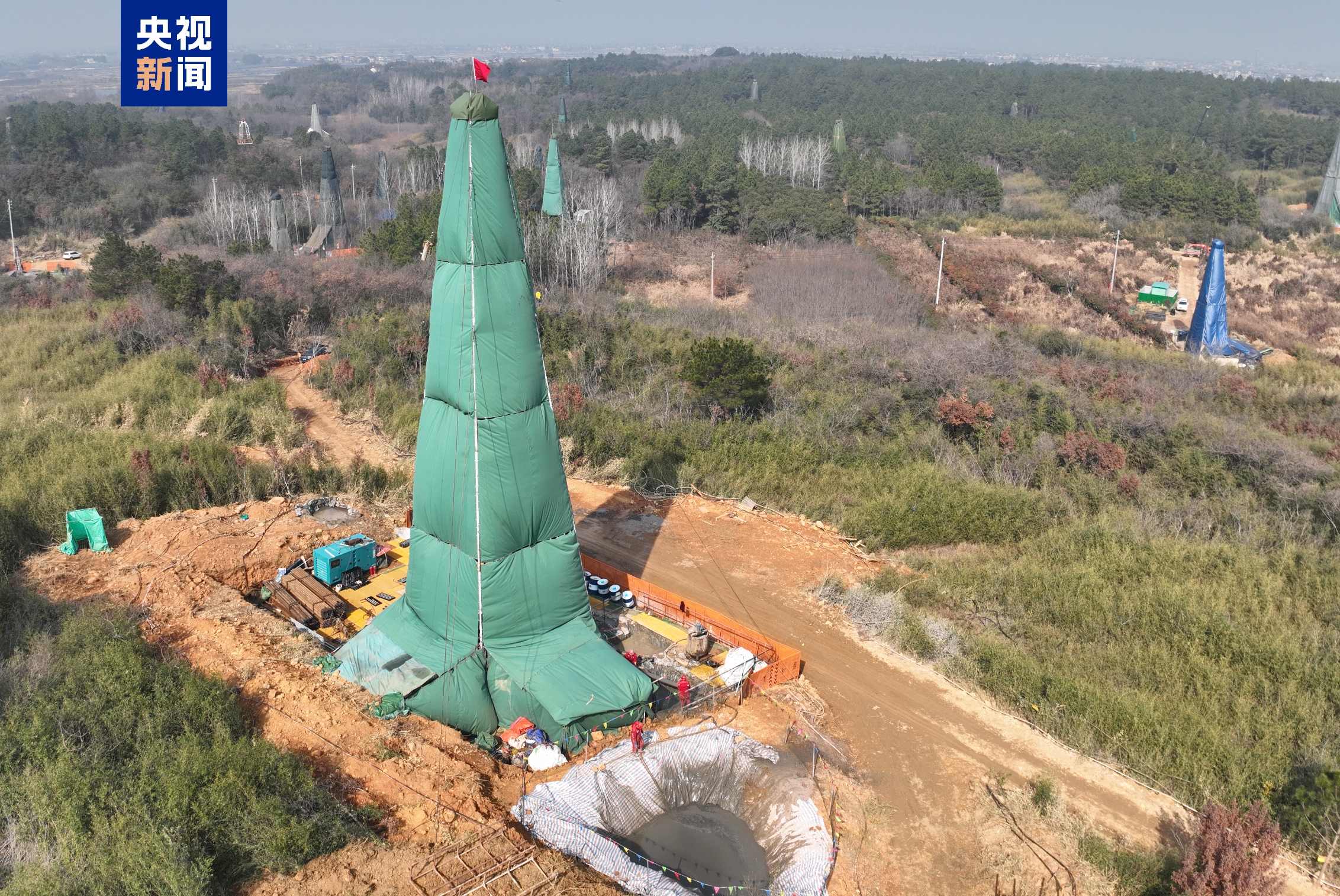
The Chating porphyry copper-polymetallic deposit found in Xuancheng, East China's Anhui Province (Photo: CCTV News)
China has made a major breakthrough in copper and gold exploration, with the Chating porphyry copper-polymetallic deposit found in Xuancheng, East China's Anhui Province emerging as the largest of its kind in the middle and lower reaches of the Yangtze River.
The deposit is estimated to contain copper resources equivalent to several large copper mines (500,000 tons) and gold resources exceeding the scale of more than 10 large gold mines (20 tons), according to the Ministry of Natural Resources on Tuesday.
The discovery could pave the way for the development of a super-large copper-gold production base in East China, and is expected to become a landmark mineral exploration achievement in the region in the first year of China's 15th Five-Year Plan (2026-30), according to CCTV News.
Copper and gold are critical minerals widely used in industries that underpin the digital era, including new energy and advanced manufacturing. Experts said the discovery not only enjoys significant geographical and infrastructure advantages, but also represents a major breakthrough in the understanding of mineralization mechanisms, per the report.
Lin Bin, a deputy director of the deep earth prediction and evaluation laboratory at the Chinese Academy of Geological Sciences and the technical lead at the exploration site, said that a key achievement of the latest exploration campaign was the identification of the scale of the Shangchang village copper-gold ore body in the Chating mining area, which further revealed the resource potential in the deep and peripheral areas of the Chating deposit.
The Chating copper-gold deposit is a typical porphyry deposit and is currently the largest porphyry copper-gold deposit identified in the middle and lower reaches of the Yangtze River, which is rare in the area, according to the report.
Since the beginning of this year, the exploration team has completed more than 70 drilling operations in just four months, including a deep exploration hole exceeding 2,000 meters. The main ore body identified so far is about 1.2 kilometers long and 1.1 kilometers wide, while the maximum thickness of mineralization encountered in a single drill hole exceeded 1,370 meters.
"Discovering a copper-gold deposit of this scale in the heartland of the Yangtze River Delta gives it particularly strong geographical and infrastructure advantages," Lin said.
The Yangtze River Delta is home to major copper smelting, cable manufacturing and new-energy industries. However, the region has relatively scarce indigenous copper and gold resources, with most copper concentrates transported from western China or imported from overseas, and this creates higher transportation costs and exposes regional supply chains to disruptions arising from international geopolitical and market developments.
Located in the heart of the Yangtze River Delta, the Chating deposit could help address the shortage of locally sourced copper and gold in East China, reduce supply-chain risks and provide support for the region's new-energy and advanced manufacturing industries, Lin said, adding that the deposit has relatively high gold grades.
The primary goal of the detailed study and rapid exploration of the deposit is to help mining enterprises increase reserves and production as quickly as possible, thereby significantly improving the region's capacity for self-supply and sustainable resource development, while strengthening the security of China's strategic mineral supplies, Lin said.
Once developed, the deposit is expected to become a super-large copper-gold production base in East China, supplying copper and gold raw materials to nearby smelting and processing industries and reducing pressure on long-distance transportation and reliance on overseas imports.
The deposit also contains associated valuable minerals such as silver and sulfur, which could be comprehensively recovered and utilized, enabling the development of multiple products from a single mine and significantly improving overall resource efficiency. The project could therefore become a key resource base for addressing East China's shortage of copper and gold and supporting deeper regional economic integration, Lin said.
Beyond its resource potential, the exploration campaign has also generated several theoretical breakthroughs.
One of the major findings challenges the traditional view in international geological theory that extensive volcanic basins are unlikely to host large porphyry copper-gold deposits. The discovery also demonstrates the significant copper-gold mineralization potential of large areas associated with Yanshanian Orogeny along the middle and lower reaches of the Yangtze River.
It also indicates that volcanic basins in areas including Xuancheng and Nanling in East China's Anhui Province, as well as Lishui and Liyang in East China's Jiangsu Province, could have potential for similar deposits, opening a new theoretical pathway for mineral exploration in volcanic-rock areas covered by thick layers of overlying strata in eastern China.
The team further plans to conduct a 3,000-meter scientific deep drilling project to further investigate the structure of the porphyry copper mineralization system and deep resource potential beneath the continental volcanic basin, expecting to provide a "Chating model" and a new exploration paradigm for identifying similar deposits in eastern China.
"We believe that many volcanic basins along the Yangtze River metallogenic belt could contain similar porphyry copper deposits, indicating enormous potential for further mineral exploration," Lin said.