


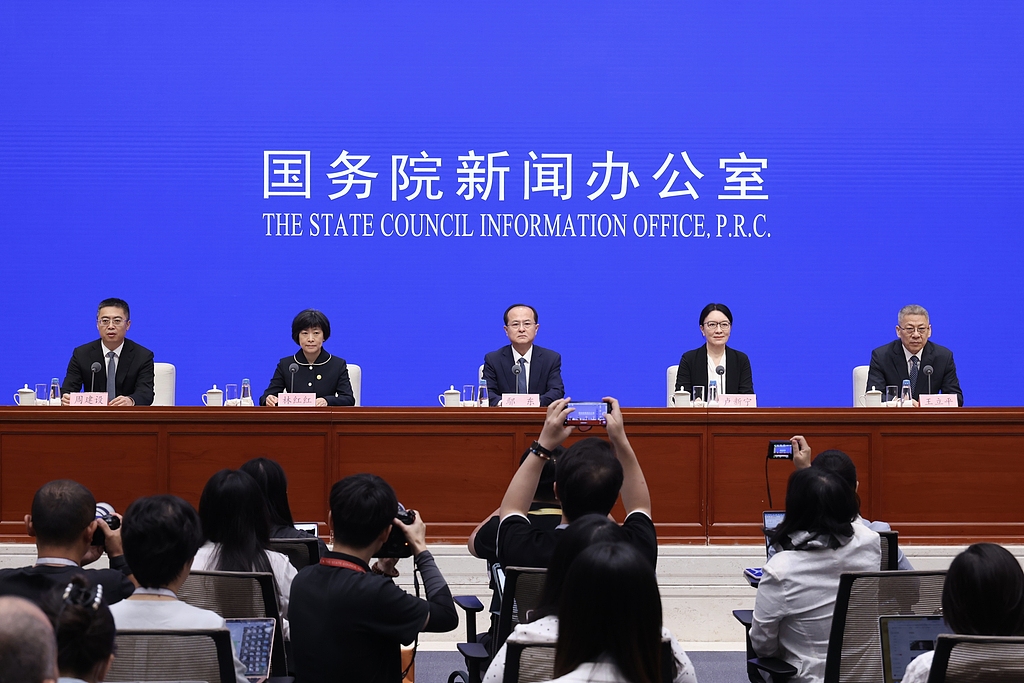
The State Council Information Office held a press conference on the upcoming China-ASEAN Expo, on September 1, 2026, in Beijing. (Photo: VCG)
The 23rd China-ASEAN Expo (CAEXPO) will be held in Nanning, South China’s Guangxi Zhuang Autonomous Region, from September 17 to 21.
Under the theme “CAFTA 3.0 Opportunities, Better Life”, the event will focus on free trade area development and regional high-quality growth, while showcasing new achievements in China-ASEAN economic and trade cooperation, an official from China’s Ministry of Commerce said at a press briefing on Tuesday.
Against this backdrop, China-ASEAN economic ties have continued to deepen, with bilateral trade reaching new heights.
According to the official, China and ASEAN bilateral trade surpassed the $1 trillion mark for the first time in 2025, reaching $1.05 trillion, the CCTV News reported.
The figure marked a year-on-year increase of 7.4 percent, underscoring the continued expansion of economic ties between China and the regional bloc. China has remained ASEAN’s largest trading partner for 17 consecutive years, while ASEAN has been China’s largest trading partner for six consecutive years, per the CCTV News.
From January to July of this year, China-ASEAN trade totaled $744.41 billion, up 24.7 percent from a year earlier and accounting for 21.8 percent of China’s total foreign trade during the period, the official said.
These latest figures indicate that trade and economic ties between the two massive economies has continued to advance in step with the formal signing of the China-ASEAN Free Trade Area 3.0 (CAFTA 3.0) Upgrade Protocol, a Chinese expert said.
Meanwhile, the year 2026 marks the 5th anniversary of the establishment of the China-ASEAN Comprehensive Strategic Partnership.
China-ASEAN partnership has become a model of mutually beneficial cooperation between economies at different stages of development, with market forces and government guidance working in tandem, Zhou Mi, a senior research fellow at the Chinese Academy of International Trade and Economic Cooperation, told the Global Times on Tuesday.
As global trade uncertainty continues to rise, China and the ASEAN member states have maintained strong momentum in commercial and investment cooperation, underscoring a deliberate and pragmatic choice in favor of free trade and economic globalization, Zhou said.
The analyst attributed the growth to a shared commitment to open markets and a more stable institutional framework. “This has helped build confidence among businesses and market participants, even as the international trade environment becomes more complex,” he said.
According to Zhou, the two sides have also made notable progress in trade complementarity. By leveraging their different positions in global and regional industrial chains, China and ASEAN have strengthened cooperation in manufacturing, supply chains, and market access.
This collaboration has not only supported economic growth and industrial upgrading on both sides, but also helped meet rising consumer demand and unlock new development potential, he noted.
At the press conference, officials also highlighted steady progress in investment cooperation and major infrastructure projects. By July 2026, cumulative bilateral investment between China and ASEAN, along with Chinese enterprises’ completed engineering contract revenue in ASEAN, had both exceeded $515 billion.
Several landmark projects are moving ahead smoothly. According to the official, the Malaysia East Coast Rail Link has made progress of more than 94 percent, the Jakarta-Bandung High-Speed Railway in Indonesia has carried more than 15 million passenger trips in total, and the China-Laos 500-kV power interconnection project has been officially launched.
“Cooperation in emerging sectors has yielded notable results, further consolidating the two sides’ positions as each other’s most active investment partners,” said the official.
Zhou said that as a growing share of investment flows into the new emerging sectors, particularly the digital economy and the green economy, these areas have become key priorities for both sides as they seek to upgrade their economic structures and strengthen long-term competitiveness.
Looking ahead, the upgraded China-ASEAN free trade pact is expected to provide stronger institutional foundation for future cooperation, Zhou said, noting that the agreement is expected to create a platform for dialogue on cross-border data flows, green cooperation, and the alignment of standards and rules. They are seen as important steps toward more coordinated and forward-looking regional economic integration.