


China-Kyrgyzstan practical cooperation gains momentum
China and Kyrgyzstan, connected by shared mountains and rivers, enjoy close ties between their peoples. As friendly neighbors and comprehensive strategic partners for a new era, the two countries have seen their relations enter a "golden period" in recent years, guided by the strategic vision of both heads of state. Practical cooperation has gained strong momentum across multiple sectors.
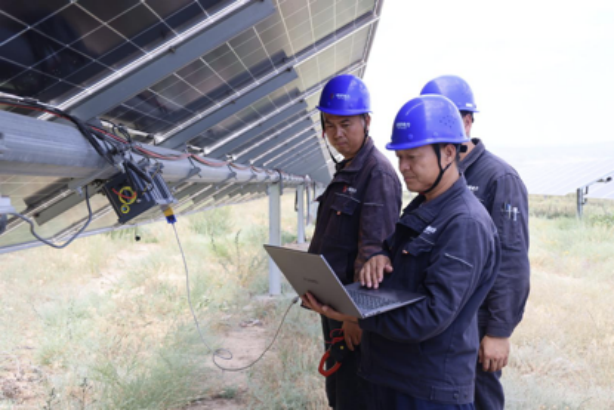
Chinese and Kyrgyz technicians inspect equipment at a 100MW photovoltaic power station in Chuy Province, Kyrgyzstan. The project represents Kyrgyzstan's first large-scale solar facility, supporting the country's transition toward clean energy. (Photo: People's Daily/Zhang Zhiwen)
Trade and economic ties open new development opportunities
With just over two months remaining before the ninth China International Import Expo (CIIE), a Kyrgyz honey company has already begun preparing for the event.
"We have participated in the CIIE several times and refined our products based on the tastes and preferences of Chinese consumers, receiving a great deal of positive feedback," said Emma Savitskaya, the company's general manager. "Last year, we signed a supply contract with a major company in Wuhan, China, which has given us even greater confidence in our future development."
Complementarity and mutual benefit have long defined China-Kyrgyzstan trade and economic cooperation. China has remained Kyrgyzstan's largest trading partner, largest source of imports and largest source of investment for years. In 2025, bilateral trade in goods reached $27.2 billion, up 20 percent year on year and setting a new record.
Investment cooperation is also growing rapidly, with the two countries deepening collaboration in agriculture, energy and mineral resources, while cultivating new areas such as artificial intelligence and the digital economy.
Both sides have supported stronger economic and trade ties through sustained efforts to make trade and investment more open and convenient. Since early this year, direct flights have been launched between Kashgar in Northwest China's Xinjiang Uygur Autonomous Region and Osh in Kyrgyzstan, as well as between Beijing and the Kyrgyz capital Bishkek, further expanding the network of passenger and cargo air routes.
The Irkeshtam and Torugart ports have been upgraded with smart technologies, while the Bedel port has introduced temporary customs clearance, significantly reducing clearance times and improving logistics efficiency. The benefits of visa-free travel are also being increasingly realized, creating new opportunities for business delegations from both sides to explore investment and cooperation.
"China-Kyrgyzstan economic and trade cooperation has become part of virtually every aspect of industrial development and daily life in both countries," said Matraimov Abdurakhman, representative of the Chamber of Commerce and Industry of the Kyrgyz Republic in China.
"Trade connectivity promotes closer ties between our peoples and facilitates the exchange of talent. I believe economic and trade cooperation between the two countries will reach new heights," he added.

Chinese workers excavate a high-altitude tunnel along the Barskoon-Bedel Highway project in Kyrgyzstan. Scheduled for completion in 2030, the 161-kilometer road will serve as the third major international land route connecting the two nations. (Photo courtesy of Akipress in Kyrgyzstan)
Infrastructure projects help break development bottlenecks
At an elevation of more than 3,800 meters on the southern slopes of the Tianshan Mountains, drilling rigs roar, and welding sparks fly at the construction site of a tunnel along the Barskoon-Bedel Highway project in Kyrgyzstan, which is being undertaken by a Chinese company.
Since excavation of the main tunnel began in March this year, construction workers have overcome challenges including oxygen deficiency and permafrost conditions. More than 10 percent of the 5,340-meter-long tunnel has now been excavated.
"I only knew basic road maintenance a few years ago. Now I have mastered quite a few professional skills for tunnel construction in high-altitude, cold environments," said Kyrgyz engineer Ashiraliev Elmek. "I learned all of this step by step from my Chinese colleagues."
The Barskoon-Bedel Highway will stretch approximately 161 kilometers and include two extra-long tunnels and 50 bridges, with a designed speed limit of 80 kilometers per hour. Scheduled for completion in 2030, it will become the third international land transport route between China and Kyrgyzstan, greatly facilitating the flow of goods and people, and further boosting bilateral trade and investment.
Known as a "land of mountains," Kyrgyzstan has long faced constraints on its economic and social development due to limited transport links. In recent years, as high-quality Belt and Road cooperation has deepened, Chinese companies have undertaken a batch of transport infrastructure projects, helping the country overcome development bottlenecks and unlock the potential of connectivity.
Construction of the China-Kyrgyzstan-Uzbekistan railway is progressing steadily and will open up a new transportation corridor between China and Central Asia. The renovation of Bishkek's municipal road network, covering more than 100 streets, has been completed, while work on the northern bypass road is in full swing. These projects have significantly improved travel conditions for residents and further facilitated cross-border logistics along major trunk routes.
Green development is also improving people's well-being
On the northern shore of Kyrgyzstan's scenic Lake Issyk-Kul, breezes sweep through the orchards of villages in Cholpon-Ata.
"In the past, wastewater flowed past our homes every day, and the smell was unbearable. Some neighbors couldn't take it anymore and moved away," said a resident named Kuba. Today, the problem is gradually being addressed.
Lake Issyk-Kul is a major tourist attraction in the region. The old wastewater facility relied on basic sedimentation treatment and lacked full purification capabilities, so it couldn't keep up with surging water-treatment demands. For years, it discharged untreated wastewater directly, posing a constant threat to the lake's ecosystem and residents' livelihoods.
After a modern wastewater treatment plant built by a Chinese company in Balykchy began operations in 2024, China Road and Bridge Corporation built another plant in Cholpon-Ata, with a designed daily treatment capacity of approximately 14,200 cubic meters.
The treated water can be reused for agricultural irrigation, while sludge can be composted and turned into a useful resource, helping alleviate local shortages of agricultural fertilizer.
In recent years, China and Kyrgyzstan have jointly implemented several sustainable, people-centered green cooperation projects, creating new drivers for economic and social development.
In Bishkek, a waste-to-energy project uses advanced technologies to turn municipal waste into clean electricity, improving the urban environment while supplementing the city's power supply. In Chuy Province, Kyrgyzstan's first large-scale photovoltaic power plant has been connected to the grid, supporting the country's transition toward cleaner energy.