


Glacier-related disasters on the Qinghai-Xizang Plateau could become more frequent: National Climate Centre
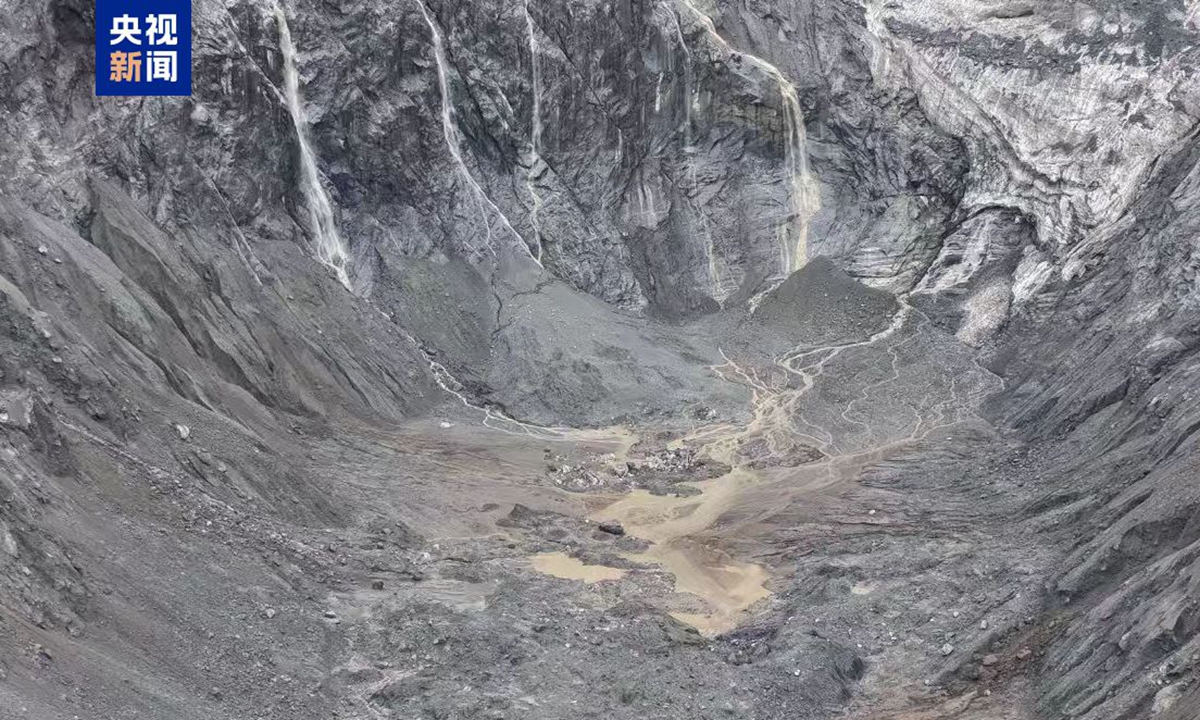
Drone photo of the impact crater taken at 8 am on September 1, 2026. (Photo: CCTV)
Glacier disasters could become more frequent as global warming further weakens glacier stability on the Qinghai-Xizang Plateau, potentially triggering cascading effects that amplify damage and widen their impact, the National Climate Centre announced on Wednesday, chinanews.com reported on Wednesday.
The Nepal August 26 landslide caused major casualties and left people missing at Gyirong Port in Southwest China’s Xizang Autonomous Region.
After analyzing remote-sensing monitoring data and information transmitted from the site, and combining these findings with on-site inspections and field visits, the cryosphere emergency response and disaster mitigation team of the Institute of Mountain Hazards and Environment, Chinese Academy of Sciences, concluded that at around 10:52 am on August 26, a glacier on the northern slope of Mount Langtang Lirung in Nepal broke off at an elevation of approximately 5,200 meters, triggering an ice-and-rock avalanche, Fengmian News reported.
The ice and rock rapidly plunged from the high-altitude area to an elevation of around 4,000 meters, scouring the mountainside and generating a massive debris flow. After surging at high speed for about 22 kilometers, it reached the Gyirong Port in China at an elevation of approximately 1,800 meters, flattening about 0.7 square kilometers of the area, including 27 buildings and associated facilities, according to Fengmian News.
Gao Rong, deputy director of National Climate Centre, said during a press conference held by the China Meteorological Administration on Wednesday that global warming is accelerating the melting of mountain glaciers worldwide. Climate warming has altered the dynamic characteristics of glaciers, leading to rising ice temperatures, faster glacier flow and more frequent surges. Since the beginning of the 21st century, particularly since 2010, ice avalanche events in high-altitude mountainous regions around the world have been on the rise.
Mountain glaciers in China are mainly distributed across the Qinghai-Xizang Plateau and surrounding areas. Against the backdrop of a warmer and wetter climate on the Qinghai-Xizang Plateau, glaciers across the region are generally undergoing accelerated melting, Gao said.
According to the Chinese Glacier Inventory, glacier coverage on the Qinghai-Xizang Plateau has shrunk by about 24 percent over the past 60 years, with some 7,000 small glaciers disappearing entirely. Rapid warming on the Qinghai-Xizang Plateau is driving accelerated melting of the cryosphere, leading to an increase in the number of glacial lakes and rapid expansion of their area, while glaciers are becoming dynamically unstable, Gao added.
It is expected that the internal structural stability of glaciers on the Qinghai-Xizang Plateau will decline further in the future. Glacier-related disasters may become more frequent and could also trigger cascading disaster effects, amplifying the scale of destruction and expanding their impact, Gao said.