


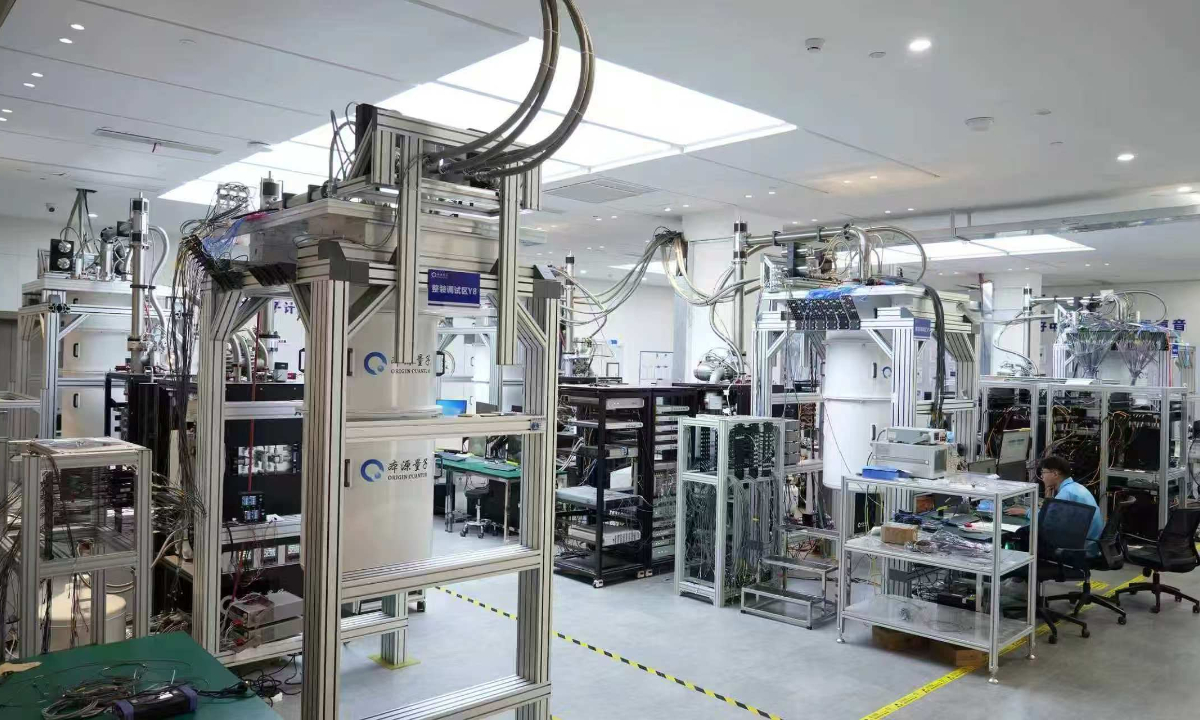
Origin Wukong superconducting quantum computer cluster(Photo: Courtesy of the Anhui Quantum Computing Engineering Research Center)
Chinese research teams have achieved a breakthrough on an independently developed superconducting quantum computer, with tests showing information transmission efficiency of up to 98 percent for a single quantum router, Science and Technology Daily reported on Wednesday.
The achievement was jointly made by several Chinese research teams.
The teams developed a coherent quantum routing system for bucket-brigade quantum random access memory (QRAM) on the Origin Wukong superconducting quantum computer. The system acts like a "fast lane" for data transmission, helping address a key challenge in scaling up QRAM.
Researchers built three independent quantum routers and a two-layer quantum routing network on China's third-generation independent superconducting quantum computer Origin Wukong for testing. The results showed that a single quantum router achieved an information transmission efficiency of up to 98 percent, while the two-layer network reached an overall transmission efficiency of 93 percent. In random-access tests, the average fidelity reached 94.8 percent for the single quantum router and 82.4 percent for the two-layer network.
The breakthrough offers a new way to build scalable QRAM on existing superconducting hardware, researchers said, according to the report. It also shows that China's quantum computing research is moving beyond improving individual performance metrics toward testing more complex quantum functions on real machines. The approach could also help cut computing costs and improve efficiency, while offering a new way to better integrate quantum chips with circuit design.