


AI, drones, robots reshape farming in Heilongjiang, China's grain heartland
Inside Beidahuang Information Company in Harbin, capital of northeast China's Heilongjiang Province, a wall-sized digital map tracks conditions across some 3.2 million hectares of farmland.
Data on soil conditions, crop growth and tractor movements update across the screen, while satellite remote sensing, the Internet of Things and AI are being integrated into different stages of farming.
It is one example of how agriculture is changing in Heilongjiang, China's top grain-producing province.
Heilongjiang has ranked first in the country in total grain output for 16 consecutive years. The comprehensive mechanization rate for plowing, sowing and harvesting has reached 99.28%.
Now, AI, drones, remote sensing and smarter machinery are pushing that highly mechanized system into a more digital phase.
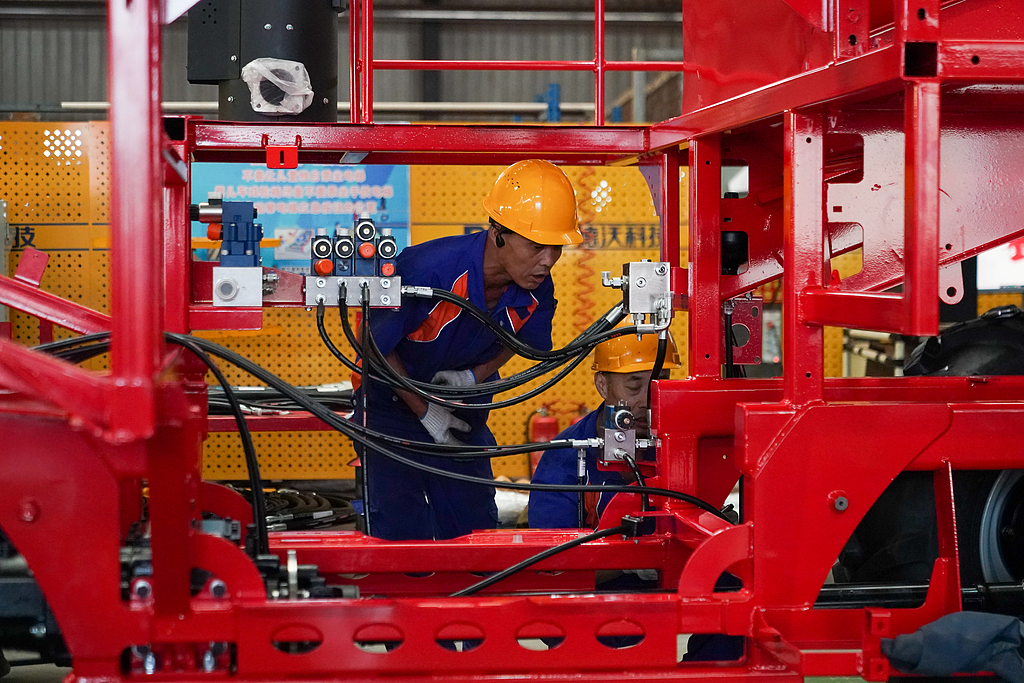
A worker assembles agricultural machinery at Heilongjiang Dewo Technology Development Co., Ltd. in Harbin, Heilongjiang Province, China, September 1, 2026. (Photos: VCG)
Farming by data
Wang Hao, deputy general manager of Beidahuang Information Company's market operation center, said a farmer inspecting crops on foot could previously cover only about 200 mu, or roughly 13 hectares, a day.
Drones and remote sensing can now monitor much larger areas and allow crop data across the monitored farmland to be updated every five days, he said.
The company's AI model for cold-region crops analyzes soil, weather and crop-growth data to generate planting plans and recommendations for variable-rate fertilization, which allows fertilizer use to be adjusted according to conditions in different parts of a field.
But scaling up agricultural AI remains challenging.
Wang said AI models require large amounts of local data and repeated testing because soil, weather and other environmental conditions can vary significantly from place to place.
Digital technology is also being used farther along the production chain.
In Wuchang, a major rice-producing area in Harbin, robots at Qiaofu Dayuan Agricultural Co., Ltd. stack packaged rice for shipment. QR codes on the products provide information including where the rice was produced and its nutritional content.
Smarter machines
Other technologies are changing the machinery working directly on farmland.
At a planting base in Heilongjiang, a four-wheel laser-weeding robot moves between crop rows. Multispectral cameras and sensors scan the ground, while algorithms distinguish crops from weeds and direct laser beams at the unwanted plants.
The system offers a chemical-free alternative to herbicides while reducing reliance on manual weeding.
Li Yongwei, deputy general manager of Harbin Huagong Zhiyun Technology Co., Ltd., said the technology can remove more than 95% of weeds while keeping crop damage below 0.1%. He said it can also cut weeding costs by up to 70% compared with manual labor.
Seeders are becoming more intelligent as well.
Electric-drive precision seeders produced by Heilongjiang Dewo Technology Development Co., Ltd. allow operators to monitor and adjust air pressure and seed spacing in real time through smart terminals.
Du Mujun, the company's chief engineer, said the system can reduce seed damage and operate about 50% faster than conventional mechanical seeders.
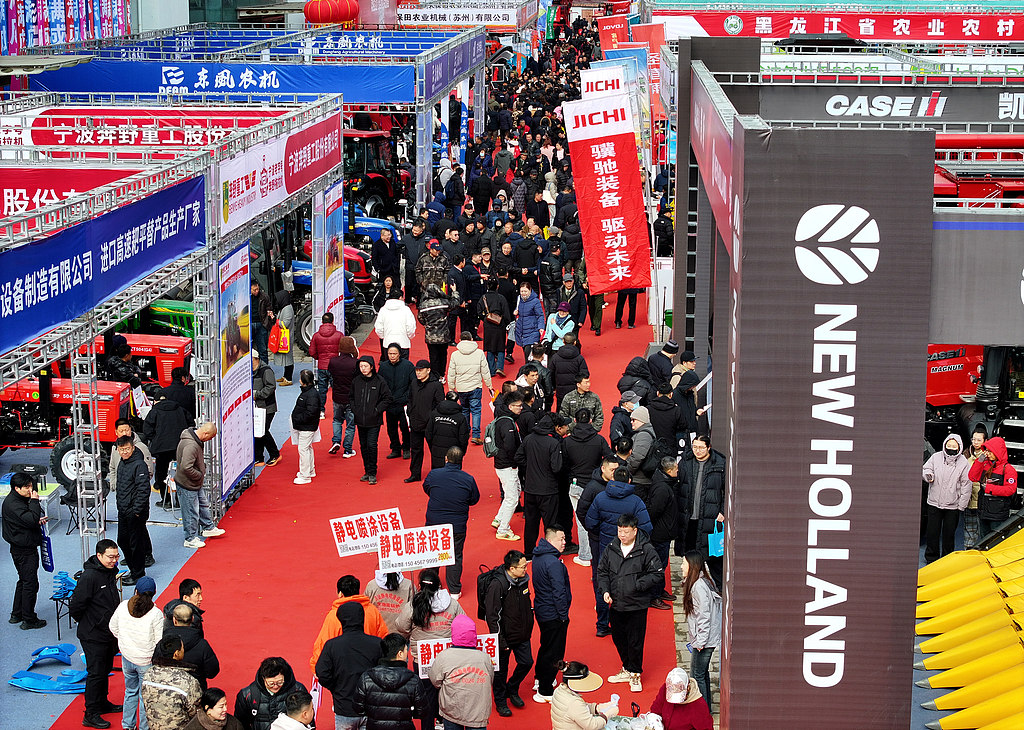
The 25th Heilongjiang Agricultural Machinery Exhibition opens in Harbin, Heilongjiang Province, China, March 14, 2026.
Beyond mechanization
Heilongjiang produced a record 82 million tonnes of grain in 2025, marking its 22nd consecutive bumper harvest. The province also had 676,000 intelligent agricultural machines that year, ranking first nationwide.
During the 15th Five-Year Plan period from 2026 to 2030, Heilongjiang plans to develop industries including agricultural robots and intelligent farming equipment.
Construction began in August on a national pilot base for AI applications in crop planting, aimed at tackling common technical bottlenecks and developing technologies that can be deployed on a larger scale.
The shift is part of China's broader push for agricultural modernization. National plans call for wider use of technologies including drones, the Internet of Things and robots in agriculture and rural areas.
For Heilongjiang, where mechanization of plowing, sowing and harvesting is already above 99%, the focus is increasingly shifting from simply mechanizing farm work to making equipment and agricultural decisions more intelligent.
Hu Jinyou, a professor at China Agricultural University, said smart agriculture is still being refined, but deeper integration between AI and agriculture is an "irreversible trend."
As a new generation of better-educated farmers enters the sector, digital management is likely to become increasingly common, he added.
(With input from Xinhua)