


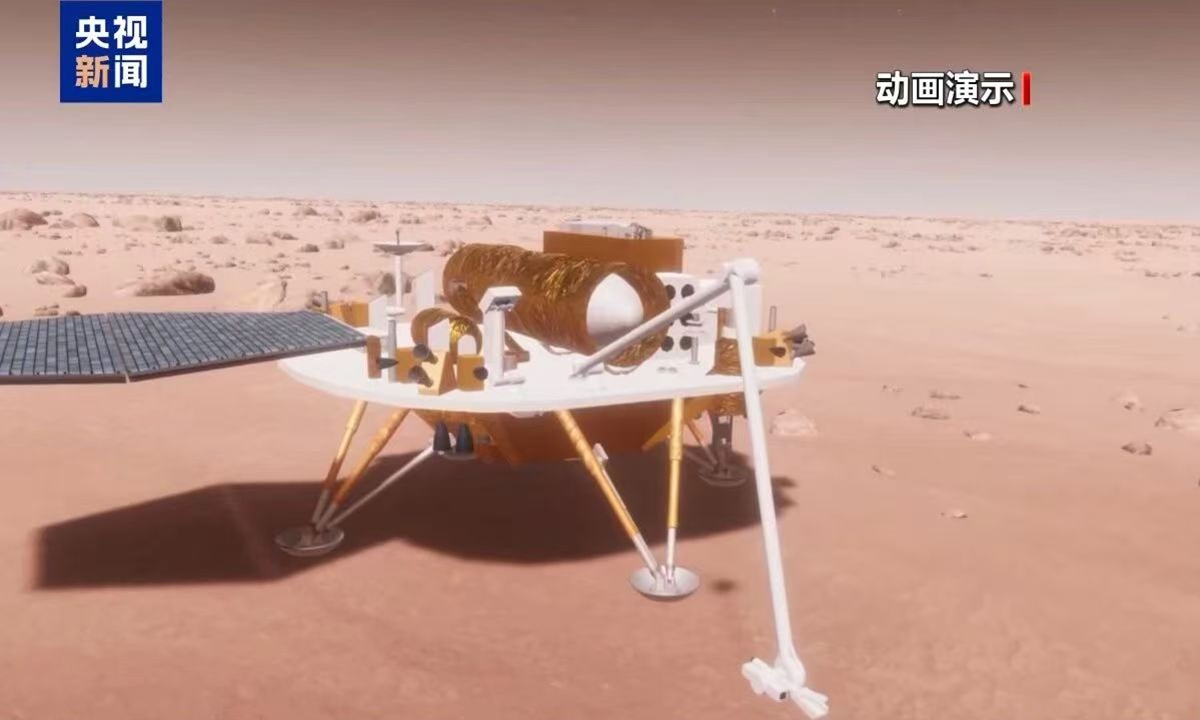
An illustation of the Tianwen-3 Mars probe mission (Photo: screenshot of the CCTV footage)
China's Tianwen-3 mission has entered the prototype development stage, with technological breakthroughs and scientific preparations advancing in parallel as China is moving closer to an unprecedented undertaking - drilling beneath the Martian surface, bringing samples back to Earth and searching them for possible traces of ancient life.
The mission, which could become humanity's first Mars sample-return mission, has placed the search for potential signs of life at the top of its scientific agenda, reflecting China's ambition to tackle one of planetary science's most profound questions: whether life has ever existed beyond Earth, a leading Chinese scientist told the Global Times on Thursday.
The Tianwen-3 mission, part of China's planetary exploration program, is planned for launch around 2028, according to the Xinhua News Agency on April 24. It aims to bring Martian samples back to Earth around 2031. The Tianwen-3 spacecraft comprises a lander, an ascent vehicle, a service module, an orbiter and a return module.
"Making the search for potential traces of life on Mars our primary scientific objective was a carefully considered scientific choice," Hou Zengqian, an academician of the Chinese Academy of Sciences and chief scientist of the Tianwen-3 mission, told the Global Times on the sidelines of the 2026 International Conference on Deep Space Exploration, also known as the Tiandu Forum, which opened in Hefei, East China's Anhui Province, on Thursday.
Mars is one of the terrestrial planets in the solar system most similar to Earth, Hou said.
A growing body of evidence suggests that early Mars once possessed liquid water, a denser atmosphere and a global magnetic field - conditions that could have supported a potentially habitable environment.
"We hope, through sophisticated analysis of the returned samples, to identify reliable signals of life," Hou said. "If conclusive evidence is obtained, it would have profound implications for answering the major scientific question of whether life has ever existed beyond Earth."
The mission will also investigate the evolution of Martian habitability, geology and internal structure as well as its atmosphere. These questions are closely interconnected, Hou noted, as life depends on a habitable environment, while habitability itself is shaped by the planet's long-term geological and climatic evolution.
The scientific ambition, however, poses a series of formidable engineering and scientific challenges - from choosing where to land and obtaining well-preserved samples to distinguishing genuine biological signals from contamination.
Hou said one of the central challenges for the Tianwen-3 mission is ensuring that the returned samples have the greatest possible scientific value. Taking into account factors including geological age, the history of water activity, habitability and the potential for preserving biosignatures, the team has preliminarily identified eight candidate landing sites.
The mission also plans to drill as deep as about two meters below the Martian surface to collect subsurface samples, which are expected to be less affected by radiation, oxidation and weathering and could therefore better preserve potential traces of life and other pristine information about Mars, Hou said.
Planetary protection and contamination control will be another critical part of the mission. China plans to build what Hou described as the world's first planetary protection laboratory, designed to prevent terrestrial microorganisms from contaminating Mars, safely isolate returned Martian samples, and minimize contamination of those samples by terrestrial organisms and materials.
Hou said technological development and construction of the necessary facilities are advancing, with the Tianwen-3 mission now entering the prototype development stage.
Regardless of whether signs of life are ultimately found, the returned Martian samples would carry irreplaceable scientific value, according to Hou.
"We hope to seize the initiative in Mars sample-return exploration," Hou said. "It is not only a demonstration of national capabilities, but also China's contribution to humanity's understanding of Mars and the search for extraterrestrial life."
Team up for the futureThe emphasis on major scientific questions at this year's Tiandu Forum was accompanied by another development highlighting the increasingly international dimension of China's deep-space exploration program.
During the opening ceremony on Thursday, the Deep Space Exploration Laboratory (DSEL) unveiled two joint laboratories established respectively with the National Astronomical Research Institute of Thailand and the Astronomical Observatory of Belgrade in Serbia, Global Times learned from the DSEL.
The China-Thailand and China-Serbia joint deep-space exploration laboratories represent another international science and technology cooperation platform established by the Deep Space Exploration Laboratory following its role in initiating the International Deep Space Exploration Association, it said.
The China-Thailand joint laboratory will focus on areas including lunar and deep-space technologies, lunar-surface robots, scientific payloads and micro- and nano-spacecraft, deep-space dynamics, planetary geology and cross-border very-long-baseline interferometry, or VLBI, observations.
Through such cooperation, researchers aim to develop advanced technological and scientific solutions for future China-Thailand deep-space exploration programs.
The China-Serbia joint laboratory, meanwhile, will draw on the Astronomical Observatory of Belgrade's more than a century of astronomical observations to conduct research in lunar and planetary science, solar and space environments and small-body dynamics.
The two sides also plan to conduct remote joint observations and share scientific data, with the goal of establishing a deep-space data-sharing platform.
Both laboratories will promote joint research projects, academic exchanges and mutual visits while helping train young scientists and engineers in deep-space science and technology.
Founded in 1887, the Astronomical Observatory of Belgrade is one of the oldest astronomical observatories in the Balkans and Serbia's professional astronomical research institution. The National Astronomical Research Institute of Thailand, meanwhile, is a major astronomical research institution in Southeast Asia and operates a 40-meter radio telescope, the largest of its kind in the region.
The establishment of the two laboratories is expected to further connect China's expanding deep-space exploration program with international scientific resources and expertise, while providing new platforms for cooperation in lunar, planetary and broader deep-space research, per the DSEL.