


It is the harvest season for apple pears, a variety of pears widely grown in Yanbian Korean Autonomous Prefecture, northeast China's Jilin Province.
"The fruit has a water content of up to 85 percent, making it exceptionally juicy," said Cao Li, head of the Department of Horticulture and Landscape Architecture at Yanbian University.
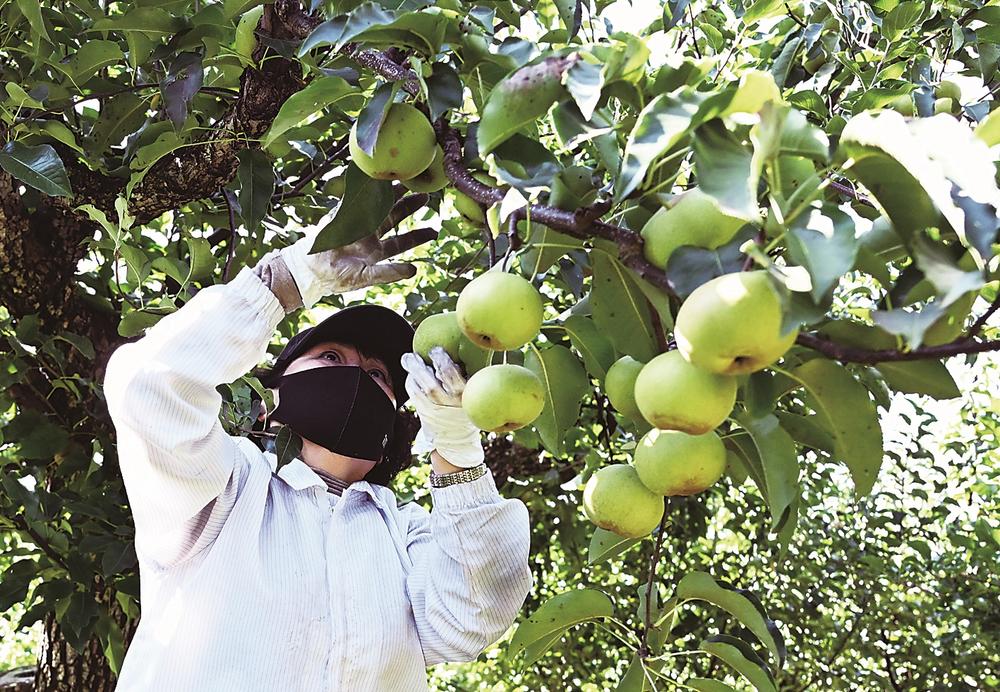
A woman picks apple pears in an orchard in Longjing, northeast China's Jilin Province. (Photo: People's Daily)
More than 80 percent of China's apple pears are now produced in Longjing, a city in Yanbian. According to data, Longjing has 1,881.5 hectares of apple pear orchards, with an annual output of 26,709 tonnes and an output value of 94.62 million yuan (about $14.08 million).
Over the years, apple pears under the brand "Hailanjiang" have received multiple prestigious certifications. In 2010, they were granted nationally protected geographical indication status.
It is hard to imagine that the 10,000-mu (one mu is about 0.067 hectares) orchard area today was once a barren mountain plagued by severe soil erosion and infertile soil more than 70 years ago.
"The farm was established in 1951," said Jin Xianzhe, deputy general manager of Yanbian Longjing Fruit Tree Farm Co., Ltd. In the 1950s, the hills here suffered from severe soil erosion and poor ecological conditions.
Generation after generation of builders reclaimed the land and planted trees, gradually turning the once-barren slopes into vast stretches of pear orchards.
"Today, the farm has 20,000 mu of orchards and 200,000 fruit trees, with annual production of high-quality apple pears remaining stable at around 20,000 tonnes. This year, abundant rainfall has helped the trees thrive, and the pears will begin hitting the market in just over a month," Jin said.
Farmers managing these vast pear orchards have moved beyond traditional, low-input farming and now employ a full suite of sustainable, green management techniques. Fully decomposed organic fertilizer has replaced excessive use of chemical fertilizers to improve mountain soil quality, while modern agricultural techniques such as integrated water and fertilizer drip irrigation and scientific pruning techniques are used to accurately and precisely manage nutrient supply.
Deep in the pear orchards lies a science and technology courtyard. Researchers bring laboratory research directly to the fields, providing full-process guidance on pruning, pollination, orchard management and harvesting, while offering free services including soil testing and fertilizer recommendations, pest and disease diagnosis, and field training to help bring scientific advances to farmers.
Sanhe village, which is nearly 100 kilometers away, is surrounded by mountains. It is home to hillside pear orchards. Liang Zuokui, born in 1983 and head of a fruit tree farmers' professional cooperative, has spent nearly two decades cultivating apple pears.
In 2008, Liang joined forces with nearby farmers to establish the cooperative. It adopted a collective development model featuring unified technical guidance, agricultural supplies, packaging and sales. Starting with just five households and 2,000 trees, it has grown to 40 households and 41,500 trees, with annual output reaching 6,000 tonnes.
By partnering with the science and technology courtyard, the cooperative has introduced standardized cultivation techniques and regularly held field training sessions, helping farmers improve orchard management and increase incomes.
As an industry leader, Yanbian Longjing Fruit Tree Farm Co., Ltd. has leased its orchards to farmers for independent operation. It has also developed integrated online and offline sales channels, helping farmers overcome the challenge of producing fruit but struggling to sell it. The model has helped more than 600 fruit-growing households steadily increase their incomes, with annual income growth exceeding 30 percent.
Building on the research achievements of the science and technology courtyard, Liang's cooperative has continued to explore deep processing and develop products such as frozen pear juice concentrate, apple pear juice, dried pears and pear popsicles.
The science and technology courtyard is exploring e-commerce livestreaming and direct-from-farm sales models to further strengthen the "Longjing Apple Pear" regional public brand and expand its market nationwide.