


Why did the same disaster leave such different numbers dead and missing on each side of the border?
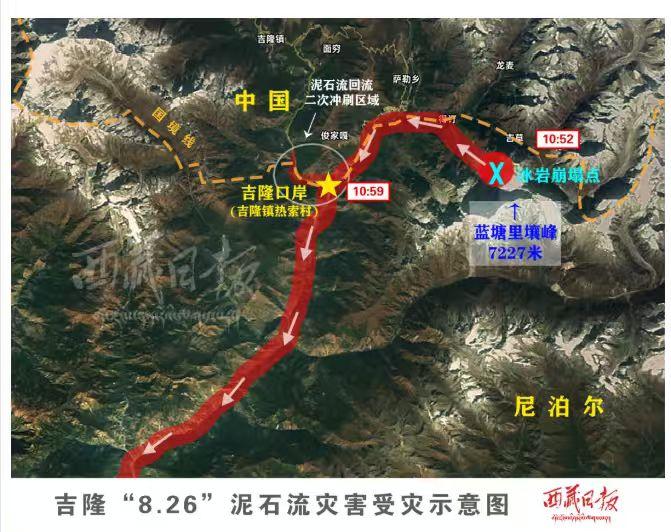
Map: Xizang Daily
On August 26, a massive cross-border mudslide triggered by an icefall from the north slope of Mount Langtang Lirung in Nepal struck communities on both sides of the border.
As of the latest data, 31 people have died and 531 remain missing at China's Gyirong border crossing, while in Nepal, 1,287 people have died and 5,083 remain missing. A reporter from Xizang Daily spoke to relevant experts and officials to find out why.
"The casualties caused by geological disasters largely depend on the scale of human exposure along the disaster corridor," said Yang Yabo, director of the Institute of South Asia Studies, Xizang Autonomous Region Academy of Social Sciences. "The difference in population size between the disaster areas in China and Nepal is a major reason."
Wang Qiang, deputy Communist Party of China secretary and town chief of Gyirong town, Gyirong county, Xizang Autonomous Region, told reporters: "In this disaster-stricken area, people are only found within the 0.7-square-kilometer border zone, mainly government staff from border inspection and customs, nearby merchants and construction workers, with a daily population of about two to three hundred, plus a fluctuating number of domestic and foreign tourists."
Reporters also learned that the closest population center to the Gyirong border crossing is Resuo village, which has a registered population of 54 people across 15 households.
Most of the village was not extensively affected by the disaster and its residents have been relocated and resettled.
According to Zhang Jianghong, assistant researcher at the Xizang Autonomous Region Academy of Social Sciences, the banks of the Bhote Koshi River in Nepal, which was struck by the disaster, are home to densely populated towns such as Syabrubesi and Timure. The valley is also home to well-known mountain trekking routes, drawing tourists from around the world.
"In terms of the scope of impact, the affected area on the Chinese side is concentrated in just the 0.7-square-kilometer border zone, so the disaster’s reach was limited," Zhang said.
However, after the mudslide entered the downstream section of the river in Nepal, the disaster flow spread out fully, radiating in a strip along the entire river valley and striking multiple points, resulting in more affected locations and a longer affected distance.
Yang said: "Overall, the significant difference in the number of missing persons and fatalities between the two locations cannot be simply attributed to differences in the strength of the disasters.
"Rather, it is the result of a combination of factors, including the population density of the affected areas, the size of the impact zone, and the speed of emergency response."