


Tech powers China's sports upgrade in new five-year plan
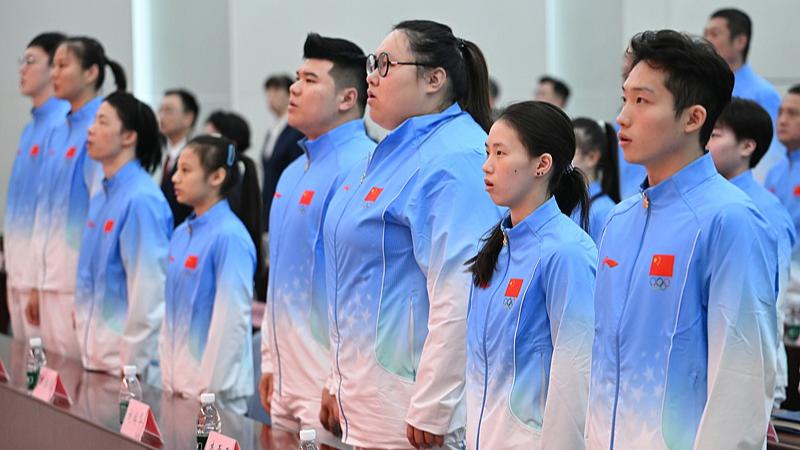
The Chinese delegation for the 20th Asian Games is officially formed in Beijing, September 4, 2026. (Photo: VCG)
As the 2026 Aichi-Nagoya Asian Games approach, technological innovation is becoming a core driver of China's sports development under the newly released 15th Five-Year Plan (2026–2030) sports powerhouse blueprint.
Unveiled by the State Council Information Office (SCIO) at a press conference on September 3, the officially approved plan prioritizes digital and intelligent upgrading across elite sports, public fitness and the sports industry.
According to officials with the General Administration of Sport of China (GAS), tech-enabled training has bolstered China's preparation for the upcoming Asian Games, as well as future Olympic campaigns.
The country is building a full-cycle digital support system powered by AI, big data and cloud computing, covering athlete selection, scientific training, real-time performance analysis and injury prevention.
The system delivers precise, personalized training solutions to sharpen athletes' competitive edge for major international events.
The GAS also announced at the SCIO briefing that authorities will relax restrictions on team establishment, event organization and athlete participation to diversify elite sports development, encouraging enterprises, universities and clubs to join as key partners.
Technology is crucial to standardizing and professionalizing diversified participation in competitive sports.
For public fitness, the GAS outlined a smarter, more precise and inclusive upgrade for China's national fitness system during the 15th Five-Year Plan period (2026-2030).
As stated in the official blueprint, China targets 40% of the population participating in regular physical exercise and 4 square meters of per capita sports venue area by 2030, with over 5,000 newly built or renovated mini sports parks and community fitness venues nationwide.
To meet upgraded public demands, the sports authority will implement an "AI+ fitness" initiative, build big data-based scientific fitness platforms, and deliver personalized exercise guidance for key groups including teenagers, the elderly, chronic disease patients and new-form employment workers.
A closed-loop "assessment-guidance-training" service will further integrate sports and healthcare to cover diverse social groups.
Technological innovation is designated as a core driver for the high-quality upgrading of China’s sports industry, according to the 15th Five-Year Plan sports development blueprint.
Official statistics show that China's sports industry scale reached 5.12 trillion yuan (around $762.8 billion) in 2025, with a national target of exceeding 7 trillion yuan by 2030.
To address weaknesses in core sports equipment technologies, authorities will boost R&D on high-performance competitive gear, smart wearable devices and intelligent venue systems, accelerate domestic equipment substitution and promote the transformation of sports tech research achievements into practical industrial outputs.
New sports industry formats are being fostered through official intelligent sports pilot programs jointly launched by the GAS and the Ministry of Industry and Information Technology.
The programs cover smart training systems, virtual sport events and digital campus sports solutions.
In addition, the national 15th Five-Year Plan explicitly supports the construction of 100 high-quality outdoor sports destinations, with standardized digital supervision to guarantee safe and high-quality development of the outdoor sports economy.
As highlighted in the official sports powerhouse construction plan, the in-depth integration of technology and sports during the 15th Five-Year Plan period will comprehensively boost athletic competitiveness, public fitness welfare and high-quality industrial development, solidifying the foundation of China's sports powerhouse construction.