


First tunnel completed on Kyrgyzstan section as China-Kyrgyzstan-Uzbekistan railway makes major progress
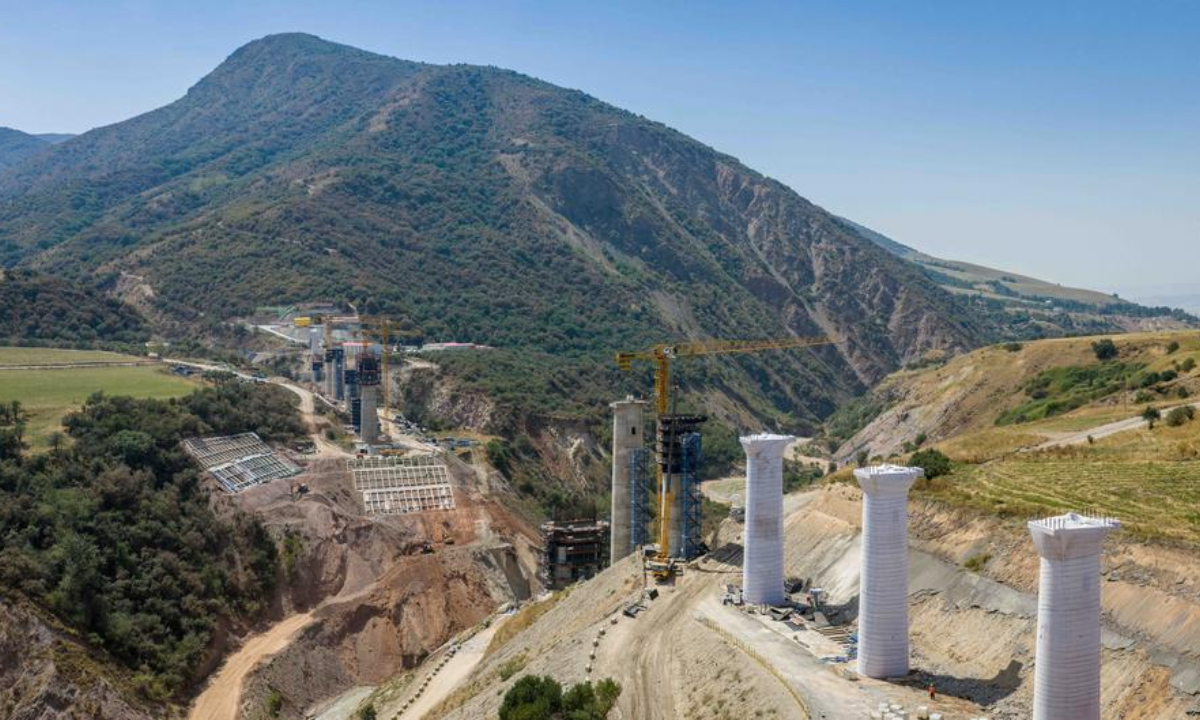
An aerial drone photo taken on Aug. 15, 2026 shows a construction site of a grand bridge above the Kec-Alat River along the China-Kyrgyzstan-Uzbekistan railway in Jalalabad, Kyrgyzstan. (Xinhua/Li Renzi)
The No.2 North Koshtobe Tunnel is 209.6 meters long, with a maximum burial depth of 41 meters. Designed as a single-track tunnel, it was completed on schedule, with the construction team maintaining safety and quality standards throughout the project, an official of the China-Kyrgyzstan-Uzbekistan Railway Co said.
The official said environmental protection has been integrated into the railway's planning and construction. The route was designed to avoid the Saimaluu-Tash National Park and other ecologically sensitive areas, while culverts were added to facilitate wildlife movement and local herding.
The official said major temporary roads and power facilities along the Kyrgyzstan section have been completed and put into operation, ensuring construction of the railway itself. Construction has begun on 27 tunnels, one being completed, as well as 43 bridges and 88 roadbed sections. Foundation work is also under way at 20 stations.
The company has also hired more than 2,000 Kyrgyz employees for railway construction and related work, the official said. Three vocational training centers have been set up in Jalal-Abad Region, Manas and Suzak, providing training in civil engineering, machinery and steel structures to more than 1,800 local workers, with qualified trainees offered jobs on the project, according to the official.
The project has sourced more than 10 billion som ($114 million) worth of materials and equipment locally, the official said. All fuel is purchased in Kyrgyzstan, while more than 60 percent of key construction materials, including cement, are locally sourced. The project has also rented over 1,700 pieces of local machinery, supporting related industries along the route.
The company has invested about 156 million som in local community projects, including village road upgrades, water and power supplies, telecom facilities, medical services and education support, the official said.
The China-Kyrgyzstan-Uzbekistan railway is a flagship Belt and Road cooperation project among the three countries. The route starts in Kashgar, Northwest China's Xinjiang Uygur Autonomous Region, enters Kyrgyzstan through the Torugart Pass, runs west via Jalal-Abad, and ends in Andijon in eastern Uzbekistan.