


Nepal and China hand-in-hand in the mudslide tragedy
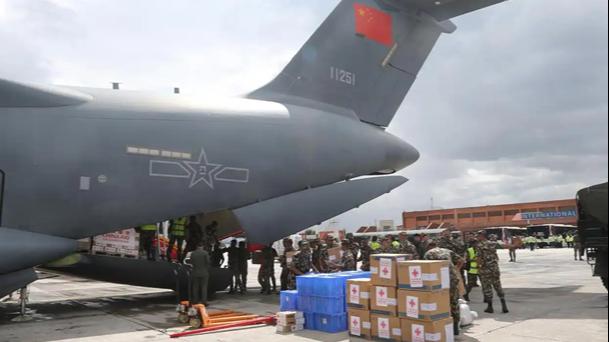
The third batch of emergency relief supplies from China arrives at Tribhuvan International Airport in Kathmandu, the capital of Nepal, September 3, 2026. (Photos: Xinhua)
A widely used Chinese proverb, "tong zhou gong ji," expresses hope that people should pull together in times of troubles. That spirit has been evident since the deadly mudslide on August 26 around Gyirong Port on the China-Nepal border, which connects China’s Xizang Autonomous Region with Nepal’s Rasuwa district.
On the Chinese side, 43 people have been confirmed dead and 519 remain missing. On the Nepali side, as of September 5, 1,344 have been confirmed dead and around 5,000 are said to be missing. Those missing include hundreds of foreigners from dozens of countries including China.
Rescuers and relatives continue to hope that more missing people will be found alive in the Himalayan tragedy which has impacted not only Nepal and China but also the entire world as countries like the United States, the UK, Australia, Japan, South Korea, and others, are eagerly awaiting the whereabouts of their missing citizens who were in Nepal as tourists, experts and workers. Nepal's Prime Minister Balendra Shah has spoken to his counterparts from India, Japan and Australia. South Korean Foreign Minister Cho Hyun arrived in Nepal on September 5 to learn more about the nine South Koreans who went missing while working at a hydropower plant in Rasuwa.
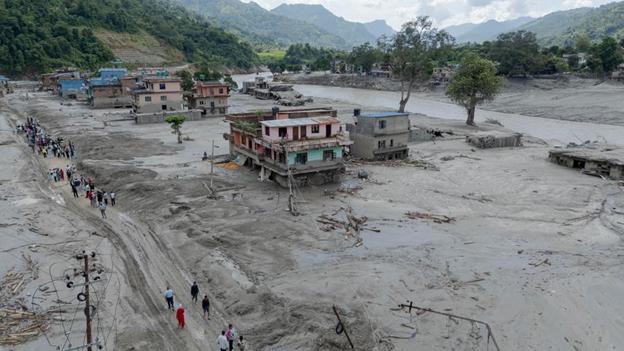
A view of a flood-hit area in Nuwakot, Nepal, August 27, 2026.
For Nepal, the disaster is a tough national tragedy for multiple reasons. First, as explained by Nepal's Finance Minister Swarnim Wagle, it has damaged one tenth of the national economy, let alone the loss of China-Nepal borderland transit infrastructures, great hydropower experts and engineers, experienced tourism professionals, elected local leaders, and hardworking bureaucrats, among others. My current media house (Shilapatra Media Network)'s publisher Suresh Simkhada is also missing. He was on his pilgrimage to Mt. Kailash located in China's Xizang Autonomous Region. Other pilgrims travelling through the border region have also been reported missing.
Despite being a victim itself, China's humanitarian gesture to Nepal is praiseworthy. Support came from both the government and members of the Chinese community in Nepal. At the state level, Chinese President Xi Jinping sent heartfelt condolences and solidarity on the tragedy to Nepal's President Ram Chandra Poudel on August 29. Poudel responded, "In this hour of national grief, the PRC's prompt support once again reaffirms the enduring strength of our time-tested bilateral friendship."
On the public level, Chinese expats living in Nepal also displayed the Himalayan height of their humanitarian concern. On September 2, they handed over 5 million Nepali Rupees on behalf of their organization.
Besides these types of support, China has also sent some much-needed experts on tunnel rescue and DNA identification to Nepal. Nepal’s political and administrative leadership has expressed gratitude for China’s generosity in this flood tragedy. Nepal's Foreign Minister Shisir Khanal said, "We are extremely grateful for the very proactive support that the government of China has given to us at this point." Khanal also thanked China for sharing "satellite and other monitoring data" to support Nepal's disaster response.
A week ago, Lok Bahadur Poudel Chhetri, a spokesperson for Nepal's Ministry of Foreign Affairs, praised China in its regular press briefing. He said, "We are grateful to the Chinese government for providing all the assistance. The team for rescue operations is already on site, and more important items for rescue support are already in Kathmandu, and more is coming."
China has left no stone unturned in helping Nepal during this difficult period. China is also well placed to support Nepal’s future disaster-preparedness efforts. Recently, I talked to Nitesh Khadka who obtained his PhD from the Institute of Mountain Hazards and Environment under the Chinese Academy of Science. He opined on the permanent Chinese assistance on mountain monitoring and Glacial Lake Outburst Flood monitoring for Nepal. Khadka said, it is possible as "Nepal and China have good ties."
The tragedy along the China-Nepal border has once again shown the spirit of standing together in times of adversity. While Nepal has mobilized its rescue forces and received support from the international community, China, despite being a victim of the disaster itself, has provided timely humanitarian assistance, specialized rescue expertise and critical monitoring data, demonstrating the depth of the two countries’ long-standing friendship. More importantly, the disaster has highlighted the highly sudden and rapidly cascading nature of transboundary mountain hazards, as well as the urgent need for joint prevention and response.
Looking ahead, China and Nepal are likely to further deepen their cooperation across the entire chain of mountain disaster monitoring and early warning, while comprehensively strengthening their capacity for coordinated response to geological disasters along the Himalayas. Such practical cooperation will not only help both countries better protect lives and livelihoods, but also add new meaning to the enduring friendship between the two countries, a friendship tested and strengthened in times of adversity.