


China-Nepal friendship holds strong amid mudslide disaster
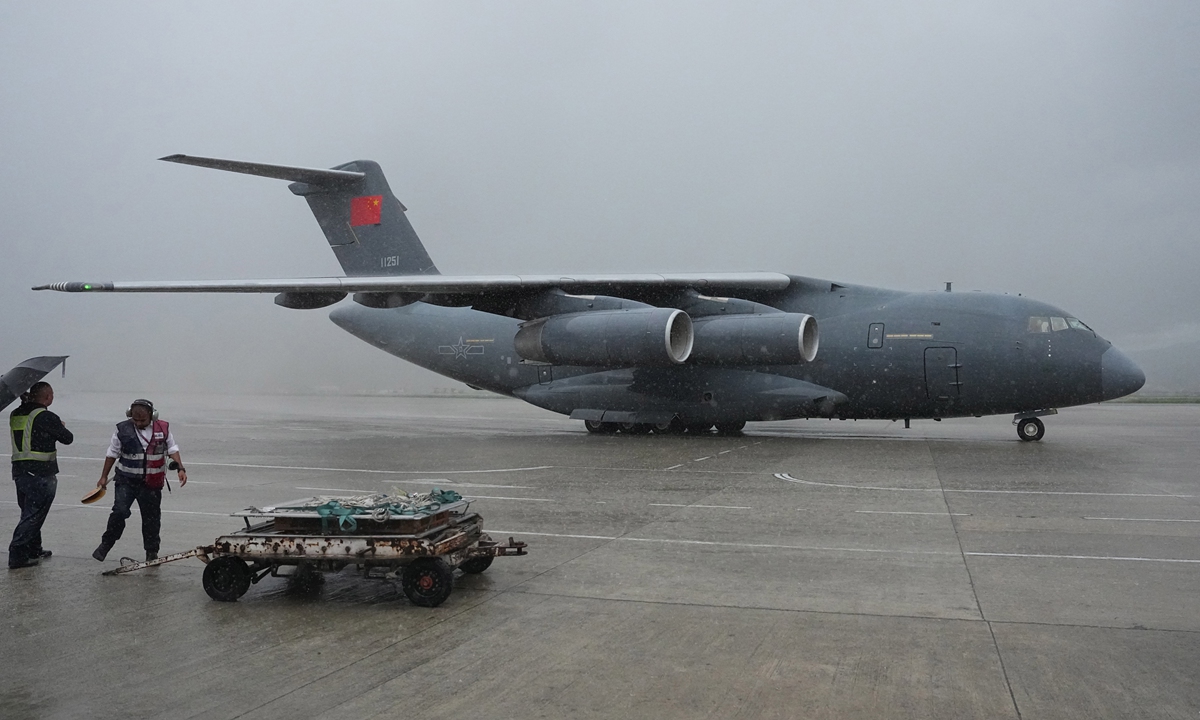
A Chinese People's Liberation Army (PLA) Air Force Y-20 transport aircraft arrives at the Tribhuvan International Airport in Kathmandu, Nepal, carrying China's second batch of emergency humanitarian aid for the Nepal mudslide disaster relief, on September 1, 2026. (Photo: VCG)
Nepal and China are a community linked by mountains and rivers. This has been one of the most frequently repeated phrases in formal speeches and informal conversations alike. This August, the enduring China-Nepal friendship has withstood the test of the mountains and rivers.
The deadly debris flow on August 26, which struck the China-Nepal border area, was not just an ordinary flood - many survivors described it as a "Himalayan tsunami." Triggered by a high-altitude geological event, the disaster unleashed a massive surge of ice, rock debris and water into the Lende Khola and Bhote Koshi river systems from Langtang Lirung. Border points such as Timure, Syabrubesi and Gyirong Port were among the hardest hit.
The intensity of the disaster was unimaginable. The loss is unbearable; the latest official figures report over 1,300 deaths and around 5,000 missing persons in Nepal, as well as over 40 deaths with nearly 550 missing in China. The devastation is heartbreaking, and a significant challenge of rehabilitation and recovery lies ahead.
The scientific community believes that the mudslide was triggered by the collapse of high-altitude glaciers in Nepal. As glaciers retreat and ice masses become increasingly unstable, ice and ice-rock avalanches are emerging as a growing threat in high-altitude regions - one that remains extremely difficult to predict. However, the situation is not limited to a natural disaster or climate crisis. Multiple narratives began to divert attention from the very first day of the disaster, including claims that the mudslide originated from the Chinese side or that China did not share prior forecasting information. These accusations intensified over the following days, sparking blame games and escalating into a geopolitical coldness. This latest disaster exposes the risk that external actors with hidden agendas attempt to manipulate the situation to sow discord between China and Nepal.
Over the past two weeks, I have interviewed dozens of people - survivors, families of the victims, displaced communities, and others directly or indirectly affected by the floods. I spent six days reporting on the ground in the districts of Rasuwa, Nuwakot and Dhading. At the community level, there is a sense of gratitude toward the Chinese side for sending expert teams to support rescue operations and for its generous disaster response.
Karbir Gaire, one of the few who survived the flood by mere seconds in Timure, the nearest stop to the China-Nepal border, is an officer at the local customs office. I interviewed Gaire on the second day following the flood, during which he expressed disappointment at the groundless blame directed toward China.
Madhav Prasad Aryal, chairman of Uttargaya Rural Municipality in Rasuwa, has lost more than 550 people from his municipality alone, with hundreds of families displaced. When Chinese nationals involved in the buffalo meat export project arrived with relief materials after a 15-hour drive, he was deeply moved by their gesture and expressed his gratitude for China's continued support. Locals in Nuwakot and Dhading shared similar sentiments regarding China's role.
On the government side, Nepali ministers and officials have emphasized that the national priority is disaster response. They acknowledged that China's contributions in rescue assistance, relief supplies, data sharing and other emergency support have been invaluable. Despite facing losses on its own side, China has offered support to help Nepalis heal more quickly from their pain.
More bilateral cooperation is expected. There is a critical need for cross-border cooperation on early warning systems, glacial lake monitoring, upstream risk management, and real-time sensor networks, among other measures. The two countries must stand together to protect themselves from such disasters. Furthermore, support for research institutions and expert teams specializing in cross-border geology must be strengthened. Such cooperation should transcend borders, the Himalayas and shared rivers. Addressing climate change is a shared responsibility of the international community.
People from both countries can overcome this tragedy only through solidarity and joint efforts. Blame is no solution in times of grief and crisis. While walking across the Bhote Koshi river recently, I was reminded: "The dead deserve dignity. The missing deserve rescue. And the truth deserves patience."
There is no place for anti-China narratives while people are grieving. They have lost loved ones, homes, land, dreams, and for many, their hopes. In such moments, Nepal cannot afford to be anyone's geopolitical tool. The country must rise and build back better, and for this, the role of the northern neighbor is most significant as an all-weather friend.