


Smart traffic control helps Tibetan antelopes migrate safely in Qinghai
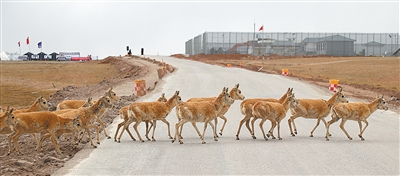
Tibetan antelopes safely cross National Highway 109. (Photo: People's Daily)
It was after 7 p.m., and the sun was sinking in the west. More than 50 Tibetan antelopes had gathered beside National Highway 109 near the Wudaoliang Conservation Station in Hoh Xil, northwest China's Qinghai Province, waiting to cross. As the red light came on, traffic came to a halt. The lead antelope bounded onto the road, paused briefly to look both ways, then quickly crossed, followed by the rest of the herd.
In late August, Tibetan antelopes that have given birth in the heart of Hoh Xil begin their return journey with their young. As a major route into southwest China's Xizang Autonomous Region, the Qinghai-Xizang Highway section of National Highway 109 sees heavy traffic.
For Tibetan antelopes, crossing the highway takes just a dozen or so seconds, but it is no easy feat. Every migration season, police at Hoh Xil and rangers come here to safeguard the herds. Whenever they spot Tibetan antelopes gathering to cross, they immediately impose temporary traffic controls.
In the past, Zhao Xinlu, deputy director of the Public Security Bureau at the Hoh Xil National Nature Reserve, would lie flat on the ground until the entire herd had crossed. Tibetan antelopes are highly sensitive and may hesitate at the slightest noise, disrupting their migration. To prevent this, police officers set up checkpoints at a distance on both sides of the road. Staff members spend the entire day outdoors, stopping vehicles more than 10 times until the antelopes have safely crossed.
This year, seasonal smart traffic lights were installed on the Wudaoliang section of National Highway 109 for the migration season. Police can control the signals remotely, switching them to red as a herd approaches and restoring traffic only after all the animals have crossed. This approach helps balance wildlife conservation with efficient traffic flow on the highway.
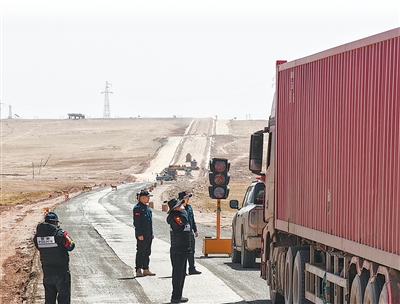
Police maintain traffic order at Hoh Xil, northwest China's Qinghai Province. (Photo/Zongzhou Yongdan)
Zhao said they use Tibetan antelope monitoring equipment developed by the Chinese Academy of Sciences to remotely monitor the animals around the migration corridor.
"We can clearly see herds gathering within 5 kilometers," he added. Once Tibetan antelopes show signs of preparing to cross, police immediately activate the traffic lights and impose temporary traffic controls.
The Wubei Bridge on the Qinghai-Xizang Railway, near the Wudaoliang Conservation Station, is one of the passages used by migrating Tibetan antelopes. Trains speed across the bridge, while beneath it, the Tibetan antelopes have grown accustomed to passing through.
This year marks the 20th anniversary of the full opening of the Qinghai-Xizang Railway. Zhao recalled that before construction began on the Golmud-Lhasa section, railway authorities sought input from the reserve and built 33 wildlife passages based on the Tibetan antelopes' migration routes and habitats. Today, Tibetan antelopes have come to accept the railway bridge as their "steel neighbor," with some even seeking shade and shelter from the rain beneath it.
Today, the Tibetan antelope population in Hoh Xil has recovered to more than 70,000, and the figure keeps growing.