


The dream of spaceflight is never beyond reach: Shenzhou-23 crew gives Tiangong Classroom to HK, Macao students
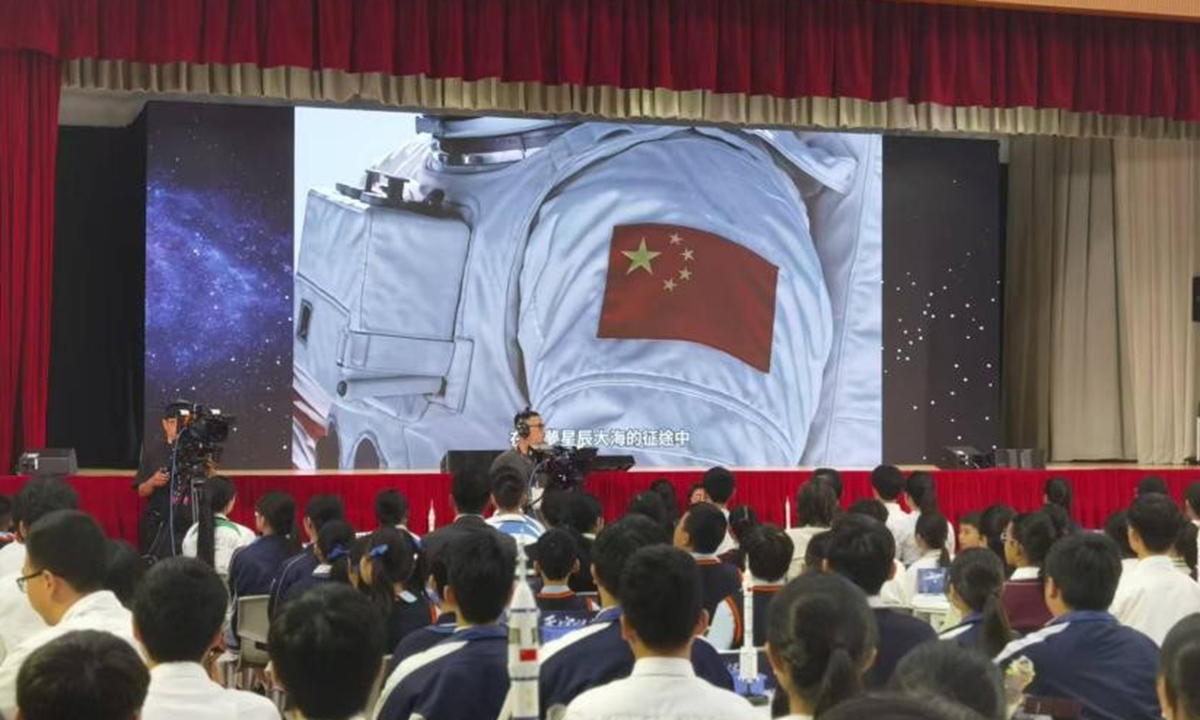
Middle school students from China's Hong Kong Special Administrative Region watch the live Tiangong class on September 9, 2026. (Photos: CCTV News)
The "Tiangong Classroom" Hong Kong and Macao Designated Session was held in a middle school in China's Hong Kong Special Administrative Region (HKSAR) on Wednesday morning, with the Shenzhou-23 crew aboard China's space station bringing a live science lesson to students in Hong Kong and Macao, CCTV News reported on Wednesday.
Commander Zhu Yangzhu, spacecraft pilot Zhang Zhiyuan and Li Jiaying, or Lai Ka-ying in Cantonese, the first astronaut from Hong Kong to travel to space, explained scientific principles and demonstrated experiments in orbit, marking the fifth Tiangong Classroom session conducted from China's space station.
Addressing the event, John Lee Ka-chiu, chief executive of HKSAR, said Lai's story shows that a dream of spaceflight is never beyond reach, encouraging young people to take astronauts as role models, equip themselves with knowledge and skills, and pursue their own dreams of exploring the stars, per CCTV News.
During the lesson, the astronauts demonstrated several interesting space science experiments and introduced the three-module configuration of the space station and the functions of its different modules, according to Science and Technology Daily.
The astronauts interacted with students in Hong Kong and Macao through a live video link. At the beginning of the broadcast, Lai demonstrated a spinning gyroscope, noting that it was the same teaching device used by Chinese astronaut Wang Yaping in the first Tiangong Classroom session, Phoenix New Media reported.
They also showed students facilities including the space kitchen and space garden, with foods including cheese and several Chinese dishes on display. The hot-air oven installed aboard the space station not only addresses the challenge of removing cooking fumes in the enclosed environment, but also can heat food to 190 C, allowing astronauts to enjoy hot pumpkin.
Lai said she had even baked a cake that morning. The golden-brown cake and its aroma reminded her of her favorite Hong Kong snack, egg waffles, per local media.
The Multi-spectral Imaging Carbon Observer, known as the Tianyun camera, the first Hong Kong-developed payload to be sent into space, was also introduced during the session. As the world's first lightweight, compact instrument capable of simultaneously detecting carbon dioxide and methane, it can precisely identify sources of greenhouse gas emissions worldwide from an altitude of 400 kilometers and quantify emission levels. The instrument is currently operating well outside the space station, CCTV News reported.
Astronaut Zhu also said that the space station's water regeneration and recycling rate has now reached an internationally advanced level.
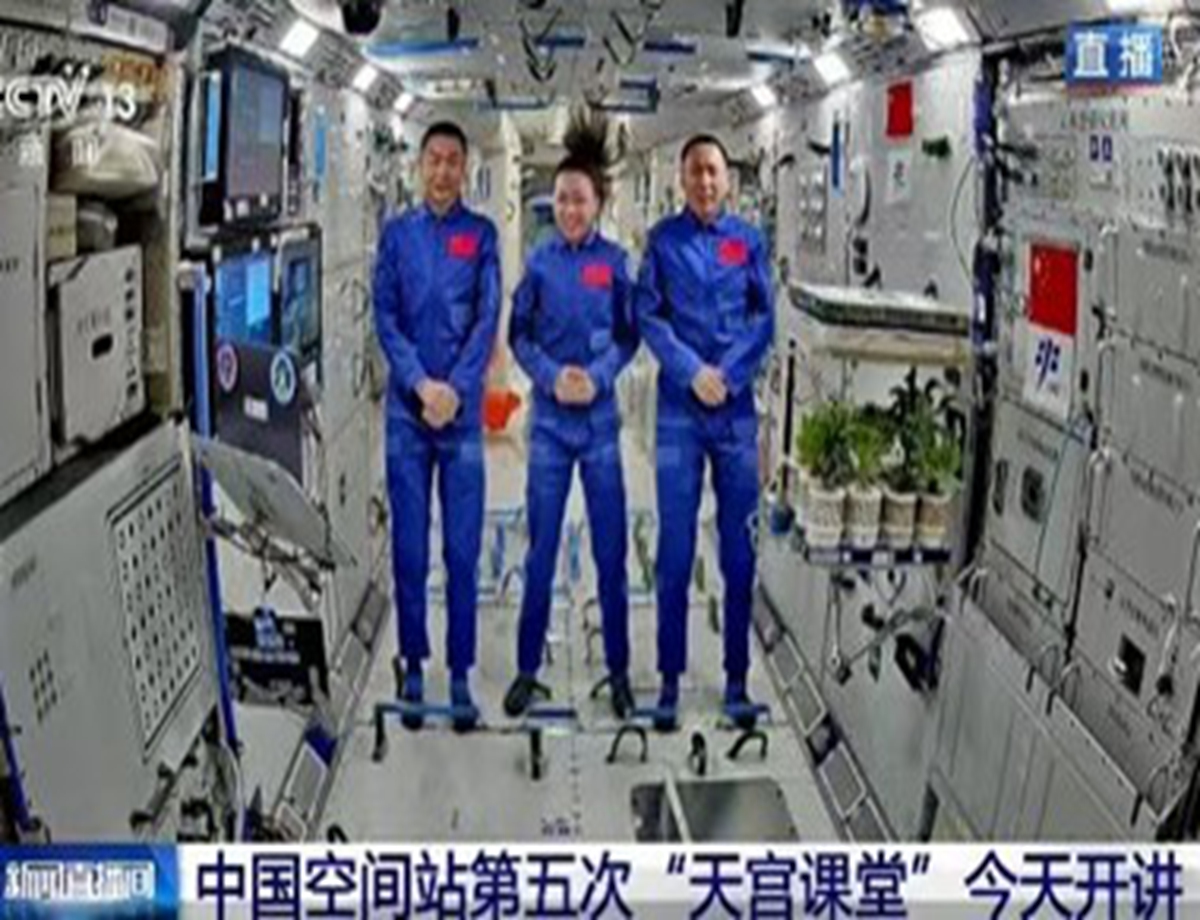
Shenzhou-23 crew gives a live science lesson to students in Hong Kong and Macao in a Tiangong class on September 9, 2026.
Wong Kam-leung, chairman of the Hong Kong Federation of Education Workers, arranged for teachers and students from a school to watch the live broadcast. He told the Global Times that the students were "full of curiosity about the universe" and visibly excited by the lesson.
"Through real-time interaction between space and Earth and live experiments, profound scientific principles become vivid and engaging in the microgravity environment, stimulating the interest of young people in Hong Kong toward aerospace science and technology and cultivating their spirit of inquiry," Wong said.
Lai's participation was particularly meaningful for Hong Kong students, he said, as she has set an example for them by demonstrating through her own experience that those who dare to pursue their dreams and work hard to equip themselves can eventually realize those dreams and take part in the country's space program.
More importantly, the central government's decision to organize a special Tiangong Classroom session for Hong Kong and Macao demonstrates its care and support for young people in the two regions, Wong said.
The lesson also allowed teachers and students to interact directly with astronauts and gain a deeper understanding of China's achievements in space science and technology, strengthening their sense of pride and belonging to the country, he added.
Behind the seemingly seamless "space-Earth dialogue" is an integrated communications and tracking network that has created a high-speed "space communication route."
According to Science and Technology Daily, voice and video signals from astronauts aboard the space station are transmitted through the station and relay satellites before reaching the Beijing Aerospace Control Center (BACC). The signals are then transmitted through communication links to the classroom on Earth.
Questions and responses from teachers and students on the ground travel through the network in the opposite direction, enabling astronauts and students to interact with almost no noticeable delay.
The combination of "people going into space" and "Hong Kong-developed equipment going into space" highlights the increasingly close integration of Hong Kong's scientific and technological capabilities into China's national space program, according to local media reports.