


China achieves breakthrough in rare-metal separation technology with world’s first continuous tower extraction line
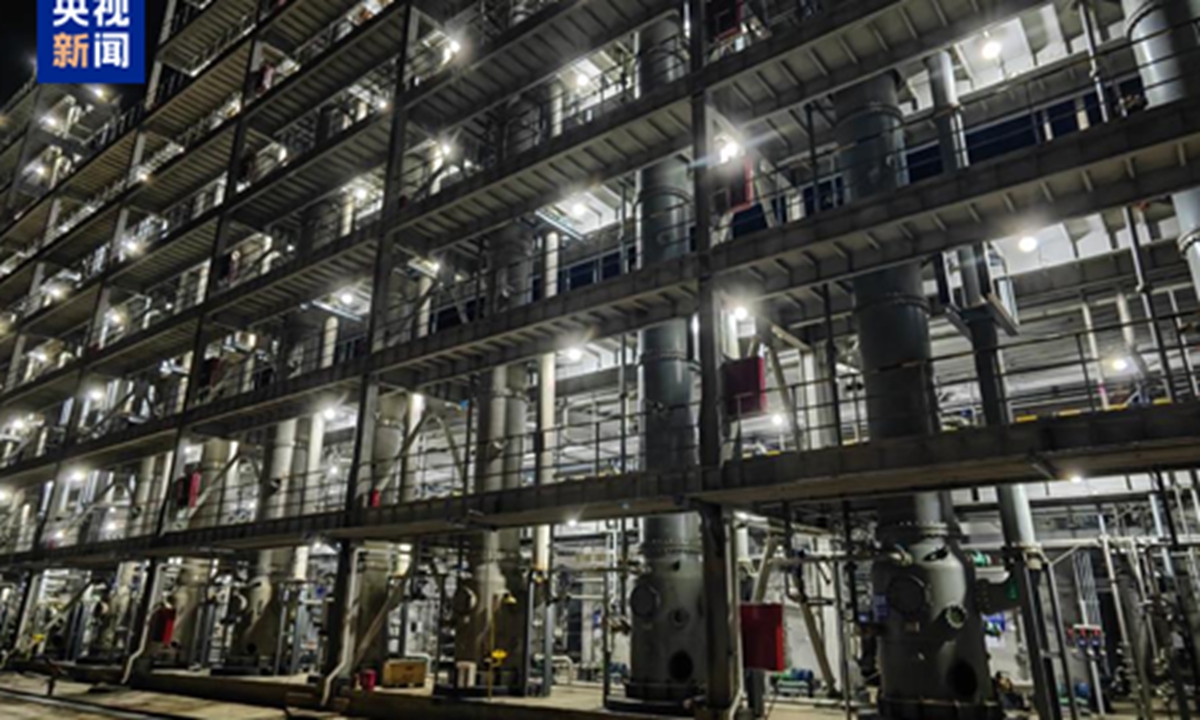
A 1,000-ton-scale continuous tower extraction demonstration line for producing rubidium carbonate and cesium carbonate in East China's Jiangxi Province. (Photo: CCTV News)
China has put into stable operation the world's first demonstration production line using continuous tower extraction technology to recover rubidium and cesium from lithium ores, marking a major advance in the country's green separation technology for rare metals, according to the Chinese Academy of Sciences (CAS).
The production line, jointly developed by the Institute of Process Engineering under the CAS and Ganfeng Lithium, is located in East China's Jiangxi Province. It can efficiently recover rubidium and cesium, two valuable rare metals often found in small amounts alongside lithium, and produce rubidium carbonate and cesium carbonate with purity levels above 99.9 percent. The products have already entered the market, the Xinhua News Agency reported on Wednesday.
Rubidium and cesium are used in high-end industries including aerospace and precision instruments. However, China has limited deposits of pollucite, a mineral that can be directly mined for cesium. Much of the country's rubidium and cesium resources are instead found in low concentrations in lithium ores and salt-lake brines.
Recovering these metals has long been difficult because their concentrations are low while the mineral solutions contain many other substances. Traditional separation methods often require large amounts of equipment and chemicals, making the process costly and making it more difficult to produce high-purity products.
To address the problems associated with traditional separation methods, researchers and the company developed a tower-based extraction system. Compared with traditional extraction equipment, one of the new towers can handle a workload equivalent to as many as 15 conventional units, while reducing the use of extraction chemicals by 40 percent and cutting the required floor space by more than half, according to the CAS.
Notably, the new equipment also has improved sealing, helping make the production process cleaner and more environmentally friendly.
The full industrial system consists of 17 extraction towers. After lithium has been recovered from the ore, the remaining mineral solution is sent into the system, where rubidium and cesium are separated and purified through several stages.
Operating data from the production line show that the overall recovery rate for cesium is above 98 percent, while that for rubidium exceeds 95 percent. The line has been able to steadily produce high-purity rubidium and cesium salts on an industrial scale.
A project official said the demonstration line shows that tower extraction technology can be successfully applied to the production of key metals, according to the report.
In the past, rubidium and cesium contained in lithium ores were often left unused during lithium production. The new process makes it possible to recover more valuable resources from the same ore, improving the overall use of lithium deposits instead of allowing associated rare metals to go to waste.
The project is a major result of a broader research program on the safe and efficient use of special lithium ores. The CAS said the technology could help improve China's comprehensive use of lithium resources while strengthening the supply security of rare metals such as rubidium and cesium.