


Ancient proteins reveal Denisovans' survival landscape in South China for the first time
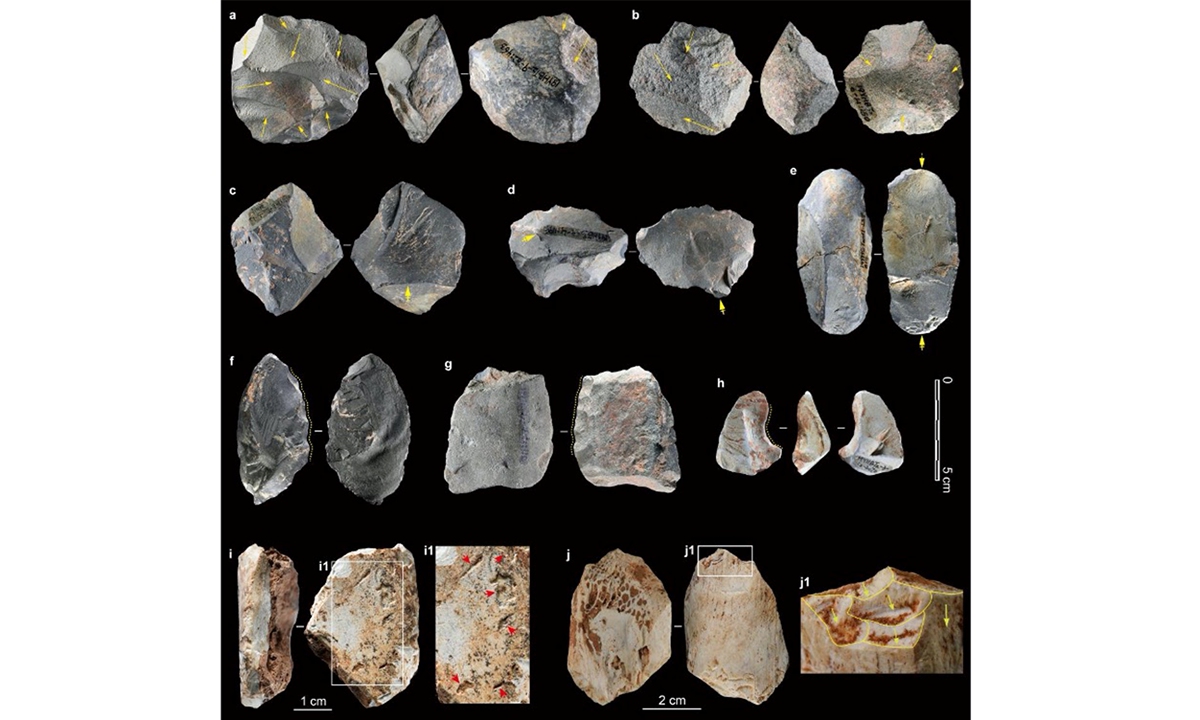
The stone artifacts unearthed from the bat cave site in Heqing, Southwest China's Yunnan Province Photo: The Institute of Tibetan Plateau Research (ITP), Chinese Academy of Sciences (Photo: CAS)
Through a multidisciplinary study of the bat cave site in Heqing, Southwest China's Yunnan Province, an international research team led by Chinese Academician Chen Fahu from the Institute of Tibetan Plateau Research at the Chinese Academy of Sciences (CAS) has for the first time systematically revealed the physical morphology, technological behaviors, and survival strategies of Denisovans in South China.
Published in Nature under the title "Ancient proteins identify various Denisovan remains from Southwest China" on Wednesday, the study reconstructs a comprehensive survival landscape of this ancient human group on the southeastern margin of the Qinghai-Xizang Plateau, according to an official release on WeChat from the Institute of Tibetan Plateau on Thursday morning.
Situated in the Heqing Basin at an altitude of 2,370 meters on the southeastern margin of the Qinghai-Xizang Plateau, the site contains a 6.6-meter-thick deposit with 10 cultural layers dating from 190,000 to 70,000 years ago.
Archaeologists excavated seven human fossils, including four teeth, two parietal fragments, and one proximal radius segment. To understand hominin occupation at the site, researchers conducted proteomic analysis on the fossils, confirming that three bones and two teeth belong to Denisovans, dating back to 167,000 to 134,000 years ago, according to the release.
The dental morphology exhibits a mix of primitive and derived Homo traits—similar to yet distinct from the Xiahe Denisovan specimen found in Baishiya Karst Cave in Northwest China's Gansu Province.
This suggests potential regional morphological variation among Asian Denisovans, indicating that the Bat Cave group may represent a distinct regional type within the Homo longi lineage, per the release.
An analysis of more than 1,300 stone artifacts reveals remarkable long-term technological stability across deep stratigraphic layers. The tool assemblage is dominated by expedient flaking and retouching techniques, supplemented by organized centripetal flaking, which demonstrates a highly flexible and pragmatic survival strategy.
Additionally, diverse bone tools—including retouchers, wedges, and opportunistic tools—were identified during the archaeological analysis. Their technical combination resembles Middle Paleolithic Neanderthal bone industries, highlighting bone processing as a core component of early human behavior in East Asia.
The faunal remains were dominated by deer and bovids, mostly prime-age adults. Extensive cut marks and percussion marks indicate specialized hunting, butchering, and meat consumption of medium-to-large ungulates, per the release.
The site's 100,000-year cultural sequence demonstrates that Denisovans adapted stably across glacial-interglacial climate fluctuations while living in a pine-dominated forest or forest-steppe environment.
Alongside the Baishiya Karst Cave site in the northeastern Qinghai-Xizang Plateau, the bat cave site provides crucial evidence for understanding the cultural and environmental adaptation of different Denisovan populations in East Asia.
Located in a critical geographic corridor between Siberia, the Qinghai-Xizang Plateau, Southeast Asia, and Oceania, the site serves as a vital bridge connecting northern and southern East Asian Denisovan records. It offers direct archaeological context for explaining the relatively high proportions of Denisovan genetic ancestry found in modern Southeast Asian and Oceanian populations.