


Combination of research strengths from the mainland and Hong Kong can indeed produce a '1+1>2' effect: Tianwen-3 Hong Kong project researcher tells GT
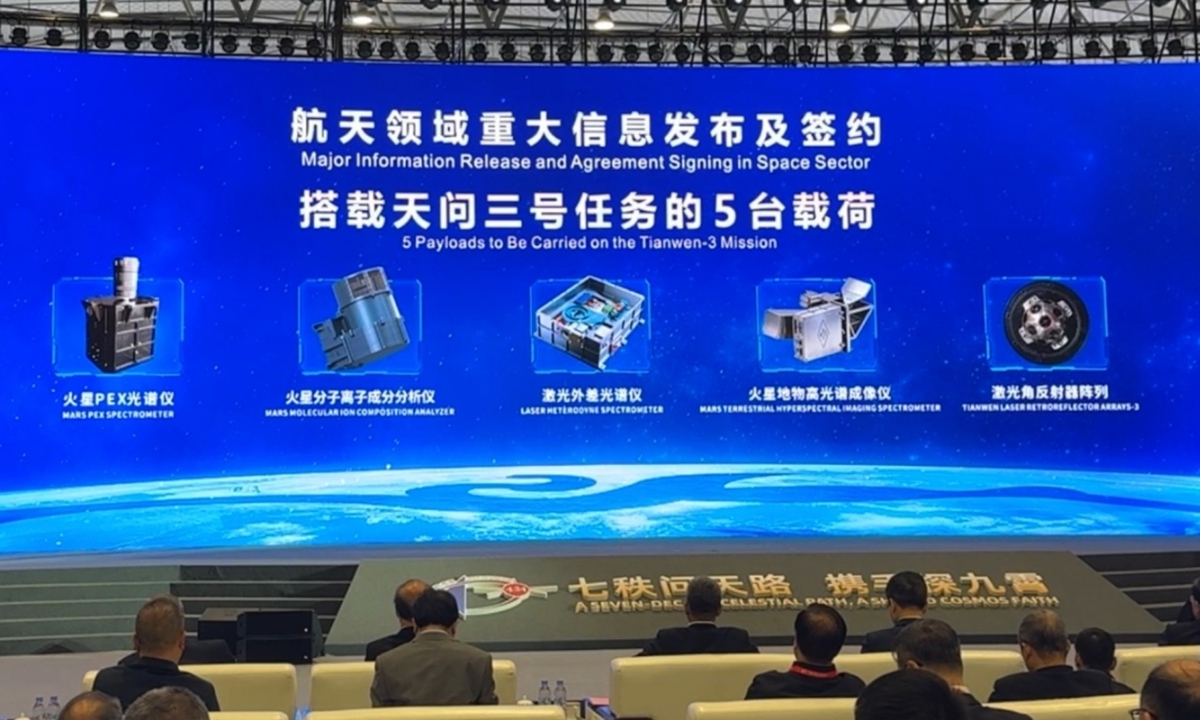
The signing ceremony for five payloads to be carried on the Tianwen-3 mission is held on April 24, 2026, in Shanghai. (Photo: CCTV News)
As students in Hong Kong and Macao watched live science experiments unfold hundreds of kilometers above Earth during the "Tiangong Class" Hong Kong and Macao Designated Session on Wednesday, Hong Kong's first astronaut Lai Ka-ying was among the Shenzhou-23 crew leading the class — a vivid reflection of growing participation of Hong Kong in the country's major space programs.
Among these efforts, the Laser Heterodyne Spectrometer project was selected as one of the cooperation projects for China's Tianwen-3 Mars Mission. Ren Wei, a professor at the Chinese University of Hong Kong (CUHK) and participant of the university's project team, said in an interview with the Global Times that the technology can measure water and its isotopes in the Martian atmosphere while meeting the stringent weight and power constraints of deep-space missions.
As the selection process for cooperation projects for the Tianwen-3 mission involved competition among dozens of teams from around the world, the development timeline for the payload was extremely tight. The team therefore went into full gear and began development work ahead of schedule.
"This is not only the first time that CUHK has 'looked beyond Earth' toward Mars, but also the first time our team has sent its own research beyond Earth," Ren said. "It is an important breakthrough for our research team, and more importantly, it demonstrates how universities in Hong Kong and Macao and research forces on the mainland can work closely together to serve the country's major strategic needs."
Ren further noted that in the past, Hong Kong had little access to such major national needs, but as exchanges and integration with the mainland have deepened, Hong Kong has gradually gained opportunities to understand the problems the country needs to solve.
"We don't have launch sites in Hong Kong, and we can't go to the deep sea or the polar regions. But the mainland provides a very large platform, where we can bring our original ideas and put them into practice, ultimately turning them into reality," Ren said.
In the development of this project, mainland and Hong Kong teams also worked together closely and efficiently. Ren said that when it comes to payload development itself, the mainland research team has far more experience, with clear management framework and coordination mechanism.
"On the other hand, Hong Kong's strength may lie in some original ideas. Sometimes we may even be a little too imaginative, but these seemingly wild ideas can occasionally help solve long-standing bottlenecks," Ren said. "The combination of the two sides can indeed produce a '1+1>2' effect."
"We hope this project can further spark people's enthusiasm for space exploration and also give them a deeper understanding of the country's major projects," Ren said.
In recent years, Hong Kong and the mainland have carried out extensive cooperation in the aerospace field. Ren said that undergraduate students in aerospace-related programs at CUHK have opportunities to visit the mainland for study tours once or twice a year. If students hope to develop further in this field in the future, exchanges with the mainland will be crucial to the training of both undergraduate and graduate students.
He noted that two mainland participants in the Tianwen-3 project are also PhD graduates trained by his team. "On the one hand, we train and provide talent for mainland research institutions; on the other hand, we can maintain sustained cooperation through them. I think this kind of relationship based on mutual trust and mutual support is very important."
"Everyone has a dream of space exploration when they are young. The universe is something we have always looked up to, and now that we have an opportunity to truly take part in it, we feel deeply honored," Ren said. "We hope young people can develop an interest in aerospace from an early age. Curiosity is like a seed — as children learn more over time, they may eventually choose to pursue a career in the field."