


European companies double down on China’s services market at CIFTIS 2026
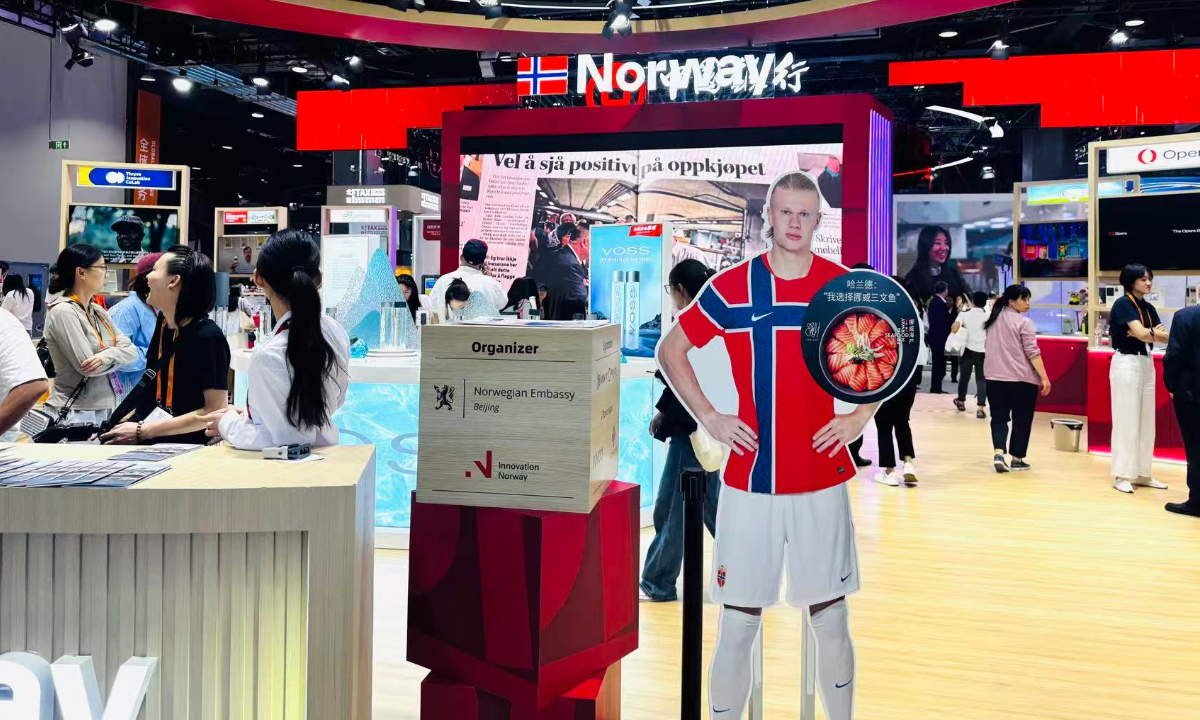
A view of Norway’s national pavilion at the 2026 China International Fair for Trade in Services on September 10, 2026 (Photo: Liu Yang/GT)
Stepping into the thematic hall of the ongoing 2026 China International Fair for Trade in Services (CIFTIS), one is immediately greeted by a life-size cutout of Erling Haaland in a Norway jersey, who became a viral sensation in China during the 2026 FIFA World Cup, driven by his stellar goal-scoring performances for Norway and his highly engaging social media presence.
Behind it stands Norway’s national pavilion at this year’s CIFTIS. A crowd of visitors cluster around the booth — some leaning in to study the origin labels on the salmon, while others holding brochures and asking staff about pricing and supply channels for the purified water on display.
This year, Norway serves as the guest country of honor at the fair. It has built a national pavilion of about 260 square meters at Beijing’s Shougang Park, highlighting Norwegian strengths and innovation in marine industries, health and nutrition supplements, agritech, energy, and digital services.
Øystein Jakobsen, an entrepreneur serving the Nordic Light Festival, told the Global Times on Thursday that “I’m exploring possibilities to link the Chinese art world with innovation, particularly through cultural exchange and collaboration.”
According to Jakobsen, his specific business involves art galleries, exhibitions, and a distinctive form of artwork created from collected garbage – transforming discarded materials into canvases, which is in line with China’s efforts to develop circular economy.
SigbjØrn Vikan, chairperson from Kosli Holding, made his first trip to China through the 2026 CIFTIS. He told the Global Times on Thursday on the booth that China's utilities sector like drinking water offers enormous opportunities for growth — enough room for multiple brands to thrive together.
“I hope to use CIFTIS as a platform to connect with Chinese manufacturing services and technological resources, and to explore a viable path for bringing high-quality Norwegian drinking water into the Chinese market,” he said, “And we have already had a contact for services chain, for the machinery technology and robots.”
If some Norwegian companies are the "new faces" at CIFTIS, then Stibo Systems, a provider of master data management solutions from Denmark is very much a seasoned regular — this marks its fourth time at the fair.
Wang Jinchao, managing director of Stibo Systems China, told the Global Times on Thursday that Chinese clients’ expectations for data service companies, especially software providers, have shifted markedly in recent years. Where basic functionality once topped the list, today they weigh whether the company understands local ecosystem, and how businesses across industries actually operate.
Wang noted that CIFTIS brings together a critical mass of large enterprises, clients and partners, making it easier for companies to understand the needs and market positioning of both their clients and those clients' customers, and ultimately to serve them better.
“Client demands in the Chinese market are rising, and local companies are growing stronger by the day. Stibo's main competitors have shifted from international brands to domestic players,” Wang said. Still, he believed the market remains worth deeper cultivation — and that the valuable feedback absorbed from China has already been integrated into the company's global products.
“The actions of Chinese companies can now visibly shape short-term global logistics supply and demand,” said Xiao Yao, general manager of the North China region at Danish international freight forwarder Scan Global Logistics, in an interview with the Global Times on Thursday.
According to Xiao, China's services trade market has undergone marked changes in recent years, with emerging industries creating new opportunities. The rapid growth of new-energy vehicle exports, for example, has generated strong market demand.
“Logistics peak season used to be more closely associated with the Spring Festival or the launch of new smartphone models. Today, shopping events such as ‘Double 11’ and ‘Double 12,’ as well as the launch of new models by domestic car brands, are also becoming important drivers of market demand,” Xiao noted.
French sportswear giant Decathlon’s Beijing regional headquarters makes its CIFTIS debut at the sports services-themed exhibition.
“For Decathlon, CIFTIS is a valuable opportunity to observe China's sports consumption trends and exchange practices with industry partners. For the sports industry as a whole, the value of the fair lies not only in displaying products and services, but also in fostering deeper connections among sports consumption, sports services and related industry resources through open exchange,” Zhao Jie, head of public relations and media communications at Decathlon China, told the Global Times on Thursday.
China’s sports consumption is shifting from “buying gear” to “buying experiences,” and we remain confident in the long-term growth of China's sports and services markets, Zhao said, noting that for a global company like Decathlon, China's appeal lies not only in its vast consumer demand, but also in its steadily improving industrial system, innovation ecosystem and services consumption scenarios.
Despite persistent policy pressure on China from the EU, European companies' interest in China's services market shows no sign of waning. From marine industries to digital services, from logistics and supply chains to sports consumption, European companies are seizing the opportunities presented by China's growing services sector.
While meeting growing consumer demands in China, they are also drawing innovation from the Chinese market in return, feeding it back into the upgrading of their own products. This two-way, mutually reinforcing dynamic is becoming the new normal in China-Europe services trade.