


US' open door for Chinese automakers little more than a verbal gesture, analysts say
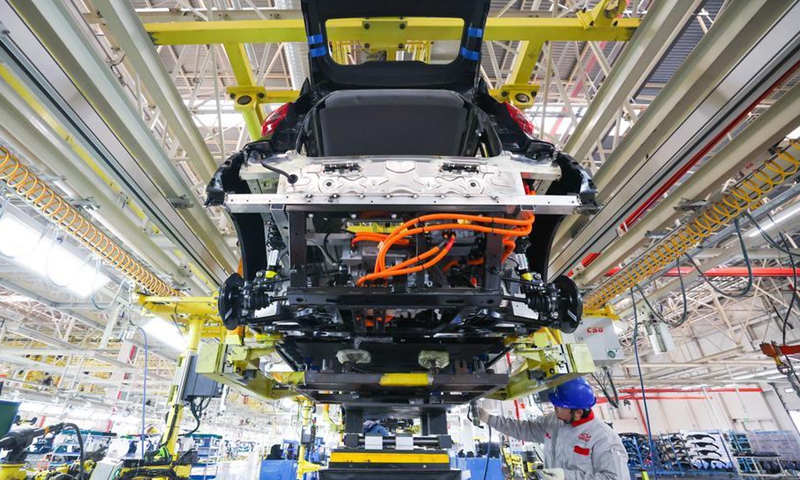
A worker assembles a new energy vehicle at the workshop of a Chinese automaker in Shijiazhuang, North China's Hebei Province, on January 8, 2026. Photo: Xinhua
US President Donald Trump's suggestion that he would allow Chinese automakers to build electric vehicles (EV) factories in the US - provided they hire American workers - amounted to little more than a verbal gesture without formal policy backing, carrying limited practical weight, analysts say.
The real effect is small, Zhang Xiang, secretary-general of the International Intelligent Vehicle Engineering Association, told the Global Times on Sunday, pointing to lengthy construction timelines: A factory in the US could take three to four years to complete, by which time the US may have taken office with different policies.
"Verbal invitations accompanied by continued barriers offer limited credibility," Zhang said.
In a Fox News interview, Trump said he would be "okay" with a Chinese company opening a plant to build cars in the US, provided it hires American workers - just as Japanese firms have done. "They hire our people, they use our people," he said.
He drew a sharp line against imports, saying that the US "has never allowed" Chinese cars in and would not start now, warning the market would otherwise be "overrun."
Trump also said he does not want Chinese automakers building in Mexico and shipping vehicles across the border.
Chinese industry insiders see a clear priority behind these remarks: Keep production and jobs on US soil rather than open the market. Yet Chinese companies face multiple barriers. High tariffs on Chinese vehicles remain in place. Policy volatility is high. Domestic automakers and political opposition are strong.
Media outlets have noted that, combined with regulatory and public-opinion resistance, large-scale Chinese vehicle manufacturing in the US remains highly unlikely.
Zhang stressed that Chinese firms will not invest lightly. "Once they go, it is real money. If the cars cannot be mass-produced or sold, the investment is lost. With no formal policy and constant shifts between containment and trade friction, few companies are willing to take the risk."
Yet Zhang argued that Chinese EV manufacturing in the US would benefit both sides.
"American consumers want good, affordable EVs but can't get them - they can only buy inferior, expensive ones," he said. "Chinese EVs control costs well because we have the world's largest supply chain and economies of scale."
Besides, existing investments from Chinese auto parts suppliers already demonstrated local gains. For example, Fuyao Glass America, the US part of Chinese glass manufacturing company Fuyao Glass Industry Group, transformed a shuttered General Motors plant in the US rust belt region into one of the world's single-site automotive glass factory.
Over the past decade, the company has created more than 2,800 direct jobs, according to the Chinese Consulate General in New York. Earlier reports put total investment above $600 million and indirect local employment above 3,000.
Similarly, Hefei-based Gotion High-tech's US subsidiary has invested about $2 billion in a battery plant in Manteno, Illinois in 2023. "The plant is staffed with a substantial majority of local employees, producing cutting-edge energy products while utilizing ever-increasing percentages of locally sourced materials," Gotion Inc said in a post in 2025.
Zhang noted that Chinese parts suppliers already operating in the US have proven they can generate jobs and contribute to local GDP. In theory, full vehicle plants would bring even greater benefits.
However, the core contradiction remains. Washington wants Chinese investments and jobs but continues to maintain tariffs and regulatory barriers that make such investments commercially unviable.
Chinese EVs currently face a 100 percent tariff under "Section 301," while all imported automobiles are subject to an additional 25 percent duty under "Section 232" that took effect in April 2025.
"In this context, if a Chinese-made EV wants to enter the US market, the heavy tariffs it faces will be more than twice the price of the vehicle. This is no longer protectionism; it is outright import prohibition," an industry insider surnamed Zeng told the Global Times.
"The US Congress is advancing the Connected Vehicle Security Act of 2026. If enacted, the bill would effectively close the door to Chinese automakers entering the US market through either joint ventures or wholly owned plants. Even vehicles manufactured on US soil would be barred from sale if their design incorporates Chinese connected systems or software," said Zeng.
US Trade Representative Jamieson Greer pointed out that, "given those sets of rules, it would probably be difficult for certain countries to establish new production here."
Currently, exports of Chinese domestic brand's electric passenger vehicles to the US are almost zero. Chinese EV exports to the US dropped by 32 percent year-on-year to about 71,000 units in 2025, with the vast majority of produced by foreign brands such as Buick and Volvo in China, according to a report released by thinkercar.com.
Trump's verbal invitation came as the aforementioned high tariffs and strict restrictions remained in effect.
If Washington really wants Chinese automakers to invest, the first step should be lowering tariffs rather than demanding compliance with employment conditions while maintaining barriers, Zeng noted.